
The compact EV segment is no longer about “good enough.” In 2026, buyers compare charging curves, winter stability, resale predictability, and 5-year cost math — not just WLTP range.
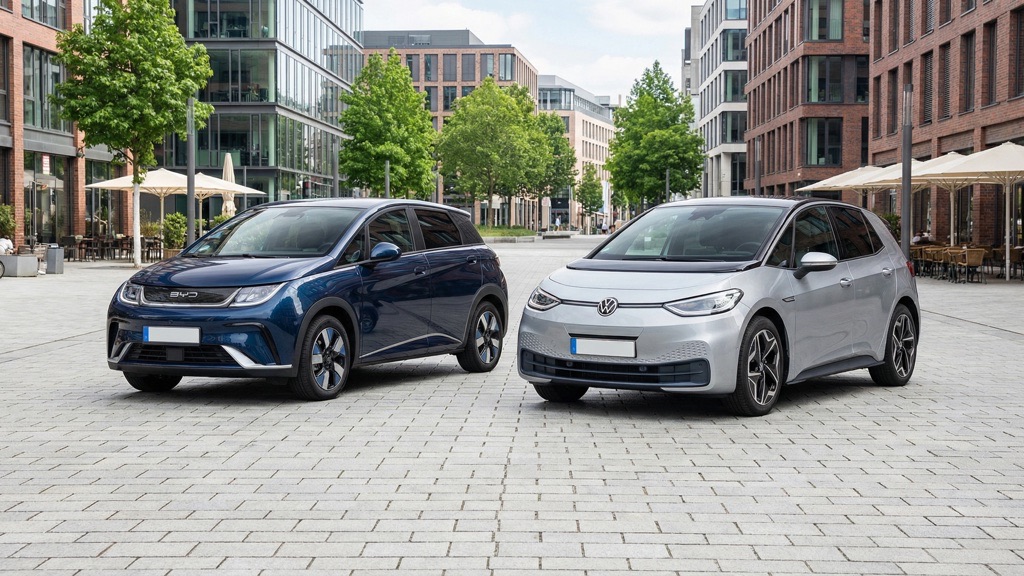
The fight between the BYD Dolphin and the Volkswagen ID.3 is one of the most consequential under €40,000 in Europe.
Ofinancially aggressiveessive.
The other is dynamically mature.
If you’re about to sign a contract, read this first.
⚡ QUICK VERDICT
Best for:
- Dolphin → Urban drivers maximizing value
- ID.3 → Frequent motorway users & long-term owners
Real-world mixed range:
- Dolphin: 355–400 km
- ID.3 Pro: 385–435 km
Winter range (-5°C, mixed):
- Dolphin: ~300–330 km
- ID.3: ~320–360 km
Biggest advantage:
- Dolphin: Lower purchase price
- ID.3: Charging consistency + high-speed composure
Main drawback:
- Dolphin: Slower DC curve, softer damping at speed
- ID.3: Higher upfront coThe ID.3 is the most complete EVin: 9.1 / 10
- ID.3: 9.6 / 10
Hierarchy (2026): The ID.3 is the most complete EV.
The Dolphin is the smarter financial shortcut — if priced right.
📊 Technical Deep-Dive
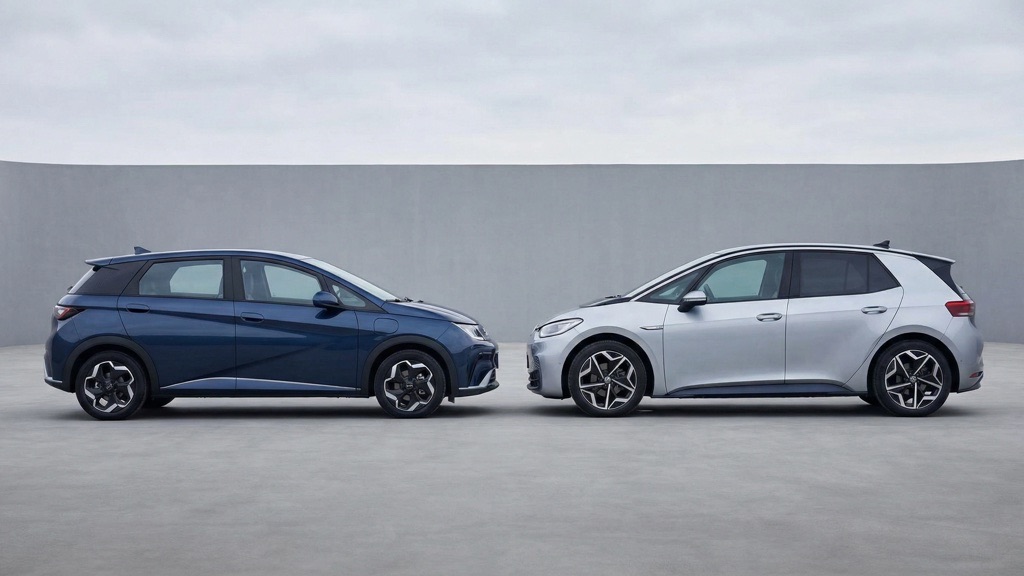
| Specification | BYD Dolphin 60 kWh | VW ID.3 Pro 58 kWh |
|---|---|---|
| Usable battery | ~58 kWh | ~55 kWh |
| WLTP range | ~427 km | ~426 km |
| Real mixed range | 355–400 km | 385–435 km |
| Winter mixed (-5°C) | 300–330 km | 320–360 km |
| Efficiency @130 km/h | 21–23 kWh/100 km | 19–21 kWh/100 km |
| DC peak charging | 88 kW | 120 kW |
| 10–80% real time | 40–45 min | 30–35 min |
| Drivetrain | FWD | RWD |
| Weight | ~1,650 kg | ~1,720 kg |
| EU starting price | ~€30,000 | ~€38,000 |
The ID.3’s aero efficiency and RWD balance show up at 130–150 km/h — exactly where WLTP stops being useful.
🔋 Deep Charging: What Actually Happens on a 600 km Trip
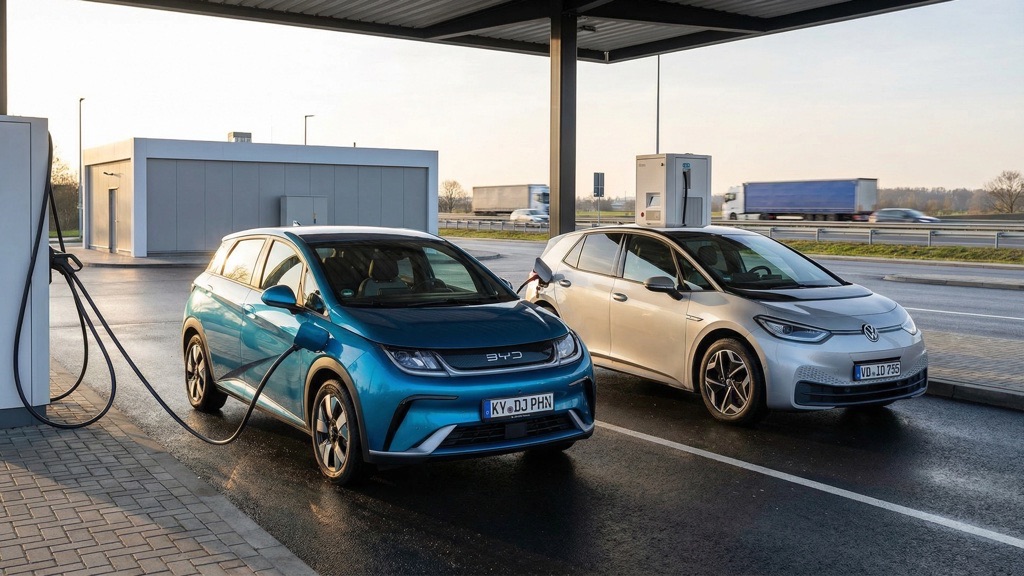
Peak kW is marketing. Curve shape is reality.
 Reviews
Tesla Battery After an Accident: Advantages, Risks and What Buyers Must Know in 2026
TL;DR A Tesla battery after an accident can appear perfectly normal — and still turn a minor crash into a...
 Cars
Cars
BYD Dolphin Review (2026): Real Range, Charging & Final Verdict
TL;DR ✅ Buy BYD Dolphin if you want one of the most efficient city EVs, a safe LFP battery, and...
 Reviews
BMW CE 02 Review (2024): Real Urban Range, Costs & Long-Term Rider Verdict
Introduction The BMW CE 02 is not a traditional motorcycle nor a classic scooter. It’s BMW’s urban electric tool for...
Curve Behavior
- Dolphin: Brief ~88 kW peak, noticeable taper after ~40–45% SOC.
- ID.3: ~120 kW peak, holds >90 kW longer; smoother taper.
15-Minute DC Boost (starting ~10% SOC)
| 15-min Highway Gain | Dolphin | ID.3 |
|---|---|---|
| Added range | ~100–120 km | ~140–160 km |
Trip Math (600 km, 130 km/h sectionsWinter Reality: ~80–90 min total DC time
Over five years of occasional road trips, that delta compounds into real convenience.
If you rarely leave the city? It’s irrelevant.
Do you do Autobahn runs? It’s decisive.
❄️ Winter Reality
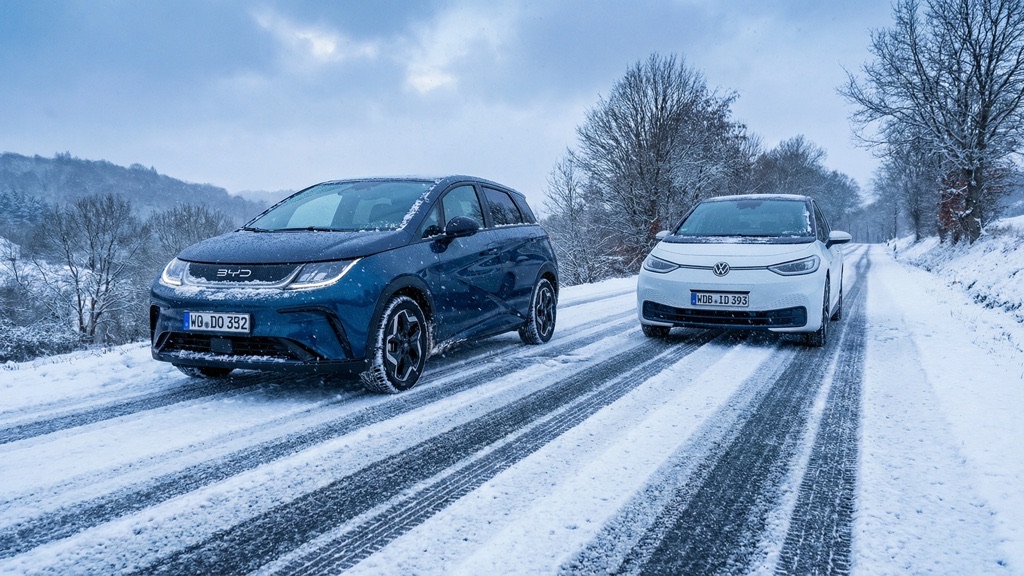
At -5°C with mixed use:
BYD Dolphin
- ~20–25% range drop
- Charging slows more noticeably in cold weather
- Battery preconditioning is less aggressive
VW ID.3
- ~18–22% drop
- More stable cold charging
- Better thermal consistency under load
In Southern Europe, this gap shrinks. In Germany, Austria, Nordics, it matters.
🚗 Driving Feel: The Subtle Differences That Decide Ownership
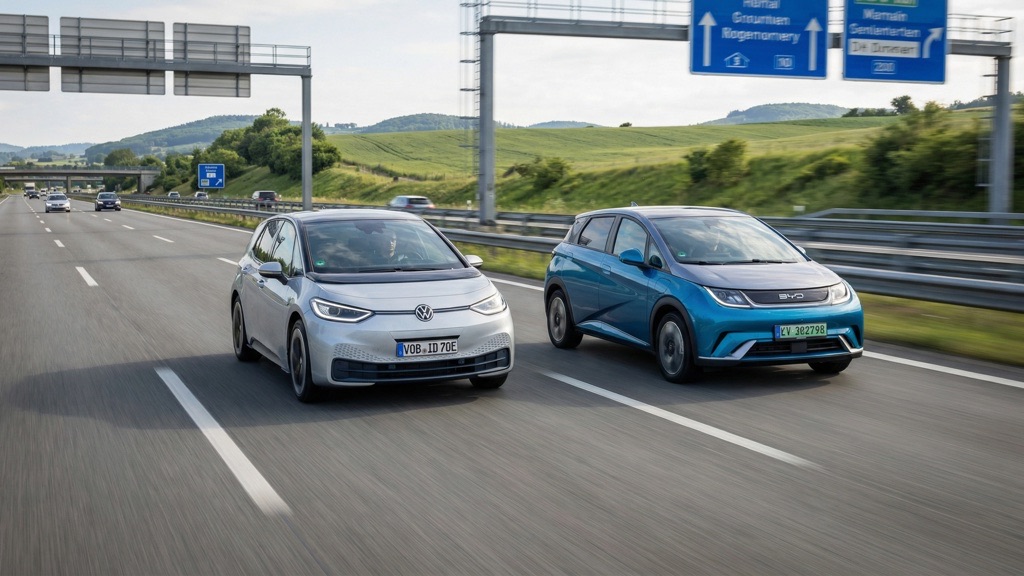
BYD Dolphin
- Light steering, easy in dense cities
- Comfortable over potholes
- Slightly under-damped on fast, undulating highways
- Regen smooth but not strong one-pedal
It feels modern and rational. Not exciting, but honest.
VW ID.3
- RWD balance is noticeable in wet conditions
- More planted at 140 km/h
- Better steering weight consistency
- Regen calibration is more predictable in traffic
It feels engineered, not just assembled.
💰 Full 5-Year Financial Model (15,000 km/year)
Assumptions: 75,000 km total, €0.25/kWh home charging.
Electricity (5 Years)
- Dolphin (~16.5 kWh/100 km avg): ~€3,090
- ID.3 (~16 kWh/100 km avg): ~€3,000
Negligible difference.
Depreciation (Estimate)
| Model | Purchase | 5-Year Value | Depreciation |
|---|---|---|---|
| Dolphin | €30,000 | €14–15k | ~€15–16k |
| ID.3 | €38,000 | €19–21k | ~€17–19k |
Volkswagen’s brand stability still provides more predictable resale in Europe.
Chinese brands are improving rapidly — but long-term data remains thinner.
Maintenance & Network
Both:
- Minimal scheduled maintenance
- Low brake wear
- OTA updates (market dependent)
VW’s European service infrastructure remains broader. BYD is expanding, but still maturing in some regions.
🧠 The Biggest Buying Mistake
Most buyers fixate on WLTP range and ignore:
- Charging curve behavior
- Winter charging consistency
- Highway efficiency
- Resale predictability
If you drive highways weekly and choose solely on price, you may feel that you’re compromising every day.
If you drive mostly in the city and pay €8,000 extra for dynamics you’ll rarely use — that’s also a mistake.
⚖️ Who Should Not Buy Either?
If you regularly drive 500+ km per trip or want minimal charging stops, you should consider stepping up to a larger battery class entirely.
Compact EVs are brilliant daily tools — but they’re not long-range tourers.
🏆 Final Expert Verdict
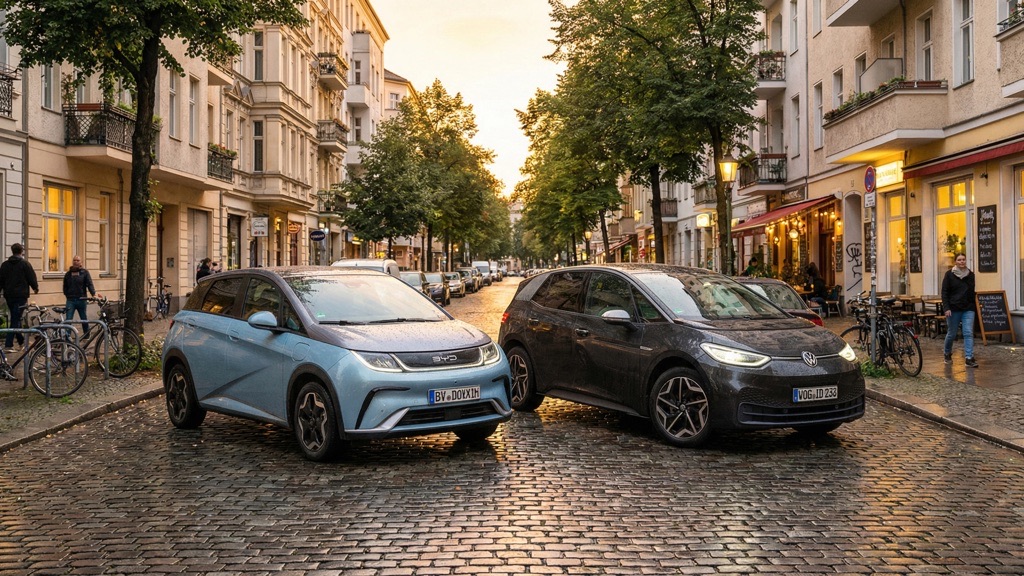
🔹 Short Verdict
In 2026, the ID.3 is the objectively more complete compact EV.
The Dolphin is the financially smarter choice when heavily discounted.
🔹 Detailed Verdict
The ID.3 wins on:
- Charging consistency
- High-speed efficiency
- Winter stability
- Chassis composure
- Resale predictability
The Dolphin wins on:
- Purchase price
- Equipment value
- Urban usability
Long-Term Outlook (7+ Years)
Volkswagen’s platform maturity and service network reduce ownership uncertainty.
BYD’s battery tech is strong — but European residual trends remain less established.
🧾 TL;DR
- Dolphin = Best value play
- ID.3 = Better engineered EV
- Winter + highway = ID.3 advantage
- Large price gap = Dolphin makes sense
If prices are close → choose ID.3.
If savings are substantial → Dolphin is a rational, defensible choice.
That’s the honest hierarchy in 2026.
FAQ
Is BYD Dolphin a better value than VW ID.3?
Yes — strictly on purchase price and equipment.
Which charges faster on road trips?
ID.3.
Which is better in winter?
ID.3 is more consistent.
Which would you personally buy?
At similar pricing — ID.3. With a major discount — Dolphin.