
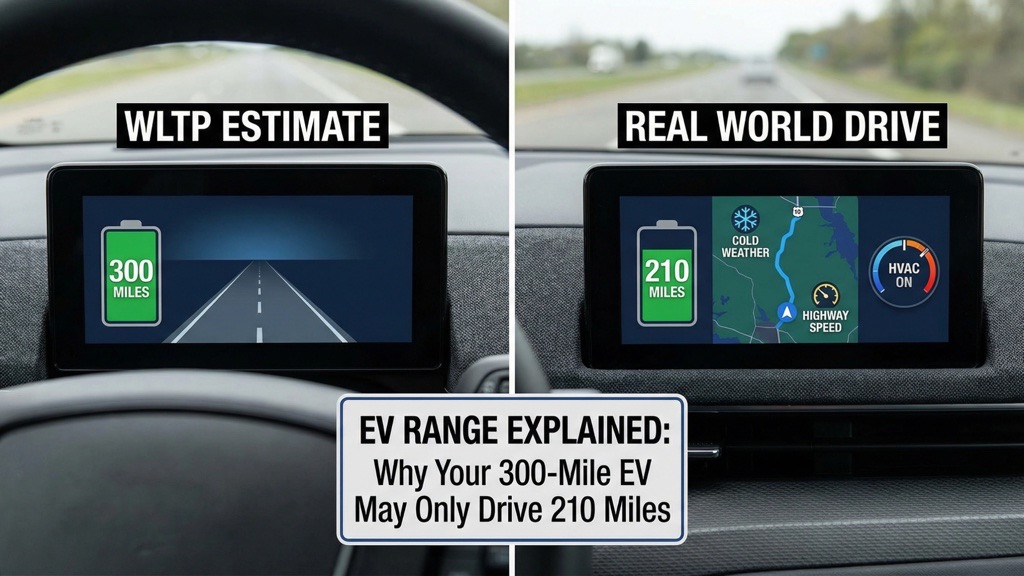
Most EV buyers overestimate how far their future car will actually drive.
They don’t realize it in summer.
They realize it in winter. On the highway. With 12% battery left.
If you’re deciding between battery sizes, this article may save you from choosing the wrong one.
Let’s separate laboratory numbers from ownership reality.
⚡ QUICK VERDICT
- Best for: Buyers comparing US & European EVs
- Not recommended for: Anyone planning to rely on WLTP alone
- Real-world planning Highway winter realityrange
- Highway winter reality: 55–65% of WLTP
- Biggest buyer mistake: Underestimating usable road-trip range
- Overall rating (clarity & accuracy): 10/10
📊 KEY RANGE STANDARDS
| Standard | Region | Realism Level | Typical Inflation |
|---|---|---|---|
| WLTP | Europe | Moderate | +10–20% vs real |
| EPA | United States | High | +5–10% vs real |
| Real World | Actual use | Maximum | None |
🇪🇺 WLTP: The Marketing Ceiling
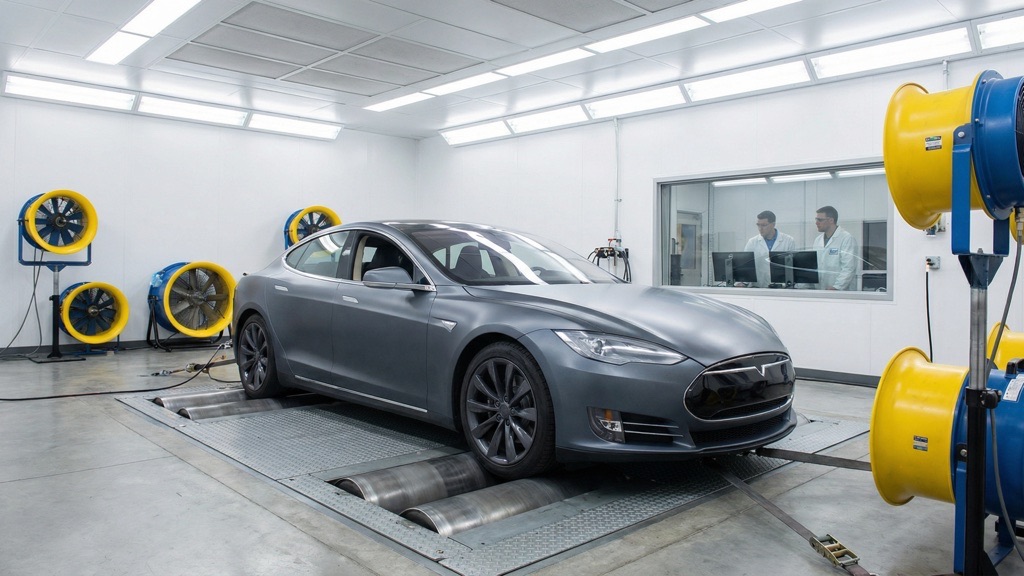
Mandated by the European Union, WLTP improved over the old NEDC — but it is still laboratory testing.
Conditions:
- Controlled temperature
- No wind
- No elevation
- Moderate acceleration
- No winter
What That Means in Practice
| WLTP Range | Mixed Real | Autobahn 130 km/h |
|---|---|---|
| 500 km | 400–425 km | 350–380 km |
| 550 km | 440–470 km | 380–410 km |
WLTP is not fake.
But it is optimistic.
If you drive fast highways in Germany, France, or Italy, WLTP is not your reality.
🇺🇸 EPA: Closer to Truth
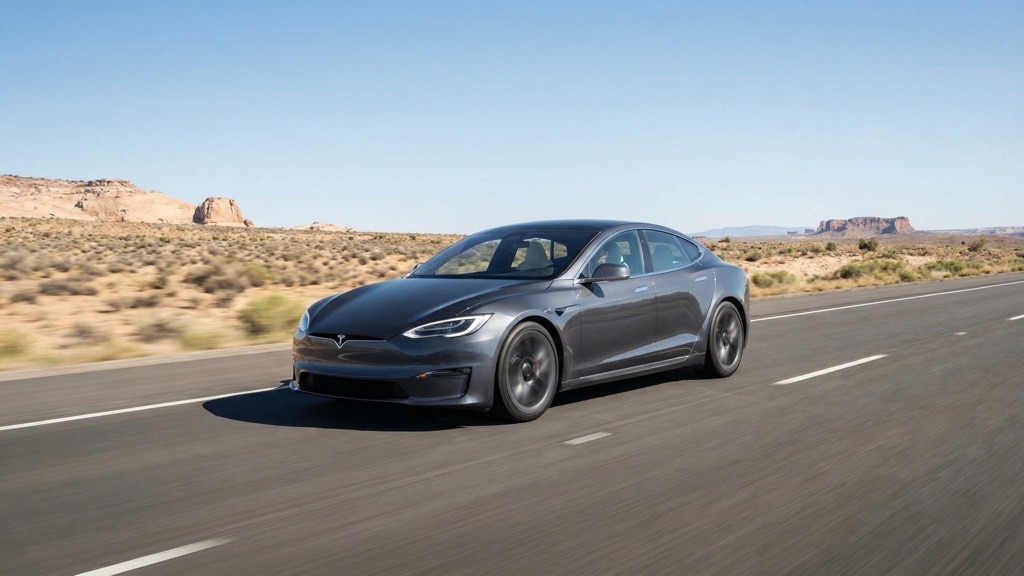
Tested by the United States Environmental Protection Agency.
EPA includes:
- Higher average speeds
- Aggressive acceleration
- Real-world correction factors
Typical EPA Accuracy
| EPA Rating | Real Mixed | 75–80 mph Highway |
|---|---|---|
| 300 miles | 27Winter reduction0 mi | |
| 330 miles | 300–330 mi | 260–285 mi |
EPA is not perfect — but it’s honest.
⚠️ The Range Shock Calculation
Let’s do real maTesla Model Yy a 300-mile EPA EV.
Now apply real-world conditions:
- Highway driving: ~250 miles
- Winter reduction (–25%): ~187 miles
- 10–80% fast-charge window: usable ~131 miles
Your “300-mile car” can behave like a 130-mile road-trip car in winter highway driTesla Model Y is where buyers get surprised.
Not because the carHyundai Ioniq 5 Long Rangeions were wrong.
 Reviews
Electric Bike Buying Guide 2026 Hub vs Mid-Drive E-Bike Motors (Authority Guide)
Introduction In 2026, most electric bikes look powerful on paper. 750W. 90Nm. Long range. Smart system. But motor placement —...
 Reviews
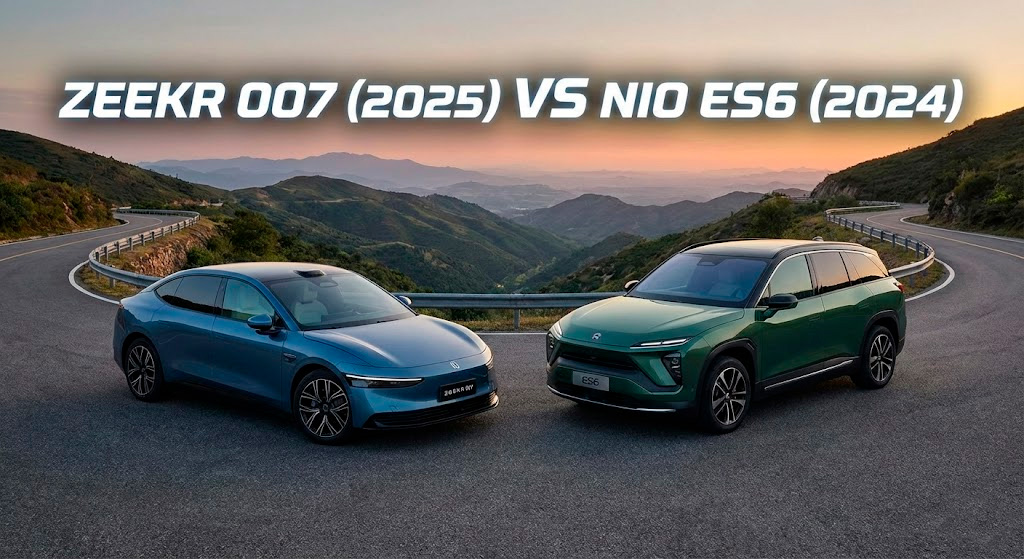
Zeekr 007 (2025) vs Nio ES6 (2024): What China’s New-Generation Electric Crossovers Can Do
China’s electric vehicle market continues to evolve at an extraordinary pace, and new models from Zeekr and NIO clearly show...
 Reviews
Top 10 Electric Motorcycles of 2026 (Range, Power & Price)
TL;DR — Top Electric Motorcycles of 2026 Buy an electric motorcycle in 2026 if you want: Real-world range up to...
📊 Real Model Comparison
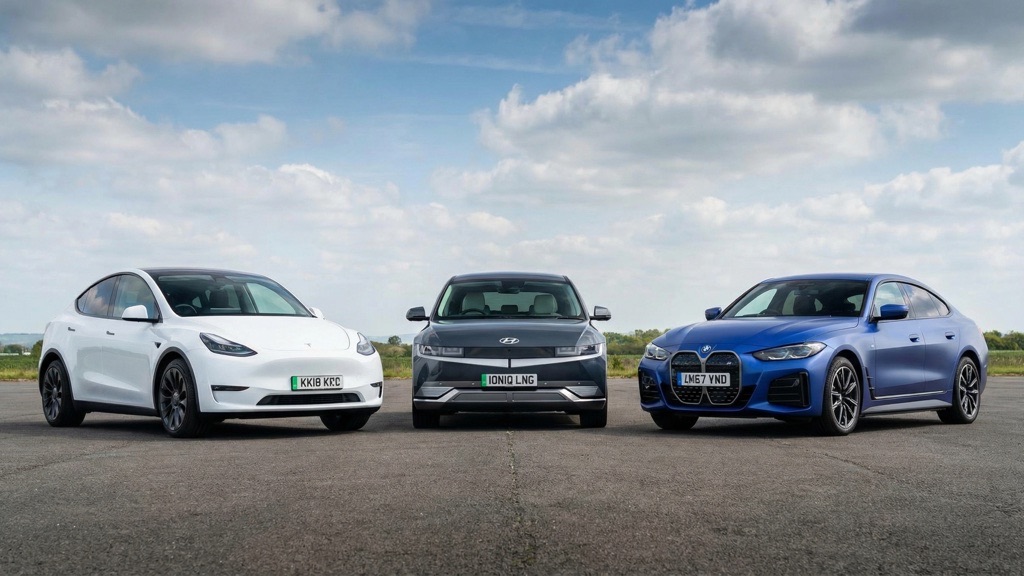
| Model | WLTP | EPA | 75 mph Real | Winter Highway |
|---|---|---|---|---|
| Tesla Model Y Long Range | 533 km | 330 mi | 250–270 mi | 210–230 mi |
| Hyundai Ioniq 5 Long Range | 507 km | 303 mi | 230–250 mi | 190–210 mi |
| BMW i4 eDrive40 | 590 km | 301 mi | 240–260 mi | 200–220 mi |
Notice something:
WLTP numbers look similar.
Highway winter reality separates them.
Efficiency matters more than brochure range.
🚗 Why Speed Kills Range
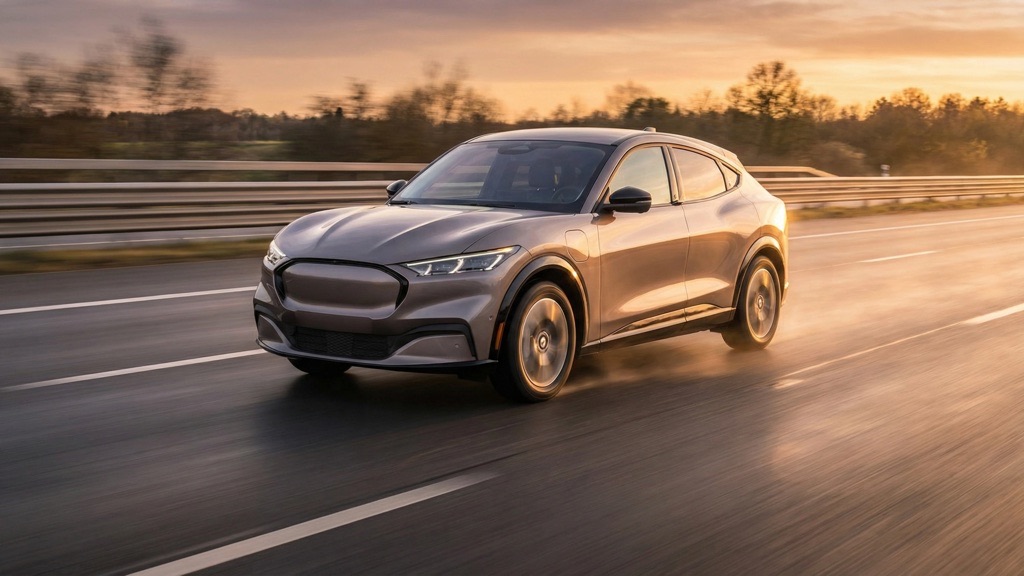
Aerodynamic drag increases exponentially.
- 55 mph → efficient
- 70 mph → noticeable drop
- 80 mph → significant drop
- 85+ mph → dramatic drop
An EV that gets 4.2 mi/kWh in the city may drop to 2.9–3.1 mi/kWh at 75 mph.
That’s physics — not brand quality.
🌡 Winter Multiplier (The Silent Range Killer)
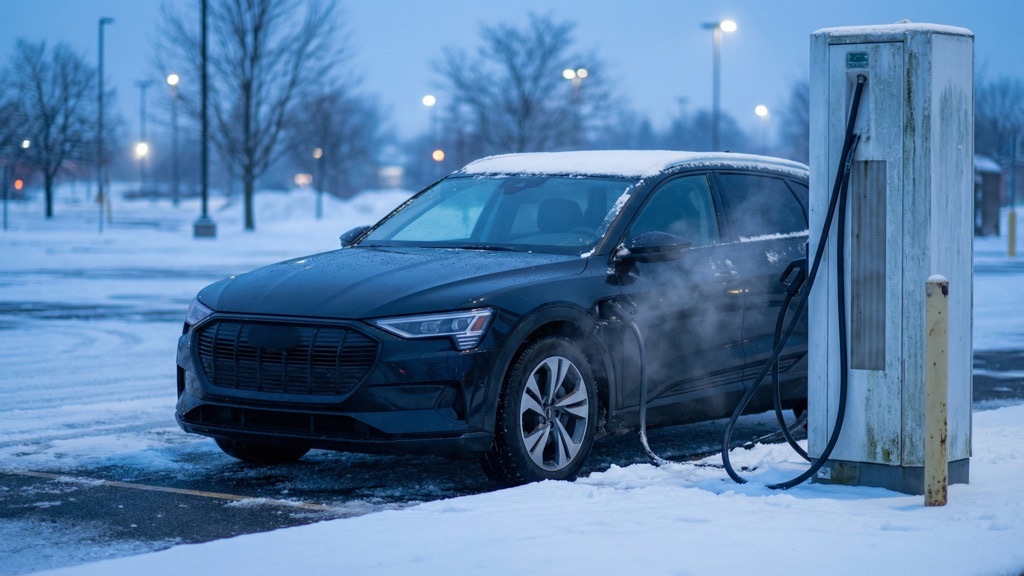
Cold weather impact:
- –15% mild winter
- –25% typical winter highway
- –35% extreme cold
Reasons:
- Battery chemistry efficiency drops
- Cabin heating demand
- Denser cold air
Heat pumps reduce impact — they don’t eliminate it.
If you live in:
- Northern US
- Scandinavia
- Canada
- Alpine regions
Add a 25–30% buffer to your planning.
🔺 The Range Reality Pyramid
Think of range in layers:
1️⃣ WLTP (marketing ceiling)
2️⃣ EPA (realistic baseline)
3️⃣ Highway reality
4️⃣ Winter highway
5️⃣ 10–80% usable window
Most buyers only look at layer #1.
Ownership happens at layer #4.
📊 Decision Matrix: What You Actually Need
| If You… | Recommendation |
|---|---|
| Drive mostly city | EPA rating is reliable |
| Commute 70+ mph daily | Add 15–20% battery buffer |
| Live in a cold climate | Add 25–30% buffer |
| Road trip monthly | Prioritize the charging curve over WLTP |
| Keep cars 5+ years | Choose a larger battery if the budget allows |
Range anxiety isn’t about range.
It’s about underestimating real usage.
⚡ Charging Speed vs Range (Overlooked Factor)
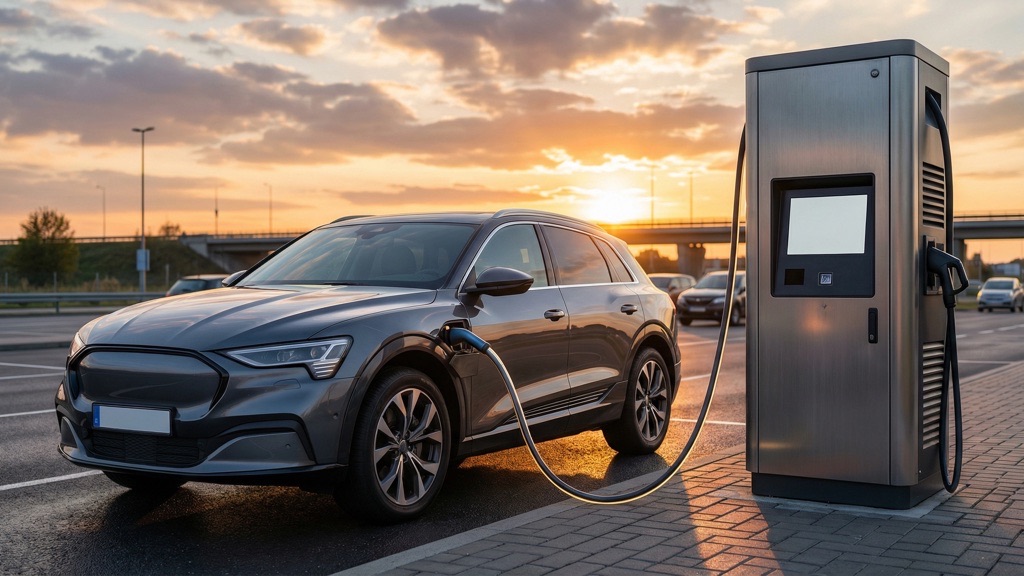
Two EVs:
- 250-mile EPA
- 250 kW peak charging
vs
- 320-mile WLTP
- 100 kW charging
On a 600-mile trip:
The faster-charging EV can arrive earlier, despite a lower rated range.
Charging curve consistency > maximum range figure.
👍 PROS & 👎 CONS of Range Ratings
👍 Pros
- Standardized comparison
- EPA closely reflects the US driving
- WLTP better than old NEDC
- Enables cross-market transparency
👎 Cons
- WLTP inflates highway expectations
- EPA doesn’t simulate extreme cold
- Neither includes wind/elevation
- Marketing often highlights best-case numbers
💰 Ownership Cost Reality
Buying too small a battery often leads to:
- Earlier trade-in
- Reduced resale appeal
- Higher long-term cost
Buying slightly more range than needed rarely causes regret.
The upfront premium is often cheaper than dissatisfaction.
🧠 FINAL EXPERT VERDICT
🔹 SHORT VERDICT
Use EPA as a baseline.
Treat WLTP as an optimistic ceiling.
Plan around 75–80% of the rated range.
Add a 25–30% buffer for winter or highway driving.
Do that — and range anxiety disappears.
🔹 DETAILED VERDICT
The ideal buyer:
- Understands the 10–80% charging window
- Calculates winter highway range before buying
- Chooses battery size based on worst-case routine
If you mostly drive urban short trips — smaller battery is fine.
If you commute long highway distances or live in cold climates, buying the bigger battery version is usually the smarter long-term decision.
Physics doesn’t change.
Smart buyers plan around it.
TL;DR
- WLTP = optimistic
- EPA = realistic
- Highway reduces range
- Winter reduces it further
- 10–80% window matters
- Buy more than your minimum need
FAQ
Is WLTP always higher than EPA?
Usually 10–20% higher.
Why does the range drop so much at 75 mph?
Aerodynamic drag increases exponentially.
Should I always choose the larger battery?
If highway driving or cold climate applies to you — yes.
Can software updates fix range loss?
They can improve efficiency slightly — but not override physics.