

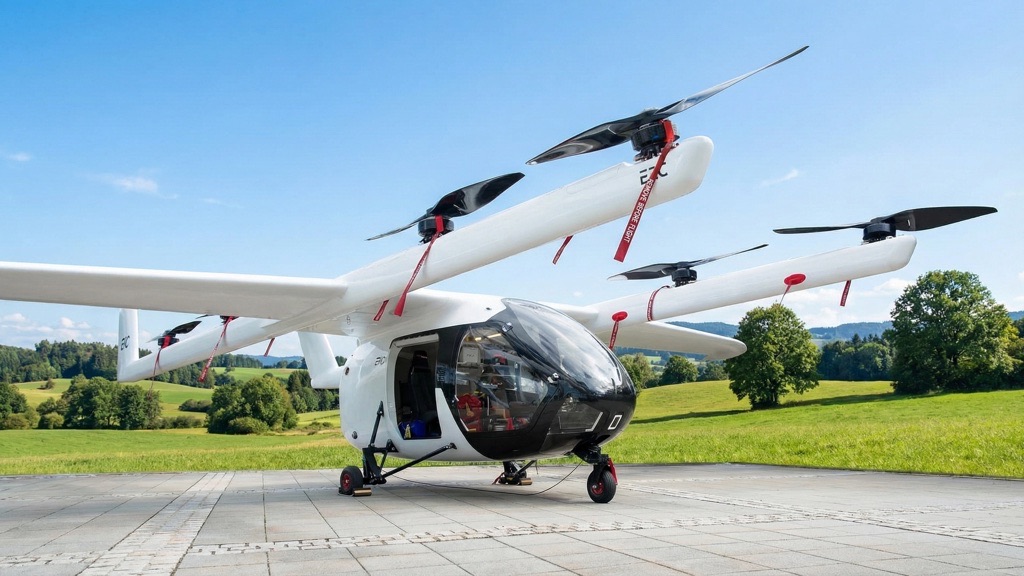
Munich-based ERC System has successfully completed the maiden flight of Romeo, its third-generation eVTOL prototype, marking a significant milestone for European electric aviation. Weighing 2,735 kilograms (6,030 lbs) with a 16-meter wingspan, Romeo is the heaviest fully electric vertical takeoff and landing aircraft to fly in the European Union, according to publicly available information. The prototype completed its first flight in November 2025 at ERC’s Flight Test Center near Munich, validating the company’s full-scale development approach for heavy-lift aircraft designed for emergency medical services and critical missions.

Building Heavy from the Start: ERC’s Development Philosophy
Founded in 2020 by aerospace professionals and currently employing approximately 60 people, ERC System has deliberately chosen a development path that differs from many competitors in the crowded eVTOL market. Rather than beginning with small-scale or reduced-mass prototypes, the company tests at representative scale and mass from the outset—a strategy the company argues is critical for validating propulsion architectures, energy management, and flight control behavior under realistic load conditions. This philosophy stems from the fundamental physics of vertical takeoff and landing aircraft, which do not scale linearly.
Romeo represents the culmination of this approach. The aircraft features eight electrically driven vertical lift units, each powering rotors approximately 2.4 meters in diameter, and includes a large cabin representative of ERC’s future medical transport configuration. During the current flight test campaign, Romeo operates in fully electric mode—a departure from the hybrid-electric production aircraft planned for 2031—because the focus is specifically on validating the takeoff and landing phases where electric power is most critical.
The predecessor to Romeo was Echo, ERC’s first full-mass prototype, which first flew in 2023 and weighed approximately 2,700 kilograms. Over more than 100 test days, Echo confirmed the viability of the distributed electric power system and thermal management capabilities that would inform Romeo’s design.

Flight Testing and Operational Approach
Romeo’s maiden flight marked the beginning of a focused flight test campaign designed to validate core flight characteristics under representative mass and system conditions. The current test phase emphasizes vertical takeoff, slow and controlled maneuvers, and vertical landing—the most demanding phases of eVTOL operations. Notably, the aircraft is being flown in an uncrewed configuration, with a test pilot controlling it remotely from a ground control station. This approach increases safety and reduces costs during early development phases while still providing critical data for certification.
Flight operations are conducted at Erding Military Airfield near Munich under approval from Germany’s Federal Aviation Authority (Luftfahrt-Bundesamt), with operations following EASA standards. The learnings generated during Romeo’s flight test campaign will directly inform the development of ERC’s first commercially available aircraft.
 News
News
The Italdesign Quintessenza Concept: A Quirky Vision of the EV Future
The world of electric vehicles is heating up, with automakers pulling out all the stops to grab attention with bold...
 News
News
BYD Atto 3 Evo Doubles Power to 443 HP While Keeping Prices Competitive
BYD’s 2026 Atto 3 Evo Delivers Supercar Acceleration in a Family SUV The 2026 BYD Atto 3 Evo represents a...
 Cars
Cars
The Chevrolet Equinox EV: A Game-Changer in the Electric SUV Market
The automotive world is buzzing with excitement over the latest addition to the electric vehicle (EV) lineup: the 2024 Chevrolet...

The Production Aircraft: Charlie and Beyond
Romeo’s test data is being used to develop Charlie, ERC’s production aircraft—a hybrid-electric, crewed lift- and-cruise eVTOL optimized for inter-hospital patient transport and emergency medical services. Charlie will feature a maximum takeoff weight of 3,300 kilograms, a useful payload of 500 kilograms, and a range of up to 800 kilometers when equipped with a hybrid-electric powertrain that uses an onboard combustion engine to recharge batteries in flight. The company plans to seek EASA certification under the SC-VTOL (Special Condition—Vertical Takeoff and Landing) standard by 2031.
Beyond the crewed aircraft, ERC has confirmed plans to develop an uncrewed cargo aircraft (UAS) for logistics operations, capitalizing on five years of experience building and testing heavy uncrewed prototypes. The company expects to release details of this uncrewed product by Q2 2026, with applications targeting military and emergency operations.
Strategic Partnerships and Market Positioning
ERC’s development roadmap is supported by significant industry backing. The company is backed by IABG, an aerospace powerhouse specializing in testing and certification services for aircraft, spacecraft, and defense solutions. More critically, DRF Luftrettung—one of Europe’s largest air rescue operators—has committed to a strategic partnership and has indicated confidence that ERC’s aircraft will have a permanent place in its fleet during the 2030s as a complement to traditional rescue helicopters.
Leading HEMS (Helicopter Emergency Medical Services) operators from Germany, Switzerland, Austria, and beyond are already engaged with the project. Dr. Krystian Pracz, CEO of DRF Luftrettung, emphasized that current healthcare trends—including clinic consolidation, longer transport distances, and workforce shortages—create urgent demand for new solutions that eVTOL aircraft can address.

Competitive Context
ERC’s focus on heavy-lift, emergency-focused eVTOL aircraft positions it distinctly within the European eVTOL landscape. While competitors like Lilium and Volocopter have pursued urban air mobility and smaller passenger configurations, ERC targets government and emergency operations where payload capacity and range justify the technology’s current costs and complexity. Romeo’s 2,735-kilogram weight class places it among the largest eVTOLs flown anywhere globally, competing more directly with traditional helicopter capabilities than with air taxi concepts.
Unanswered Questions and Timeline
While Romeo’s successful maiden flight validates ERC’s full-scale testing approach, several critical questions remain. The company has not yet disclosed detailed performance metrics from the November 2025 flight, including hover duration, control response characteristics, or energy consumption rates. Additionally, the path to certification by 2031 assumes no major technical obstacles emerge during the extended flight test campaign—a timeline that may face pressure if significant design modifications become necessary.
The uncrewed cargo aircraft variant, expected to be detailed by Q2 2026, represents a significant expansion of ERC’s addressable market, but details on payload capacity, range, and intended military applications remain undisclosed.
Verdict
ERC System’s Romeo represents a credible, well-funded approach to heavy-lift eVTOL development grounded in aerospace expertise and strategic partnerships with established emergency services operators. By testing at full scale and mass from the outset, the company is addressing real physics challenges that smaller-scale competitors may not encounter until later development stages. The backing of DRF Luftrettung and IABG provides both operational credibility and technical rigor. For investors and operators in emergency medical services and government logistics, ERC’s trajectory warrants close attention—though the 2031 certification timeline and the company’s relatively small team size suggest execution risks remain. This is a project for those betting on specialized, high-value eVTOL applications rather than mass-market urban air mobility.