

Xiaomi’s Most Powerful SUV Yet Delivers Nearly 1,000 HP
Xiaomi has officially filed the YU7 GT, a high-performance variant of its YU7 SUV that delivers 738 kW (990 horsepower), making it the company’s most powerful vehicle to date. The dual-motor electric SUV significantly outpaces the standard YU7 Max’s 508 kW (681 horsepower) and is expected to accelerate from 0–100 km/h in approximately 2 seconds, compared to the Max variant’s 3.23-second time. The filing with China’s Ministry of Industry and Information Technology marks an official step toward the GT’s launch later in 2026, positioning Xiaomi as a serious contender in the ultra-high-performance EV segment.

Company Context: Xiaomi’s Automotive Ambitions
Xiaomi entered the automotive market with its SU7 sedan in 2024, establishing itself as a technology-driven EV manufacturer competing directly with Tesla and Chinese rivals like BYD and NIO. The YU7 SUV, launched as the company’s first sport utility vehicle, represents Xiaomi’s expansion into the high-volume segment. The YU7 GT variant demonstrates Xiaomi’s commitment to performance-focused models that leverage its expertise in hardware integration and software optimization. The company plans to launch the YU7 GT alongside the SU7 L and YU9 in 2026, with reports suggesting the GT could become Xiaomi’s first model sold in Europe.
Performance Specifications: Dual-Motor Dominance
| Specification | YU7 GT | YU7 Max | YU7 Pro |
|---|---|---|---|
| Total Power Output | 738 kW (990 hp) | 508 kW (681 hp) | 365 kW (489 hp) |
| Front Motor | 288 kW | 220 kW | 130 kW |
| Rear Motor | 450 kW | 288 kW | 235 kW |
| 0–100 km/h Acceleration | ~2.0 seconds (estimated) | 3.23 seconds | 4.27 seconds |
| Top Speed | 300 km/h | 253 km/h | 240 km/h |
| Curb Weight | 2,460 kg | 2,405 kg | 2,425 kg |
| Tire Size (Front/Rear) | 265/40R21 / 295/35R21 | Not specified | Not specified |
The YU7 GT’s dual-motor setup pairs a 288 kW front motor with a 450 kW rear motor, supplied by Suzhou Inovance Automotive and Xiaomi’s Auto Technology unit. This configuration delivers a combined 738 kW output—a 45% increase over the YU7 Max—while maintaining a curb weight of 2,460 kg, only 55 kg heavier than the Max variant. The GT’s aggressive motor distribution (front/rear split of 288/450 kW) emphasizes rear-wheel power delivery, typical of performance-oriented dual-motor designs that prioritize acceleration and handling dynamics.
The 300 km/h top speed represents a significant jump from Max’s 253 km/h capability. Regulatory filings also indicate a secondary configuration with a 270 km/h top speed, suggesting Xiaomi may offer performance variants with different speed limiters for market-specific regulations.

Design and Technology: Aggressive Aesthetics Meet Smart Features
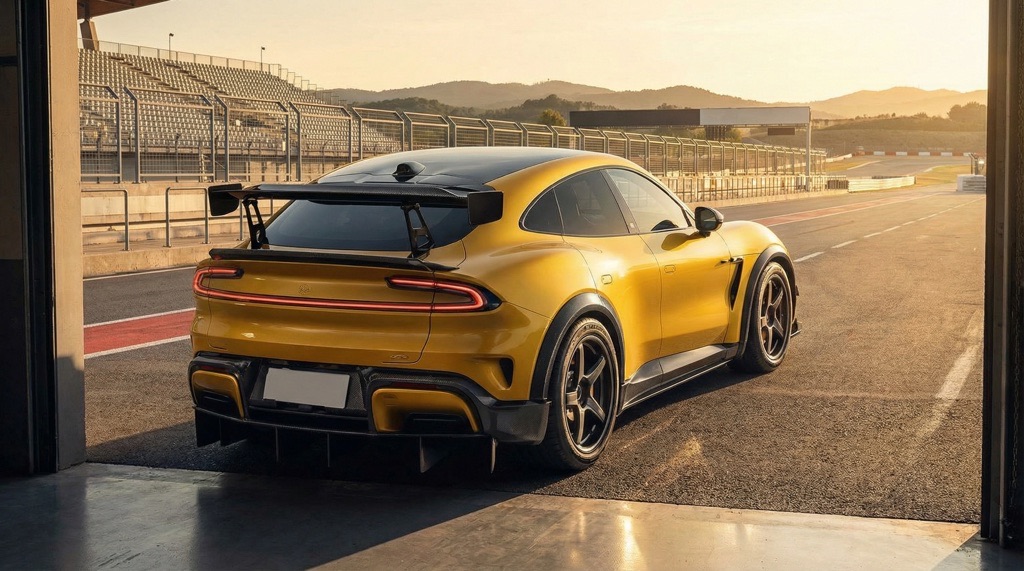
The YU7 GT adopts an all-black exterior design that contrasts sharply with the standard YU7’s more youthful color palette. Regulatory images reveal extensive customization options, including multiple front badge designs, various wheel designs with red brake calipers, and brake caliper colors in red, purple, blue, green, and yellow. Optional decals feature lightning bolt graphics, blacked-out rear spoilers, side mirrors, and ducktail rear wings, signaling Xiaomi’s intent to appeal to performance enthusiasts.
 Cars
Cars
Jaguar Recalls 2278 I-Pace SUVs Over Folded Anode Tab Fire Risk
Jaguar Land Rover is recalling 2,278 2020-2021 I-Pace electric SUVs in the US due to a high-voltage battery overheating risk...
 Cars
Cars
Tesla Cybertruck Finally Gets “Indestructible” Wheels: Unplugged Performance Protects the EV Pickup From Curb Damage
The Tesla Cybertruck may be marketed as nearly indestructible, but one weakness has persisted since launch: its factory alloy wheels....
 Cars
Cars
Volkswagen ID Code Electric Car Concept: A Futuristic Marvel with Impressive Specs
Volkswagen has taken a leap into the realm of science fiction with its latest concept, the ID. Code. Boasting talking...
Dimensionally, the YU7 GT measures 5,015 mm in length, 2,007 mm in width, and 1,597 mm in height—marginally larger than the standard YU7’s 4,999 mm × 1,996 mm × 1,600 mm footprint. Both share a 3,000 mm wheelbase. The GT rides on 265/40R21 front and 295/35R21 rear tires, larger and wider than the standard YU7’s 245/55R19 setup, improving grip and visual aggression.
All YU7 variants, including the GT, feature Xiaomi’s HyperVision display system—a tri-panel mini-LED instrument cluster with 108-PPD resolution, 1200 nits brightness, and 903-zone local dimming. The system runs on a Qualcomm Snapdragon 8 Gen 3 SoC, enabling 1.35-second boot times and 15-minute OTA updates. The GT also inherits Xiaomi’s HAD supervised autonomous driving system, equipped with one 128-line Hesai LiDAR (200-meter range), one 4D mmWave radar, 11 cameras, 12 ultrasonic sensors, and an NVIDIA DRIVE AGX Thor-U chip capable of 700 TOPS processing.
Battery and Charging: Details Remain Unclear
The YU7 GT’s battery specifications have not yet been confirmed in official filings. Regulatory documents indicate a ternary lithium-ion battery pack supplied by CATL, but capacity and range figures are absent from current disclosures. The standard YU7 Max uses a 101.7 kWh NMC battery providing 760 km CLTC range with 12-minute 10–80% charging capability, but the GT’s larger motors and higher performance demands will likely require a different battery strategy. Details not yet confirmed regarding the GT’s specific battery capacity, range rating, and charging specifications.
Competitive Positioning: Where the GT Stands
The YU7 GT enters a competitive segment dominated by performance-focused electric SUVs. The Tesla Model X Plaid delivers 1,020 hp with a 2.5-second 0–60 mph time, but starts at significantly higher price points in most markets. The BYD Song Pro DM-i and other Chinese performance SUVs offer lower horsepower but better efficiency through hybrid powertrains. The NIO ES6 Performance delivers 533 hp with dual motors, positioning it below the GT in raw power but potentially superior in autonomous driving capabilities. The YU7 GT’s 990 hp output places it among the most powerful production SUVs globally, rivaling or exceeding most competitors in acceleration potential while maintaining Xiaomi’s technology-first approach.
Launch Timeline and Market Expectations
The YU7 GT is scheduled for launch in 2026 alongside the SU7 L sedan and YU9 SUV. Reports suggest the GT could become Xiaomi’s first model sold in Europe, marking the company’s international expansion beyond China. One source references a September 25 event for unveiling, though this date requires confirmation. The regulatory filing published on February 6, 2026, represents an official step in the homologation process, typically preceding launch announcements by several months in China.
Unanswered Questions
Several critical details remain unconfirmed: the exact battery capacity and CLTC range rating, the confirmed 0–100 km/h acceleration time (currently estimated at ~2 seconds), pricing strategy relative to the YU7 Max, availability of the 270 km/h variant and its performance differences, and the specific launch date within 2026. Additionally, real-world performance validation through independent testing has not yet occurred, and European market specifications (if confirmed) may differ from the Chinese filing.
Verdict
The Xiaomi YU7 GT represents a bold statement in the performance EV segment, delivering nearly 1,000 horsepower in a five-seat SUV package with advanced autonomous driving technology and premium infotainment systems. For buyers prioritizing acceleration and technological integration over traditional luxury brand prestige, the GT offers compelling performance credentials at what is likely to be a competitive price point relative to Tesla and European competitors. However, the absence of confirmed battery specifications, real-world range data, and independent performance validation means potential buyers should await official specifications before making purchase decisions. The GT is positioned for tech-savvy performance enthusiasts in China and potentially Europe who value Xiaomi’s hardware-software integration and are willing to adopt a newer automotive brand.