

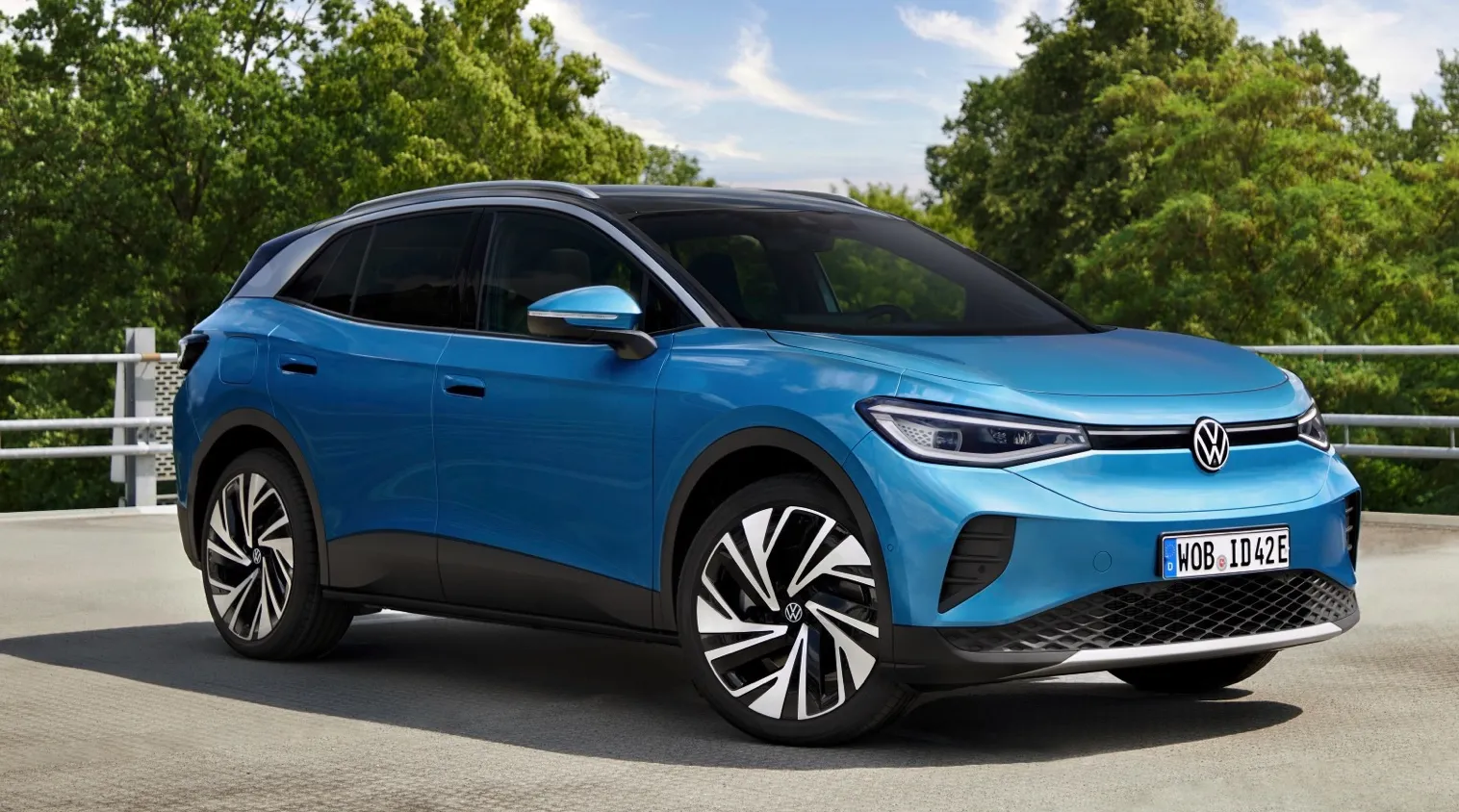
Volkswagen ID.4 Pure
Key Specifications
Real Range Estimation
| City - Cold Weather * | 280 km |
| Highway - Cold Weather * | 200 km |
| Combined - Cold Weather * | 240 km |
between 200 - 415 km
| City - Mild Weather * | 415 km |
| Highway - Mild Weather * | 260 km |
| Combined - Mild Weather * | 325 km |
Battery
| Nominal Capacity | 55.0 kWh |
| Battery Type | Lithium-ion |
| Number of Cells | 192 |
| Architecture | 400 V |
| Warranty Period | No Data |
| Warranty Mileage | No Data |
| Useable Capacity | 52.0 kWh |
| Cathode Material | No Data |
| Pack Configuration | 96s2p |
| Nominal Voltage | 352 V |
| Form Factor | No Data |
| Name / Reference | No Data |
Performance
| Acceleration 0 - 100 km/h | 9.0 sec |
| Top Speed | 160 km/h |
| Electric Range * | 285 km |
| Total Power | 125 kW (170 PS) |
| Total Torque | 310 Nm |
| Drive | Rear |
Home and Destination Charging (0 -> 100%)
Charging is possible by using a regular wall plug or a charging station. Public charging is always done through a charging station. How fast the EV can charge depends on the charging station (EVSE) used and the maximum charging capacity of the EV. The table below shows all possible options for charging the Volkswagen ID.4 Pure. Each option shows how fast the battery can be charged from empty to full.
Europe
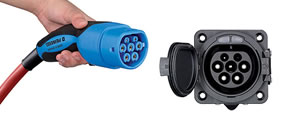
Charging an EV in Europe differs by country. Some European countries primarily use 1-phase connections to the grid, while other countries are almost exclusively using a 3-phase connection. The table below shows all possible ways the Volkswagen ID.4 Pure can be charged, but some modes of charging might not be widely available in certain countries.
| Type 2 (Mennekes - IEC 62196) |
|---|
 |
| Charging Point | Max. Power | Power | Time | Rate |
|---|---|---|---|---|
| Wall Plug (2.3 kW) | 230V / 1x10A | 2.3 kW | 26h45m | 11 km/h |
| 1-phase 16A (3.7 kW) | 230V / 1x16A | 3.7 kW | 16h45m | 17 km/h |
| 1-phase 32A (7.4 kW) | 230V / 1x32A | 7.4 kW | 8h30m | 34 km/h |
| 3-phase 16A (11 kW) | 400V / 3x16A | 11 kW | 5h45m | 50 km/h |
| 3-phase 32A (22 kW) | 400V / 3x16A | 11 kW † | 5h45m | 50 km/h |
† = Limited by on-board charger, vehicle cannot charge faster.
Fast Charging (10 -> 80%)
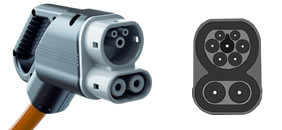
Rapid charging enables longer journeys by adding as much range as possible in the shortest amount of time. Charging power will decrease significantly after 80% state-of-charge has been reached. A typical rapid charge therefore rarely exceeds 80% SoC. The rapid charge rate of an EV depends on the charger used and the maximum charging power the EV can handle. The table below shows all details for rapid charging the Volkswagen ID.4 Pure.
- Max. Power: maximum power provided by charge point
- Avg. Power: average power provided by charge point over a session from 10% to 80%
- Time: time needed to charge from 10% to 80%
- Rate: average charging speed over a session from 10% to 80%
| Combined Charging System (CCS Combo 2) |
|---|
 |
| Charging Point | Max. Power | Avg. Power | Time | Rate |
|---|---|---|---|---|
| CCS (50 kW DC) | 50 kW | 40 kW † | 57 min | 210 km/h |
| CCS (100 kW DC) | 100 kW | 65 kW † | 35 min | 340 km/h |
| CCS (150 kW DC) | 115 kW † | 70 kW † | 33 min | 360 km/h |
| This vehicle does not support Autocharge |
|---|
| This vehicle supports Plug & Charge |
† = Limited by charging capabilities of vehicle
Autocharge: allows for automatic initiation of a charging session at supported CCS charging stations.
Plug & Charge: allows for automatic initiation of a charging session at supported CCS charging stations in accordance with ISO 15118.
Actual charging rates may differ from data shown due to factors like outside temperature, state of the battery and driving style.
Dimensions and Weight
| Length | 4584 mm |
| Width | 1852 mm |
| Width with mirrors | No Data |
| Height | 1640 mm |
| Wheelbase | 2771 mm |
| Weight Unladen (EU) | 1991 kg |
| Gross Vehicle Weight (GVWR) | 2500 kg |
| Max. Payload | 584 kg |
| Cargo Volume | 543 L |
| Cargo Volume Max | 1575 L |
| Cargo Volume Frunk | 0 L |
| Roof Load | 75 kg |
| Tow Hitch Possible | Yes |
| Towing Weight Unbraked | 750 kg |
| Towing Weight Braked | 1000 kg |
| Vertical Load Max | 75 kg |
About this Vehicle
Volkswagen ID.4 Pure Overview
The Volkswagen ID.4 Pure is positioned as the entry-level Volkswagen electric SUV, bringing the brand’s MEB-based EV technology to buyers who want a practical, family-friendly crossover without the premium price tag. As the base trim in the ID.4 range, it targets drivers moving from combustion compact SUVs into their first electric vehicle, prioritizing comfort, space, and ease of use over outright performance. With its clean design, roomy cabin, and intuitive tech, the ID.4 Pure is aimed squarely at mainstream EV adopters rather than early tech enthusiasts.
Built on Volkswagen’s modular MEB platform, the ID.4 Pure combines rear-wheel drive, a smaller battery, and efficient motors to deliver competitive EV specs for daily commuting and suburban driving. In Europe, the ID.4 Pure slots below the Pro and GTX trims, offering a slightly shorter electric vehicle range but the same core practicality and safety. This matters in the EV landscape because it gives Volkswagen a genuinely accessible gateway into its ID range, making the switch to electric more attainable while still offering a full-size cabin, decent towing, and modern driver assistance.
For shoppers researching a Volkswagen electric SUV and reading a detailed Volkswagen ID.4 Pure review, this model stands out by blending conservative styling, strong refinement, and predictable running costs with a well-judged spec for real-world use.
—
Volkswagen ID.4 Pure Performance and Driving Experience
The Volkswagen ID.4 Pure delivers relaxed, linear acceleration rather than headline-grabbing speed. Using a single rear-mounted motor, the Pure offers around 170–180 hp (125–135 kW) and roughly 235–310 Nm (173–229 lb-ft) of torque, depending on exact market tune, giving it a smooth step-off and enough punch for motorway on-ramps and overtakes. Rear-wheel drive keeps steering light and predictable, while the battery in the floor provides a low center of gravity, contributing to secure, composed handling rather than sporty dynamics.
Ride comfort is a priority: the suspension is tuned for compliance over rough city streets and long-distance cruising, and cabin isolation is good for the class. The ID.4 Pure feels stable at speed, with predictable regenerative braking that’s easy for new EV drivers to adapt to. Overall, the driving experience is calm, confidence-inspiring, and well-suited to family use.
| Specification | Value |
|---|---|
| 0-60 mph (0-100 km/h) | approx. 8.5–9.0 sec (0-100 km/h) |
| Top Speed | 99 mph / 160 km/h |
| Power Output | approx. 170–180 hp / 125–135 kW |
| Torque | approx. 173–229 lb-ft / 235–310 Nm |
—
Volkswagen ID.4 Pure Range and Battery Specifications
The Volkswagen ID.4 Pure battery specs center on the smaller pack in the ID.4 family: a 52 kWh usable (≈55 kWh gross) lithium-ion pack designed for efficiency and lower cost rather than maximum distance. Official Volkswagen ID.4 Pure WLTP range is around 224–234 miles (360–377 km) depending on wheel size and equipment. In mixed real-world driving, you should expect a Volkswagen ID.4 Pure real-world range of roughly 185–210 miles (300–340 km), with motorway speeds and cold weather pulling that closer to the lower end.
Energy efficiency for the ID.4 Pure typically sits around 260–300 Wh/mi (160–185 Wh/km) in everyday use, helped by its single-motor RWD setup and modest power output. As with any EV, range is influenced by temperature, driving style, use of climate control, and terrain; winter motorway trips will show significantly lower numbers than gentle summer urban use.
| Range Metric | Value |
|---|---|
| WLTP Range | ~224–234 miles / 360–377 km |
| EPA Range | n/a (primarily a Europe-focused trim) |
| Real-World Range | ~185–210 miles / 300–340 km |
| Battery Capacity | ~52 kWh (usable) |
—
Volkswagen ID.4 Pure Charging Times and Options
The Volkswagen ID.4 Pure supports typical home and public charging options, making day-to-day use straightforward. On AC, it offers up to 11 kW three-phase where available, or lower single-phase rates in some markets. On a 7 kW home wallbox (Level 2 equivalent), a full charge from empty to 100% typically takes around 8–9 hours, ideal for overnight charging. On 11 kW AC, that time drops closer to 6–7 hours.
DC fast charging is supported at up to about 110 kW, allowing a 10–80% session in roughly 30–35 minutes in optimal conditions. This makes the ID.4 Pure convenient for longer journeys, especially when paired with pan-European CCS networks. In practice, many owners will charge primarily at home and use DC fast chargers only on road trips, treating the car more like a smartphone that’s topped up overnight than a vehicle that must be “filled” at a station.
| Charging Method | Time | Speed |
|---|---|---|
| Level 1 (120V) | ~24–30 hours (0–100%) | ~2–3 kW |
| Level 2 (240V/7kW) | ~8–9 hours (0–100%) | ~7 kW |
| Level 2 (240V/11kW) | ~6–7 hours (0–100%) | ~11 kW |
| DC Fast Charge (10-80%) | ~30–35 min | up to ~110 kW |
—
Volkswagen ID.4 Pure vs Competitors
In the compact electric SUV segment, the Volkswagen ID.4 Pure vs Tesla Model Y RWD comparison shows the Tesla offering more range and quicker acceleration, but often at a higher price and with a more tech-centric, minimalist interior. Against the Hyundai Ioniq 5 and Kia EV6, the ID.4 Pure trades ultra-fast charging speeds and bolder styling for a more conventional SUV feel and a softer ride. Compared to the Audi Q4 e-tron, the ID.4 Pure delivers similar MEB-based fundamentals at a lower price point, making it a rational, value-focused choice in any Volkswagen ID.4 Pure comparison.
—
Frequently Asked Questions
The Volkswagen ID.4 Pure is a strong choice if you value comfort, interior space, and straightforward usability over maximum range and performance; its main drawbacks are slower DC charging than some rivals and a shorter range than larger-battery ID.4 variants.
> The Volkswagen ID.4 Pure is Volkswagen’s entry-level electric SUV, pairing a ~52 kWh battery, around 185–210 miles of real-world range, and a single rear motor with approximately 170–180 hp. With up to ~110 kW DC fast charging, 11 kW AC charging, and a spacious MEB-based interior, the ID.4 Pure offers an accessible, family-friendly route into EV ownership for buyers prioritizing comfort and practicality over outright performance.
Related Vehicles
View All Volkswagen
Volkswagen ID.7 Tourer GTX
 Volkswagen
Volkswagen ID.7 Tourer Pro S
 Volkswagen
Volkswagen ID.3 Pro S
 Volkswagen