

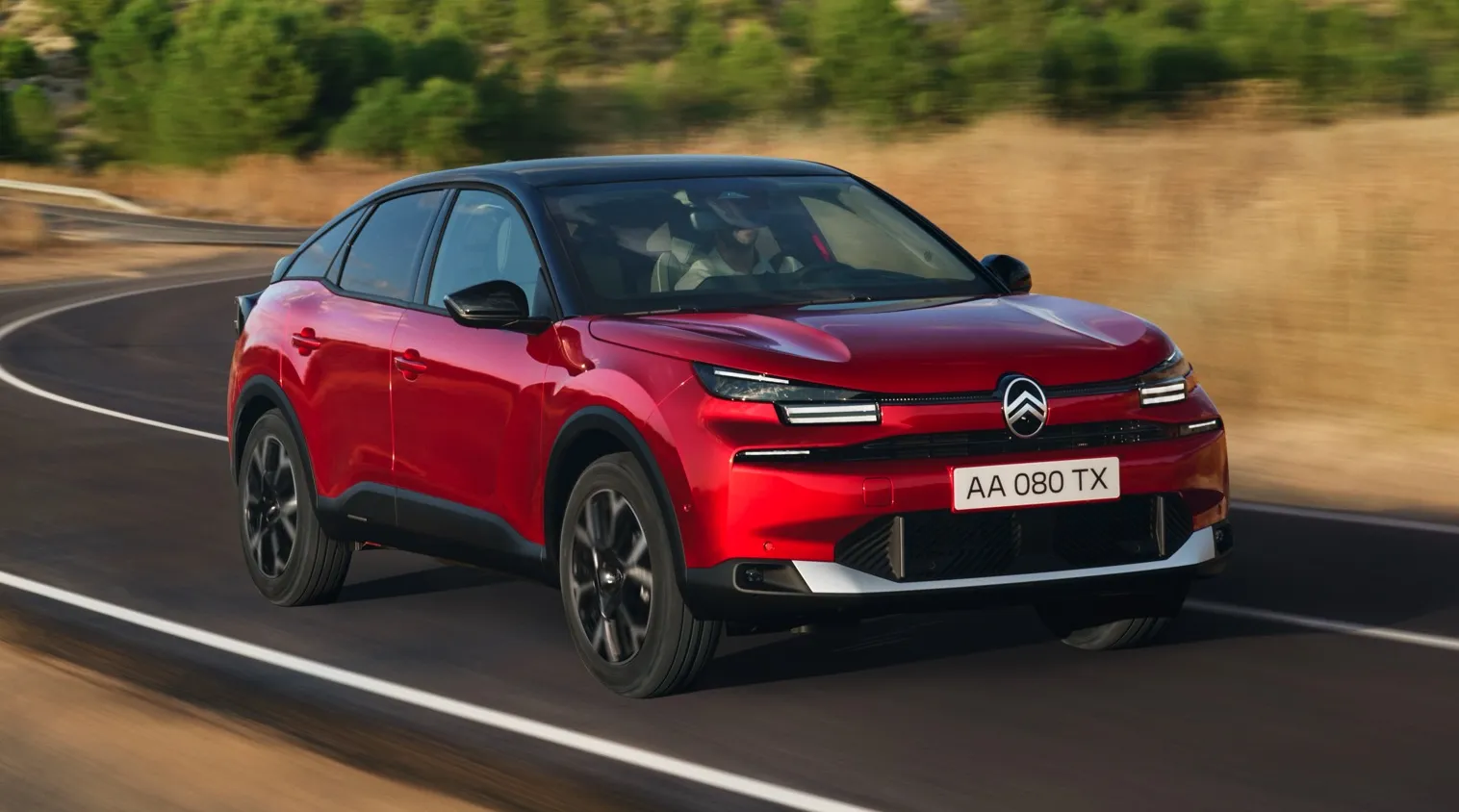
Citroen e-C4
Key Specifications
Real Range Estimation
| City - Cold Weather * | 285 km |
| Highway - Cold Weather * | 205 km |
| Combined - Cold Weather * | 245 km |
between 205 - 440 km
| City - Mild Weather * | 440 km |
| Highway - Mild Weather * | 265 km |
| Combined - Mild Weather * | 335 km |
Battery
| Nominal Capacity | 50.0 kWh |
| Battery Type | Lithium-ion |
| Number of Cells | 216 |
| Architecture | 400 V |
| Warranty Period | 8 years |
| Warranty Mileage | 160,000 km |
| Useable Capacity | 46.3 kWh |
| Cathode Material | No Data |
| Pack Configuration | 108s2p |
| Nominal Voltage | 400 V |
| Form Factor | No Data |
| Name / Reference | No Data |
Performance
| Acceleration 0 - 100 km/h | 10.8 sec |
| Top Speed | 150 km/h |
| Electric Range * | 290 km |
| Total Power | 100 kW (136 PS) |
| Total Torque | 260 Nm |
| Drive | Front |
Home and Destination Charging (0 -> 100%)
Charging is possible by using a regular wall plug or a charging station. Public charging is always done through a charging station. How fast the EV can charge depends on the charging station (EVSE) used and the maximum charging capacity of the EV. The table below shows all possible options for charging the Citroen e-C4. Each option shows how fast the battery can be charged from empty to full.
Europe
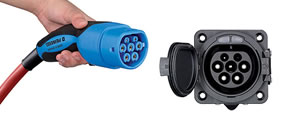
Charging an EV in Europe differs by country. Some European countries primarily use 1-phase connections to the grid, while other countries are almost exclusively using a 3-phase connection. The table below shows all possible ways the Citroen e-C4 can be charged, but some modes of charging might not be widely available in certain countries.
| Type 2 (Mennekes - IEC 62196) |
|---|
 |
| Charging Point | Max. Power | Power | Time | Rate |
|---|---|---|---|---|
| Standard 7.4 kW On-Board Charger | ||||
| Wall Plug (2.3 kW) | 230V / 1x10A | 2.3 kW | 23h45m | 12 km/h |
| 1-phase 16A (3.7 kW) | 230V / 1x16A | 3.7 kW | 14h45m | 20 km/h |
| 1-phase 32A (7.4 kW) | 230V / 1x32A | 7.4 kW | 7h30m | 39 km/h |
| 3-phase 16A (11 kW) | 230V / 1x16A | 3.7 kW † | 14h45m | 20 km/h |
| 3-phase 32A (22 kW) | 230V / 1x32A | 7.4 kW † | 7h30m | 39 km/h |
| Optional 11.0kW On-Board Charger * | ||||
| Wall Plug (2.3 kW) | 230V / 1x10A | 2.3 kW | 23h45m | 12 km/h |
| 1-phase 16A (3.7 kW) | 230V / 1x16A | 3.7 kW | 14h45m | 20 km/h |
| 1-phase 32A (7.4 kW) | 230V / 1x32A | 7.4 kW | 7h30m | 39 km/h |
| 3-phase 16A (11 kW) | 400V / 3x16A | 11 kW | 5 hours | 58 km/h |
| 3-phase 32A (22 kW) | 400V / 3x16A | 11 kW † | 5 hours | 58 km/h |
† = Limited by on-board charger, vehicle cannot charge faster.
* = Optional in some countries, standard in others. Check local specifications for details.
Fast Charging (10 -> 80%)
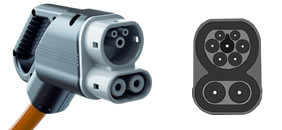
Rapid charging enables longer journeys by adding as much range as possible in the shortest amount of time. Charging power will decrease significantly after 80% state-of-charge has been reached. A typical rapid charge therefore rarely exceeds 80% SoC. The rapid charge rate of an EV depends on the charger used and the maximum charging power the EV can handle. The table below shows all details for rapid charging the Citroen e-C4.
- Max. Power: maximum power provided by charge point
- Avg. Power: average power provided by charge point over a session from 10% to 80%
- Time: time needed to charge from 10% to 80%
- Rate: average charging speed over a session from 10% to 80%
| Combined Charging System (CCS Combo 2) |
|---|
 |
| Charging Point | Max. Power | Avg. Power | Time | Rate |
|---|---|---|---|---|
| CCS (50 kW DC) | 50 kW | 40 kW † | 51 min | 230 km/h |
| CCS (100 kW DC) | 100 kW | 78 kW † | 26 min | 460 km/h |
| CCS (150 kW DC) | 100 kW † | 78 kW † | 26 min | 460 km/h |
| This vehicle supports Autocharge |
|---|
| This vehicle does not support Plug & Charge |
† = Limited by charging capabilities of vehicle
Autocharge: allows for automatic initiation of a charging session at supported CCS charging stations.
Plug & Charge: allows for automatic initiation of a charging session at supported CCS charging stations in accordance with ISO 15118.
Actual charging rates may differ from data shown due to factors like outside temperature, state of the battery and driving style.
Citroen Claimed Specifications
The table below shows the claimed specifications from the manufacturer for charging the Citroen e-C4. The specifications can differ from the table above for a variety of reasons. If real-world charge tests are available, these differences can be signifcant. If no real-world tests are available, the table above will be based on the manufacturer specifications as per the table below.
- Max. Power: maximum charge power during charging session
- Charge From: battery percentage (% SoC) where charging session is started
- Charge To: battery percentage (% SoC) where charging session is ended
- Time: time needed for charging session
| Citroen Claimed Specifications |
|---|
| Max. Power | Charge From | Charge To | Time |
|---|---|---|---|
| 100 kW | 10 % | 80 % | 30 min |
Dimensions and Weight
| Length | 4360 mm |
| Width | 1834 mm |
| Width with mirrors | 2032 mm |
| Height | 1525 mm |
| Wheelbase | 2670 mm |
| Weight Unladen (EU) | 1536 kg |
| Gross Vehicle Weight (GVWR) | 2020 kg |
| Max. Payload | 559 kg |
| Cargo Volume | 380 L |
| Cargo Volume Max | 1250 L |
| Cargo Volume Frunk | 0 L |
| Roof Load | 80 kg |
| Tow Hitch Possible | No |
| Towing Weight Unbraked | 0 kg |
| Towing Weight Braked | 0 kg |
| Vertical Load Max | 0 kg |
About this Vehicle
Citroen e-C4 Overview
The Citroen e-C4 positions itself as a mainstream electric hatchback, blending French comfort with practical EV specs for urban commuters and families seeking an affordable alternative to premium rivals. Priced from around £26,150 OTR for the standard range model, this Citroen electric hatchback targets budget-conscious buyers in the compact EV segment, offering Citroën Advanced Comfort® suspension and seats that prioritize serene driving over sporty thrills. Its fastback-inspired design philosophy emphasizes refined styling, a spacious 380L boot (expandable to 1,250L), and modern tech like a 10-inch touchscreen with connected navigation.
What sets the e-C4 review apart in the EV landscape is its dual-battery lineup on the CMP platform: a 50 kWh option for city runs and a 54 kWh pack for longer journeys, delivering up to 420 km WLTP range. Key distinguishing features include progressive hydraulic suspension for plush ride quality, wireless Apple CarPlay/Android Auto, and safety aids like Active Safety Brake. In a market dominated by Tesla and Hyundai, the Citroen e-C4 matters for delivering European comfort at accessible prices, making electric vehicle range and efficiency approachable without compromising on everyday usability.
Citroen e-C4 Performance and Driving Experience
The Citroen e-C4 delivers smooth, effortless power with its front-wheel-drive electric motor, excelling in relaxed cruising rather than track-day heroics. The standard range version offers 136 hp (100 kW) with a 0-62 mph time of 10 seconds, while the extended range upgrades to 156 hp (115 kW) and 192 lb-ft torque for a brisker 9.2-second sprint. Real-world driving impressions highlight its softly sprung setup, which glides over rough roads and speed bumps better than stiffer rivals, providing a wafting motorway gait ideal for daily commutes.
Handling remains composed for a comfort-focused EV, with electronic power steering and a 10.9m turning circle suiting city parking. No AWD option exists—it’s pure RWD-free FWD efficiency—but the instant torque ensures peppy urban acceleration without drama.
| Specification | Value |
|---|---|
| 0-60 mph (0-100 km/h) | 9.2 sec (extended range) / 10 sec (standard) |
| Top Speed | 106 mph / 170 km/h |
| Power Output | 156 hp / 115 kW (extended) |
| Torque | 192 lb-ft / 260 Nm |
Citroen e-C4 Range and Battery Specifications
Official Citroen e-C4 WLTP range reaches 257 miles (420 km) on the 54 kWh battery or 219 miles (357 km) with the 50 kWh pack, though real-world range typically hits 200-230 miles depending on conditions. Battery technology uses lithium-ion chemistry with 50.8 kWh usable in the larger unit, paired with efficient energy consumption around 160-180 Wh/mi. Cold weather or aggressive driving can drop range by 20-30%, but highway efficiency shines thanks to aerodynamic design and regenerative braking.
Factors like terrain and load influence output, with urban cycles yielding the best results. The e-C4 battery specs make it versatile for mixed use, balancing cost and capability in the compact EV class.
| Range Metric | Value |
|---|---|
| WLTP Range | 257 miles / 420 km (54 kWh) |
| EPA Range | ~230 miles / 370 km (est.) |
| Real-World Range | 200-230 miles / 320-370 km |
| Battery Capacity | 54 kWh (50.8 usable) |
Citroen e-C4 Charging Times and Options
Home charging for the Citroen e-C4 is straightforward with a Mode 3 Type 2 cable: Level 1 (120V) takes overnight for a full top-up, while Level 2 at 7.4 kW or 11 kW completes 20-80% in 4h40 or 3h10. DC fast charging peaks at 100 kW, achieving 20-80% in just 27 minutes on compatible networks like Ionity or public rapid chargers, making road trips feasible.
Practical scenarios favor wallbox installs for daily use, with compatibility across major EU/UK networks. The included cable supports accelerated public charging, minimizing downtime for busy owners.
| Charging Method | Time | Speed |
|---|---|---|
| Level 1 (120V) | 24+ hours | ~1.3 kW |
| Level 2 (240V/7kW) | 4h40 (20-80%) | ~7.4 kW |
| Level 2 (240V/11kW) | 3h10 (20-80%) | ~11 kW |
| DC Fast Charge (10-80%) | 27 min | up to 100 kW |
Citroen e-C4 vs Competitors
In the Citroen e-C4 vs competitors arena, it undercuts the Hyundai Ioniq 5 on price while matching similar real-world range (200+ miles) but trades angular styling for superior comfort via Advanced Comfort® suspension. Against the Tesla Model 3, the e-C4 offers a plusher ride and lower entry cost (£26k vs £40k+), though it lags in acceleration and supercharger access. The Kia EV6 edges it in power and tech, but the e-C4 shines in value-packed family practicality over sporty dynamics.
Frequently Asked Questions
Related Vehicles
View All Citroen
Citroen e-SpaceTourer M 50 kWh
 Citroen
Citroen e-C3 Aircross
 Citroen
Citroen e-SpaceTourer XL 50 kWh
 Citroen