

For more than two decades, Citroën has been a specialist in compact, city-focused cars. The C3 nameplate alone has been around for over 22 years, and the fourth-generation Citroën e‑C3 continues that tradition—this time as a fully electric hatchback designed for everyday urban mobility.
Despite looking much larger than the original C3, the new e-C3 remains firmly in the compact class. It’s only around 160 mm longer and 70 mm taller than the first generation. Citroën avoids calling it an SUV or crossover—and rightly so. This is still a hatchback, just with a slightly raised ride height and a more upright stance.
The version reviewed here is the Citroën e-C3 with the 44 kWh battery, positioning itself as one of the most affordable electric cars in Europe.




Key Specifications (Citroën e-C3 44 kWh)
-
Drivetrain: FWD
-
Motor output: 83 kW (113 hp), 120 Nm
-
Battery capacity: 44 kWh (total)
-
WLTP range: up to 320 km
-
Charging: up to 100 kW DC (CCS), 11 kW AC
-
Dimensions: 4,015 × 1,755 × 1,567 mm
-
Wheelbase: 2,540 mm
-
Ground clearance: 163 mm
-
Weight: 1,419 kg (unladen)
-
Tech highlights: Wireless Apple CarPlay, Android Auto, OTA updates
The e-C3 shares much of its technical foundation with the Fiat Grande Panda, but undercuts it significantly on price in many markets—sometimes by as much as 15%.
Exterior Design: Rugged Without Overdoing It
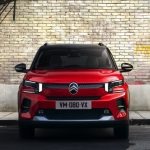
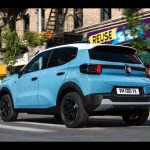
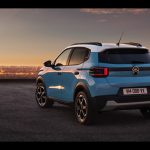
Citroën’s design language is anything but subtle, and the e-C3 is no exception. The exterior is packed with sharp lines, contrasting panels, and bold accents. Compared to older C3 generations with playful, rounded styling, the new model looks more serious and confident.
The upright front end is a result of modern pedestrian safety standards, but Citroën uses that height to create a strong visual presence. A large Citroën logo dominates the grille, while C-shaped LED headlights provide solid night-time visibility.
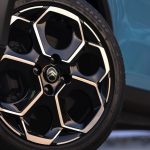
From the side, the e-C3 looks compact and friendly. The higher ride height gives it a tougher stance without trying to mimic an SUV. Optional 17-inch wheels look great and still retain enough sidewall for comfort.
At the rear, oversized tail lights and bold branding give the car a surprisingly imposing look for its size. Overall, the e-C3 feels more restrained and stylish than the Grande Panda, which leans harder into rugged design cues.
Interior: Simplicity Done Right
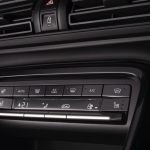
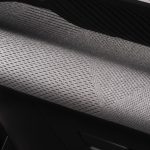
Step inside, and the Citroën e-C3 immediately impresses with its simplicity. Controls are large, intuitive, and clearly laid out. Unlike some rivals, Citroën uses soft-touch materials in all the main contact areas, giving the cabin a surprisingly premium feel for the price.
 Reviews
How Do Hybrid Electric Vehicle Work?
Hybrid electric vehicles (HEVs) combine an internal combustion engine (ICE) with one or more electric motors powered by batteries. Unlike...
 Reviews
Mini Countryman EV Review (2026): Real-World Range, Charging, Ownership Costs & Expert Verdict
The Mini Countryman Electric is not trying to win the EV spreadsheet war. It’s not the longest-range compact SUV. It’s...
 Reviews
Tesla Model 3 vs BYD Seal (2025)
Tesla Model 3 vs BYD Seal: What Should You Choose in 2025? (Full Expert Comparison) The global EV market in...
A fun design detail: each door sill features a different red slogan, adding character to an otherwise minimalist interior.
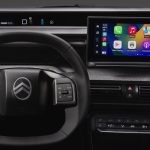
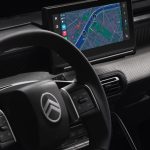
The oval steering wheel—with flattened top and bottom—feels odd at first but becomes natural quickly. It houses simple controls for cruise control and audio.
Displays & Infotainment
-
Driver display: A compact projection-style display (similar in concept to BMW’s head-up display philosophy).
-
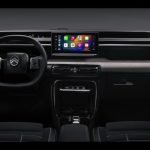
Main screen: 10.25-inch touchscreen with fast response and sharp graphics.
However, there is a major drawback: the driver display cannot show energy consumption data. For an electric car, this is a serious usability flaw and one shared with the Fiat Grande Panda.
The infotainment system itself is basic but responsive. Wireless Apple CarPlay and Android Auto come standard—something even premium brands still charge extra for.

Space & Practicality
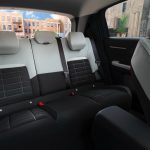
Despite its compact footprint, the e-C3 comfortably seats four adults. Even a 1.95 m (6’4”) driver can sit behind their own seat, although legroom is tight. Headroom, however, is more than adequate.
-
Boot capacity: 310 litres (above average for the segment)
-
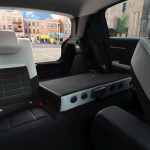
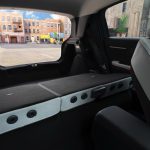
Rear seats: Do not fold completely flat
-
Frunk: None
The lack of a flat load floor and a front trunk limits ultimate practicality, but for daily city use, the space is perfectly adequate.
Driving Experience: Calm and Predictable
The Citroën e-C3 is not a driver’s car—and it doesn’t try to be. Power delivery is smooth but unremarkable, steering feedback is minimal, and the suspension prioritises comfort over engagement.
Where it does shine is ride comfort, thanks to Citroën’s Advanced Comfort suspension with progressive hydraulic cushions. Small bumps and poor road surfaces are absorbed effortlessly, though sharp speed bumps can unsettle the car due to its short wheelbase.
At higher speeds, the e-C3 feels more stable and confidence-inspiring than the Fiat Grande Panda, which becomes noisy and unsettled above 130 km/h.
One downside is the lack of true one-pedal driving. Regeneration exists, but full stops always require the brake pedal.
Technology & Driver Aids
Technology levels are intentionally minimal:
-
No driving modes
-
Very limited vehicle settings
-
Basic navigation
-
Rear parking camera with average image quality
That said, Citroën deserves praise for how easily driver aids can be disabled. Lane-keeping assist and traffic sign recognition can be turned off with a simple button press—no menu diving required.
Real-World Range & Charging
Because the car does not display consumption data, precise testing is difficult. After around 200 km of mixed driving, the battery dropped to just under 10%.
Compared to rivals like the Renault 5 or Hyundai i10, the e-C3 delivers noticeably less range from a similar battery size.
Charging speeds are theoretically solid at up to 100 kW DC. However, in cold conditions, peak charging during testing was only around 35 kW—well below expectations and a potential issue for colder climates.
Competition
-
Fiat Grande Panda: More character and quirks, built-in charging cable, but worse high-speed stability and interior materials.
-
Hyundai Inster: More modern tech, better infotainment and interior space, but feels less solid and more expensive when equipped similarly.
-
Dacia Spring: Cheaper, but significantly less refined, less safe, and far more basic.





Verdict: A True Urban Electric Bargain
The Citroën e-C3 may not lead the class in range, technology, or performance—but it doesn’t need to. Its strengths lie in comfort, simplicity, build quality, and price.
It’s an electric car designed for people who want hassle-free urban mobility, not endless menus or sporty thrills. Compared to ultra-budget EVs like the Dacia Spring, the e-C3 feels far more complete and mature.
Pros
-
Extremely easy to use
-
Comfortable suspension
-
High material quality for the price
-
Stable at speed
-
Usable rear seats
-
Simple driver-aid deactivation
Cons
-
No energy consumption readout
-
Weak cold-weather charging performance
-
Very basic infotainment
-
No one-pedal driving
-
Rear seats don’t fold flat
-
Limited range and no battery options
Bottom line:
The Citroën e-C3 is exactly what a modern city EV should be—affordable, comfortable, and unintimidating. If you mainly drive in urban environments and value simplicity over tech overload, it’s one of the best value electric cars currently on sale.