
China’s largest-ever winter test of electric vehicles has delivered surprising results, reshaping perceptions of how EVs perform in extreme cold. The high-profile test involved 67 electric vehicles, making it the largest winter EV comparison ever conducted — a feat officially recognized by the Guinness World Records.
Despite its global reputation, Tesla failed to dominate the rankings, finishing behind several Chinese rivals across key performance categories.
Extreme Winter Conditions and Real-World Testing
The tests were conducted in Inner Mongolia, with ambient temperatures ranging from –10°C to –25°C. All vehicles were driven under identical real-world conditions:
-
Cabin heating turned on
-
Mixed routes including highways, city roads, and off-road sections
-
Vehicles driven until full battery depletion
The judging panel evaluated each EV across seven critical winter scenarios:
-
Cold-weather driving range
-
Energy consumption
-
DC fast-charging performance
-
Cabin heating efficiency
-
Automatic emergency braking (AEB)
-
Acceleration
-
Off-road capability
The record-breaking test was organized by the Chinese automotive portal Autohome.
 Cars
Cars
BYD Targets 2027 Solid-State Batteries with 400 Wh/kg Density and 10,000-Cycle Sodium Tech for EVs
BYD plans to install all-solid-state batteries in high-end EVs by 2027, achieving 400 Wh/kg energy density and over 1,200 km...
 News
News
BYD Deploys 1360 kW Megawatt Chargers Adding 400 km Range in 5 Minutes – Largest Network Planned
BYD has begun deploying Megawatt Flash Charging stations with 1360 kW peak power, capable of adding approximately 400 km of...
 Cars
Cars
Renault R5 Turbo 3E: The Silent Screamer Bringing the 80s Back — Without the Noise
Renault has done something both genius and utterly absurd — it has resurrected one of its most iconic rally cars,...
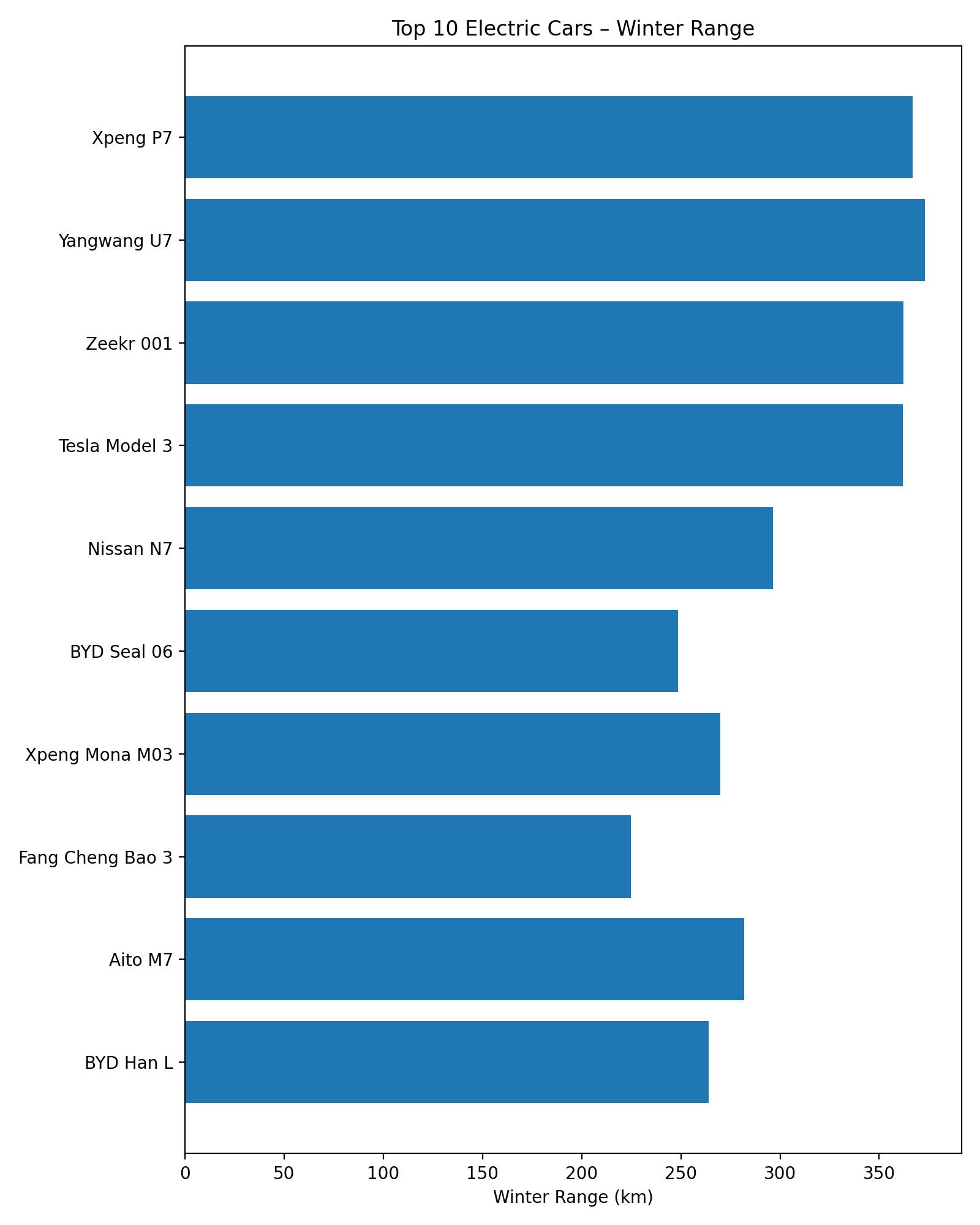
Best Cold-Weather Range: Chinese EVs Take the Lead
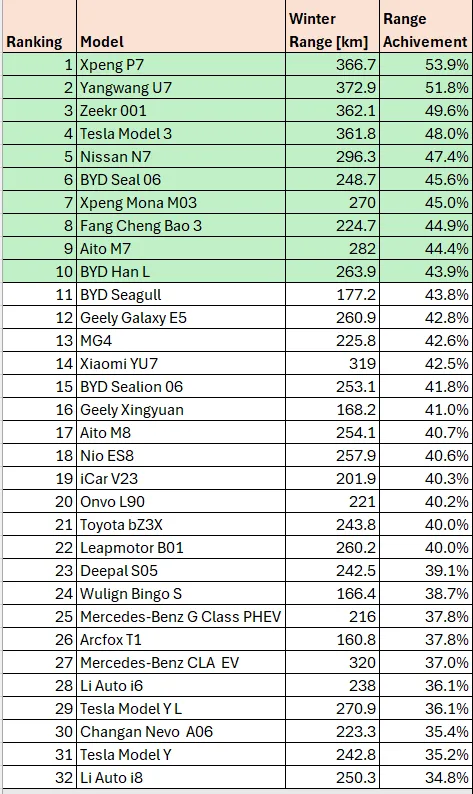
When it came to retaining driving range in freezing conditions, Chinese manufacturers clearly outperformed Tesla.
Top results by percentage of official CLTC range retained:
-
Xpeng P7 — 53.9%
-
BYD Yangwang U7 — 51.8%
-
Zeekr 001 — 49.6%
-
Tesla Model 3 — 48%
The results show that cold weather consumed less than half the battery capacity of the top-performing EVs.
By contrast:
-
Tesla Model Y placed 31st, retaining only 35.2% of its rated range
-
The weakest result overall came from Li Auto i8 with 34.8%
All remaining vehicles in the test were plug-in hybrids.
Energy Efficiency in Sub-Zero Temperatures
Energy consumption was measured in kWh per 100 km, with lighter and more compact vehicles showing a clear advantage.
Top performers:
-
BYD Seagull — 23.5 kWh/100 km
-
Geely Xingyuan — narrowly behind
-
BYD Seal 06 — third place
Tesla Model 3 ranked fifth, consuming 24.9 kWh/100 km.
Among larger vehicles:
-
Xiaomi YU7 placed 20th at 33.7 kWh/100 km
-
Tesla Model Y trailed by just 1.2 kWh/100 km, highlighting how cold weather disproportionately affects heavier crossovers
Cold-Weather Charging: Surprising Winners
Fast-charging performance in freezing conditions revealed even greater differences between EV platforms. Using a standardized 30%–80% charging test, the results were unexpected.
Fastest cold-weather charging:
-
Avatr 06 — 15 minutes
-
Nevo 06
-
Fulwin A9L
Lower down the ranking:
-
Xiaomi YU7 — 39th, 31 minutes
-
Tesla Model Y — 44th, 35 minutes
These results underline how dramatically battery thermal management and charging architecture influence winter charging speeds.
What the Test Reveals
The findings clearly show that Chinese EV manufacturers are rapidly mastering cold-weather optimization, outperforming Tesla in:
-
Winter range retention
-
Energy efficiency
-
Charging speed in sub-zero conditions
As EV adoption expands into colder regions, winter performance is becoming a decisive factor — and China’s domestic brands are setting new benchmarks.