
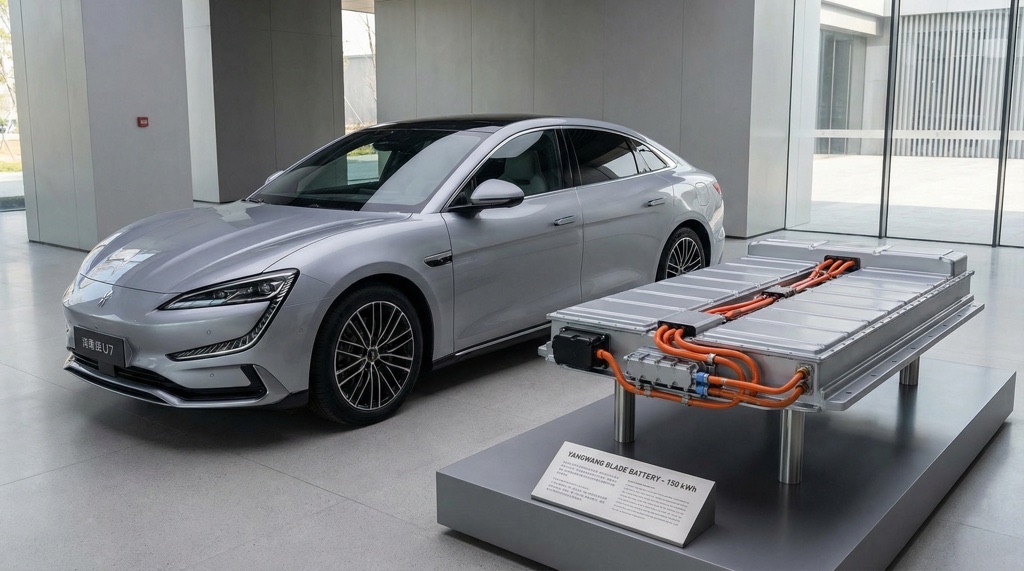
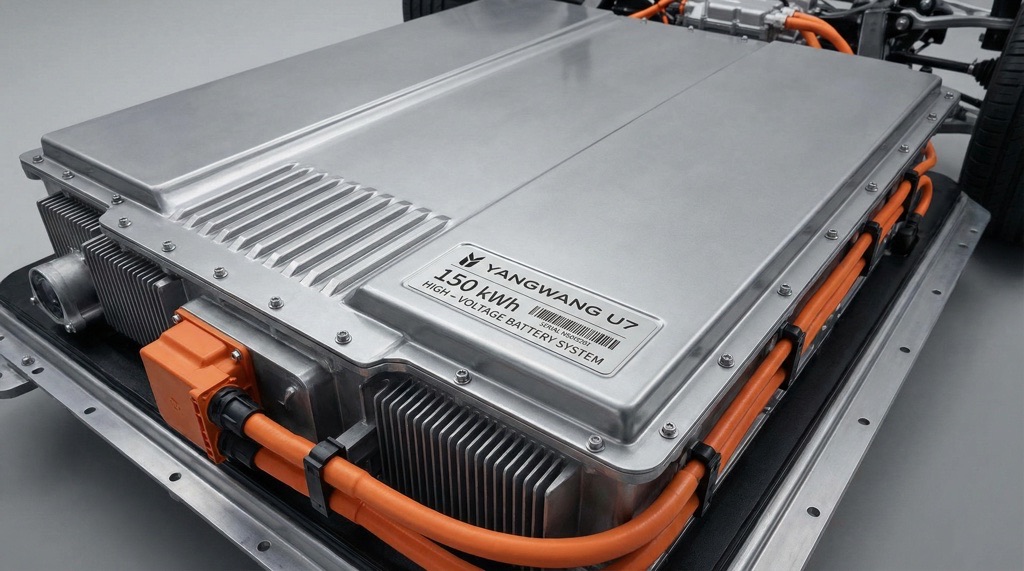
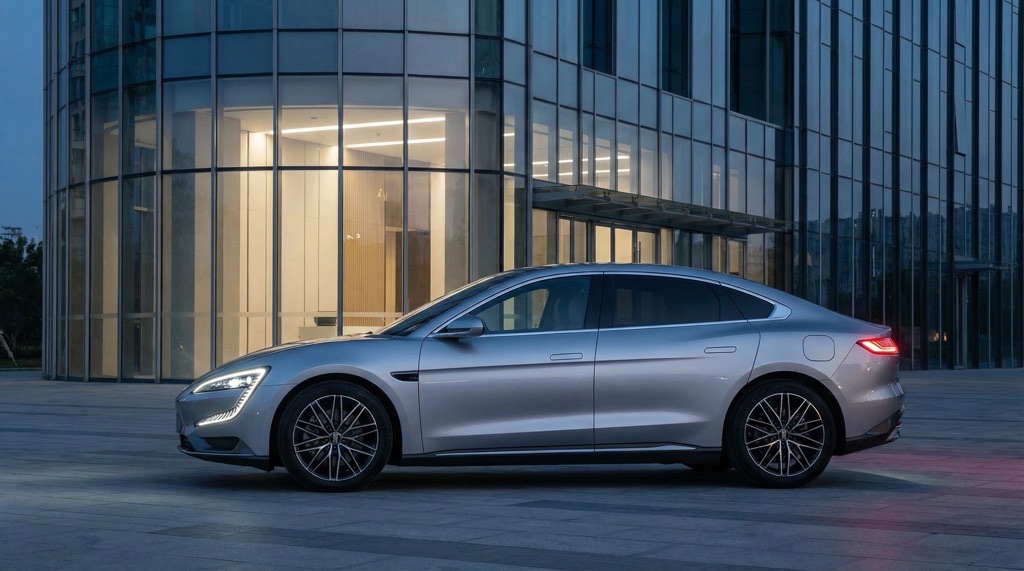
BYD’s ultra-luxury sub-brand Yangwang has filed details for an updated U7 sedan with a 150 kWh LFP Blade battery, enabling up to 1,006 km CLTC range in its base 1,287 hp variant. This refresh improves efficiency to 17.7 kWh/100 km—a 10% gain over the prior model—while adding 100 kg to the curb weight. For EV buyers seeking maximum range in a high-performance luxury sedan, this positions the U7 as BYD’s longest-range BEV, challenging import-heavy premium segments in China.
Background: Yangwang’s Rise in China’s Luxury EV Market
Launched in 2024, Yangwang is BYD’s premium EV brand targeting vehicles above RMB 1 million, though the U7 starts at RMB 628,000 ($89,800), making it the brand’s most accessible model. Built on the e4 platform with individual wheel drive (IWD), the U7 emphasizes performance, aerodynamics (0.195 Cd), and advanced chassis tech like DiSus-Z active suspension. The original U7 BEV offered 720 km CLTC range with a 135.5 kWh pack; the PHEV used a 52.4 kWh battery for 200 km electric range.
Yangwang’s lineup includes the U8 off-road SUV (from RMB 1.098 million), U8L extended version (RMB 1.28 million), and U9 supercar (RMB 1.68 million). The U7 BEV update follows the PHEV launch, with regulatory filings from China’s MIIT confirming specs as of January 2026. Market launch is expected within months, potentially boosting Yangwang’s share in China’s luxury sedan space, dominated by imports like Mercedes S-Class and BMW 7 Series EVs.
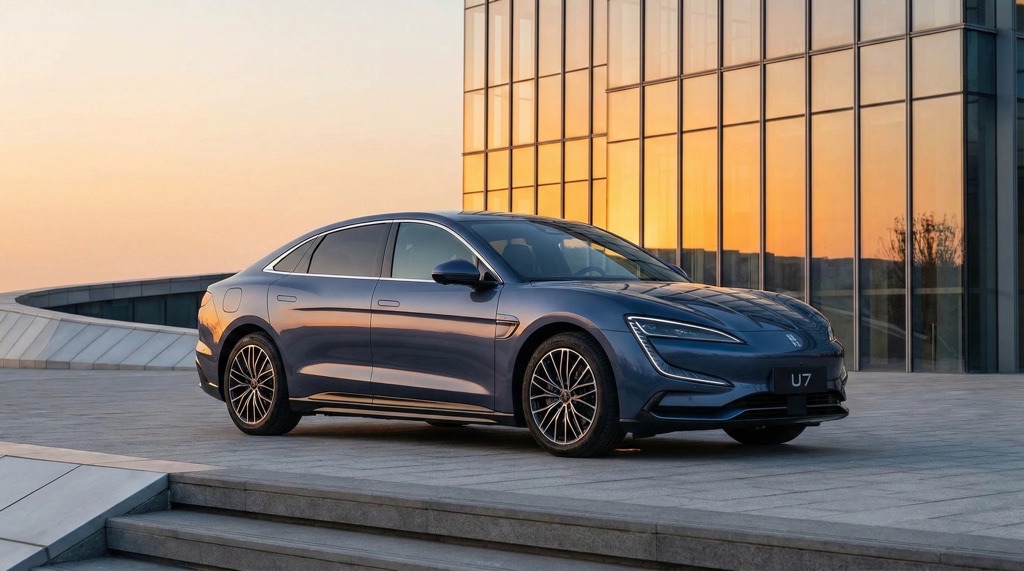
Key Specifications
| Specification | Details |
|---|---|
| Dimensions (L/W/H/WB) | 5,265 / 1,998 / 1,517 mm / 3,160 mm |
| Battery (BEV) | 150.01 kWh LFP Blade (926 kg, 162 Wh/kg); 135.5 kWh option (903 kg, 150 Wh/kg) |
| Battery (PHEV) | 52.4 kWh (446 kg, 200 km CLTC electric range) |
| Power (BEV) | 1,287 hp (960 kW) or 1,341 hp; Quad motors, 240 kW each; 1,584-1,680 Nm torque |
| Range (CLTC, BEV) | 1,006 km (1,287 hp); 860 km (1,341 hp); 800 km (135.5 kWh) |
| Consumption (BEV) | 17.7 kWh/100 km |
| 0-100 km/h | 2.9 seconds |
| Top Speed | 270 km/h |
| Drag Coefficient | 0.195 Cd |
| Seating | 4 or 5 seats |
| Price (Current) | From RMB 628,000 ($89,800) |
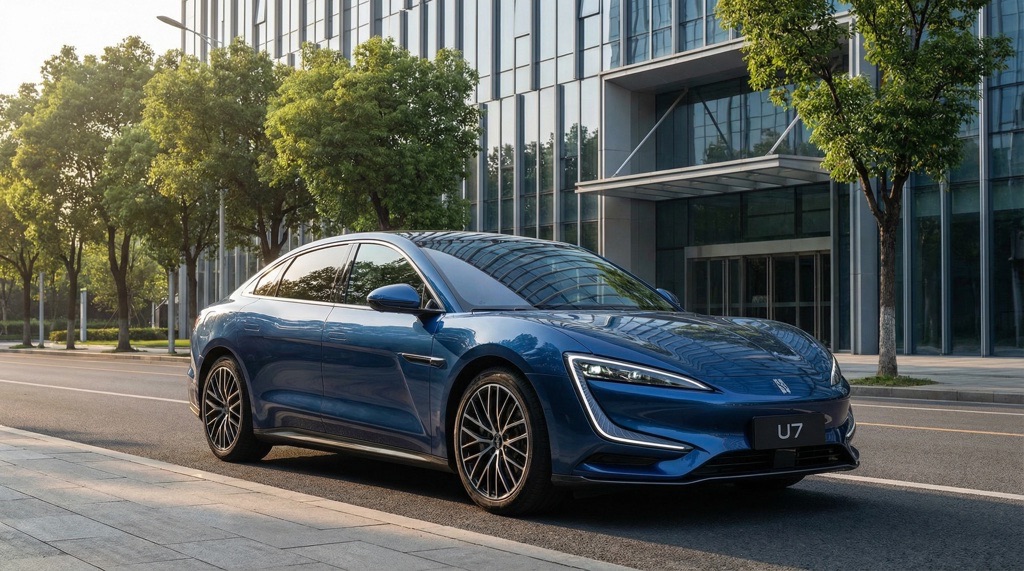
Powertrain and Battery Efficiency Analysis
The 2026 U7 BEV pairs its massive 150 kWh LFP Blade battery—BYD’s lithium-iron-phosphate tech—with quad permanent-magnet motors at each wheel, enabling precise torque vectoring and 20 degrees of rear-wheel steering for a 4.85 m turning radius. Total output hits 960 kW (1,287 hp standard, up to 1,341 hp top variant), with 1,584 Nm torque stock and peaks at 1,680 Nm. Acceleration remains blistering at 2.9 seconds to 100 km/h, unchanged from the prior model.
Efficiency stands out: 17.7 kWh/100 km consumption is achieved despite a 100 kg weight increase to around 2,500 kg (estimated from battery weights). This 10% improvement over the 135 kWh predecessor’s figures suggests aero tweaks (retaining 0.195 Cd), software optimizations, and DiSus-Z suspension with 10 ms response and energy recovery. CLTC ranges—1,006 km base, 860 km top—are lab-optimistic; real-world WLTP or EPA could drop 20-30%, but still class-leading for a 5.2 m sedan.
 Cars
Cars
Bugatti Goes Pint-Sized with the Electric Baby II Type 35 Centenary Edition
Just when you thought Bugatti couldn’t get any more exclusive or outrageous, they’ve gone and released a miniature electric version...
 Cars
Cars
Honda Base Station Prototype Weighs Under 1500 lbs and Tows with CR-V – Democratizes Camping for Compact EVs
Honda has unveiled the Base Station Prototype, a lightweight camper trailer weighing under 1,500 pounds that can be towed by...
 News
News
BYD Seal 07 EV Launches with 400km 5-Minute Charging: Game-Changer or Marketing Hype?
BYD’s New Seal 07 EV Promises 400km Range in Five Minutes—But There’s a Catch BYD officially launched the Seal 07...
Interior, Tech, and Driver Assistance
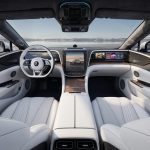
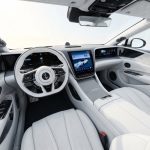
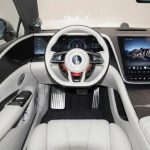
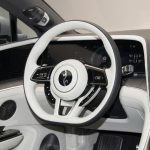
Inside, the U7 features a 23.6-inch digital cluster, AR-HUD, 12.8-inch curved OLED touchscreen, and 6-inch passenger display, all on DiLink 150 with a 4 nm chip and dual NVIDIA Orin-X processors. Rear passengers get dual 12.8-inch screens. Nappa leather, real wood, and 23-speaker Dynaudio Platinum audio elevate luxury. Seats offer 20-way adjustment, heating, ventilation, and massage.
God’s Eye A (DiPilot 600) ADAS includes 3 LiDARs, 5 mmWave radars, 13 cameras, and 12 ultrasonics for L2+ autonomy. The e4 platform’s four-wheel steering and DiSus-Z active dampers with electromagnetic actuators prioritize comfort and handling. Unanswered: Exact pricing for 2026 models and WLTP/EPA range confirmations.
Safety and Platform Details
Yangwang’s e4 IWD system integrates four motors with individual control, enhancing traction and stability. DiSus-Z recovers energy via suspension motors, feeding back to the 800V SiC architecture. Aerodynamics (0.195 Cd) and Blade battery safety (no thermal runaway risk) address luxury buyer concerns. Critical note: CLTC testing inflates ranges; independent tests needed for validation.
Comparison with Competitors
| Model | Power (hp) | Battery (kWh) | Range (CLTC/WLTP) | 0-100 km/h (s) | Price Start (RMB) |
|---|---|---|---|---|---|
| Yangwang U7 2026 (BEV) | 1,287-1,341 | 150 | 1,006 km CLTC | 2.9 | 628,000 |
| Zeekr 001 | 1,265 | 140 | 1,036 km CLTC | 2.9 | ~500,000 |
| Nio ET9 | 697 | 150 | 700 km CLTC | 3.8 | 800,000 |
| Mercedes EQS | 516 | 118 | 857 km WLTP | 4.3 | ~1,000,000 |
The U7 undercuts pricier rivals like Nio ET9 while matching Zeekr 001’s range and power at similar acceleration. Versus global EQS, it offers double the power and range potential at half the price in China, though import tariffs affect direct competition.
Verdict
The 2026 Yangwang U7 BEV sets a benchmark for range (1,006 km CLTC) and efficiency (17.7 kWh/100 km) in a 1,300 hp luxury sedan, ideal for Chinese executives prioritizing long-distance travel without range anxiety. It’s a win for BYD’s Blade tech scalability, but buyers should await real-world tests and pricing confirmation. Best for performance-oriented EV adopters in Asia; less practical for U.S./EU due to charging infrastructure gaps.