
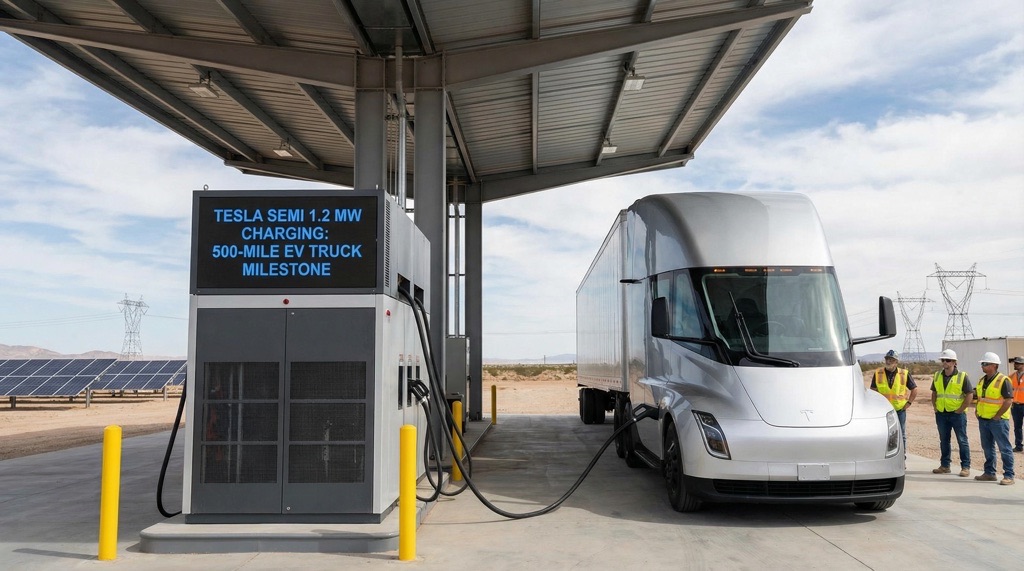
Tesla has demonstrated its semi-electric truck charging at a record 1.2 megawatts (MW), or 1206 kW, providing the first real-world evidence that ultra-fast charging can support long-distance freight operations. This milestone, shown in an official video posted on January 13, 2026, aligns with Tesla’s claim of recovering 70% of the truck’s 500-mile (800 km) range in 30 minutes. For fleet operators, this addresses a key barrier to adopting battery-electric Class 8 trucks, potentially reducing downtime on high-volume routes.
Background: Tesla’s Path to Semi Production
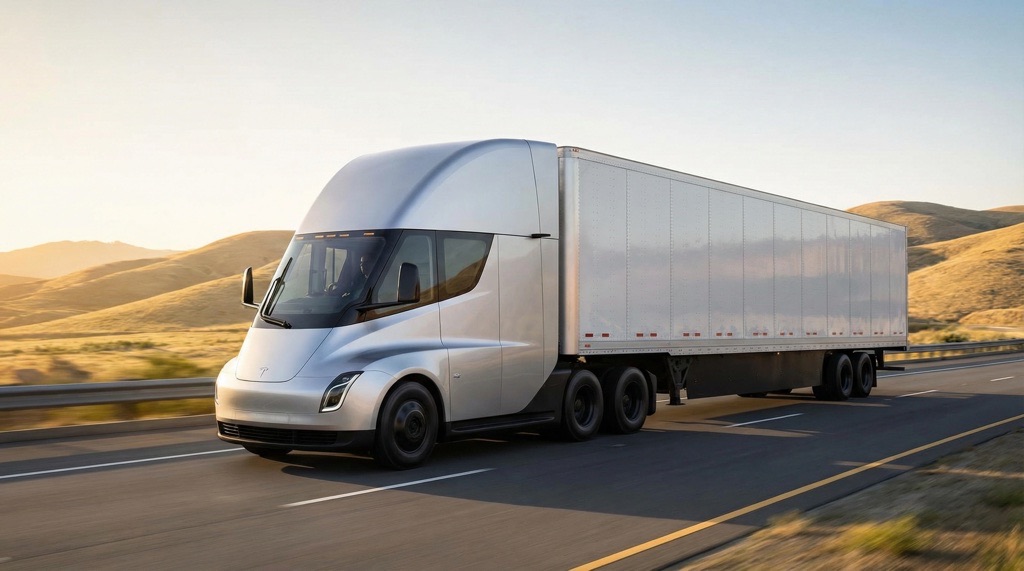
Tesla unveiled the Semi in November 2017, promising a Class 8 truck with 500 miles of range, 1.7 kWh per mile efficiency (later refined to under 2 kWh/mile), and rapid charging via proprietary Megachargers. Initial pilots began in 2022 with customers like PepsiCo, which deployed a small fleet for regional routes. Production delays pushed volume manufacturing to 2026, with Tesla expanding facilities near Giga Nevada. As of January 2026, a refreshed Semi design has been spotted, featuring design tweaks ahead of high-volume output starting in the first half of the year, ramping to full capacity later.
Tesla’s market position in heavy-duty EVs remains dominant in ambition but nascent in scale. Competitors like Daimler (eFreightliner) and Volvo offer shorter-range electrics, while Tesla’s infrastructure focus – including 46 planned Megacharger stations by early 2027 – positions it for network effects. PepsiCo’s real-world use confirms operational reliability, though public charging data was scarce until now.
Key Specifications
| Specification | Details |
|---|---|
| Peak Charging Power | 1.2 MW (1206 kW) |
| Range (Full Charge) | Up to 500 miles (800 km) |
| Charging Claim | 70% range in 30 minutes |
| Battery Capacity (Estimated) | 800-900 kWh (often cited as ~850 kWh) |
| Energy Consumption | Less than 2 kWh per mile (~1.06-1.7 kWh/km) |
| Charger Architecture | V4 Cabinet, 400-1000V compatible, Megawatt Charging System (MCS) ready |
| Cooling System | Liquid-cooled cable and immersion-cooled connector |
| Production Start | First half of 2026, full ramp H2 2026 |
Charging Demonstration Breakdown
The video from Tesla Semi’s X account shows engineers monitoring a charging session where power ramps up steadily to 1.2 MW. This is nearly five times the peak of North America’s fastest passenger car chargers (typically 250-500 kW for V4 Superchargers or Cybertruck). At 1.2 MW, the system adds roughly 20 kWh per minute, enabling a 10-80% charge (about 595 kWh for an 850 kWh pack) in under 45 minutes if sustained – though real-world taper due to heat remains unshown.
Key enablers include V4 cabinets scaling beyond 500 kW for Cybertruck, a proprietary Megacharger port distinct from NACS, and advanced thermal management. No visible overheating occurred, but Tesla omitted state-of-charge (SoC) data, peak duration, or full charge curves – critical for daily fleet use. Early prototypes used multiple Superchargers, but Megachargers are optimized for Semi’s ~850 kWh pack, equivalent to eight Model S batteries.
 Cars
Cars
China Names the Best Electric Car for Winter Driving — Tesla Finishes Only Fourth
China’s largest-ever winter test of electric vehicles has delivered surprising results, reshaping perceptions of how EVs perform in extreme cold....
 Cars
Cars
BYD Seal 08 Flagship Sedan Enters Winter Testing – Ocean Series’ 2026 Q1 Launch Nears
BYD has released winter testing images of the Seal 08 flagship sedan, confirming active development ahead of its Q1 2026...
 Cars
Cars
Genesis GV60 Magma: The Gentleman’s Performance Electric SUV
Genesis enters the high-performance electric vehicle arena with the GV60 Magma, a sophisticated blend of luxury and power that transforms...
Infrastructure and Production Readiness
Tesla’s first Megacharger pilot launched at Giga Nevada in 2021, with expansions underway. Dan Priestley, Tesla Semi engineering lead, confirmed factory chargers hit 1.2 MW, and 46 public stations are slated for 2027 rollout, debuting at the 2025 Advanced Clean Transportation Expo. This network targets trucking rest stops, essential for zero-emission logistics. Customer depots like PepsiCo’s will expand in 2026 alongside deliveries.
A revamped Semi was recently spotted at Giga Nevada’s Megacharger, signaling final pre-production tweaks. High-volume production ties to this infrastructure, as Semi’s 1.2 MW needs dedicated stalls, unlike passenger EVs.
Performance Analysis: Strengths and Gaps
The 1.2 MW demo validates Tesla’s long-held promises, outpacing MCS standards (up to 1 MW targeted industry-wide). Efficiency at 1.06 kWh/km supports 70% recovery, aligning with 400 miles in 30 minutes. Liquid cooling handles extreme currents, a must for Class 8 duty cycles. However, unanswered questions persist: Can 1.2 MW sustain beyond peak? What’s the SoC threshold for full power? Grid demands for widespread Megachargers could strain utilities without Megapack integration, as seen in Tesla’s Sweden Supercharger workaround.
Real-world pilots show reliability, but scaling to thousands of units requires proven 24/7 uptime. Battery degradation over 1 million miles – another Tesla claim – lacks independent verification.
Comparison with Competitors
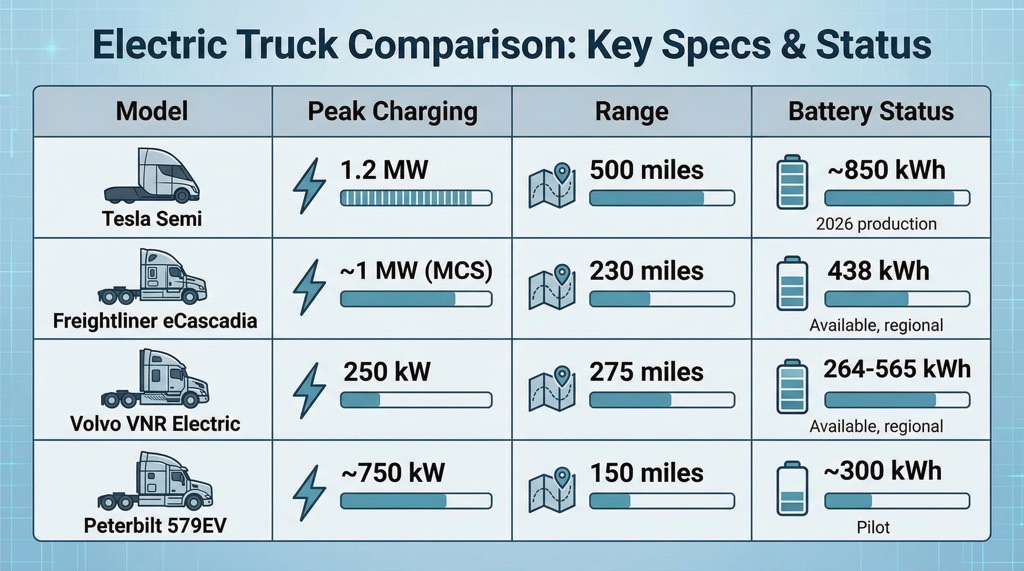
| Model | Peak Charging | Range | Battery | Status |
|---|---|---|---|---|
| Tesla Semi | 1.2 MW | 500 miles | ~850 kWh | 2026 production |
| Freightliner eCascadia | ~1 MW (MCS) | 230 miles | 438 kWh | Available, regional |
| Volvo VNR Electric | 250 kW | 275 miles | 264-565 kWh | Available, regional |
| Peterbilt 579EV | ~750 kW | 150 miles | ~300 kWh | Pilot |
Tesla leads in power and range, but rivals focus on shorter-haul drayage with existing CCS/MCS. Semi’s edge is long-haul potential if infrastructure scales.
Verdict
This 1.2 MW demo is a pivotal step, proving Tesla Semi’s charging can match diesel refuel times for 500-mile routes – ideal for fleets like PepsiCo eyeing cost savings over 5-10 years. It’s for forward-thinking operators prioritizing emissions reduction and uptime, but only if Megacharger networks deploy on schedule. Skeptics await full charge data and million-mile durability tests; details not yet confirmed could temper hype. For now, 2026 marks Semi’s breakout year in electric trucking.