
Updated with the latest information as of March 21, 2025
While much of the aviation industry is obsessed with futuristic flying taxis and rooftop vertiports, one company is quietly winning the orders race by doing something radically simple: building an airplane that behaves like an airplane — just far better.
Electra has secured nearly $9 billion in pre-orders for its hybrid-electric eSTOL (electric Short Takeoff and Landing) aircraft, eclipsing the order books of most eVTOL manufacturers. And it’s doing so without ducted fans, tilt rotors, or science-fiction aesthetics.
What Is Electra Building — and Why Does It Matter?
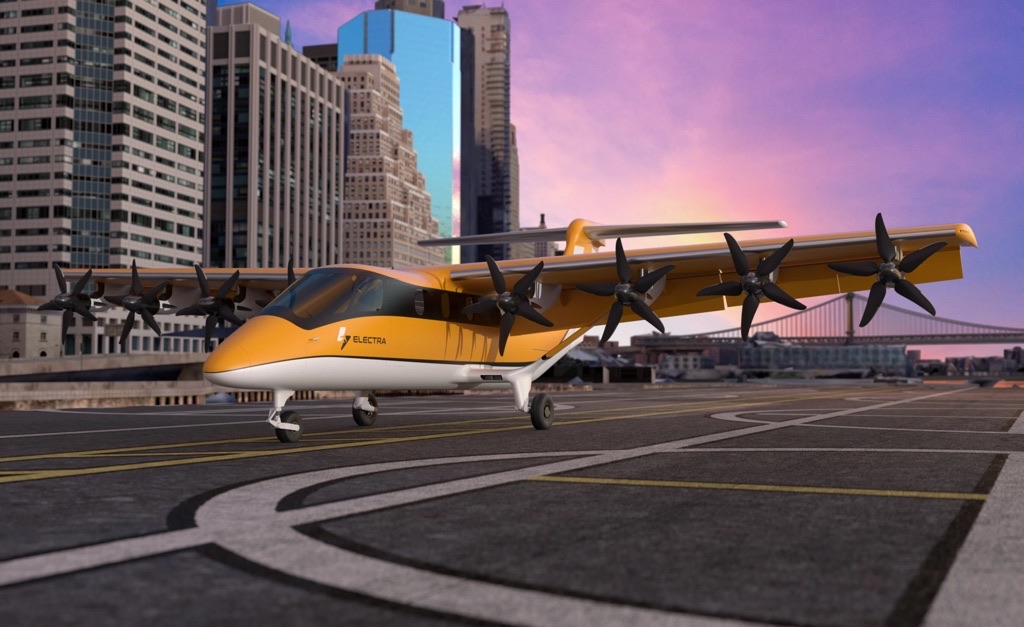
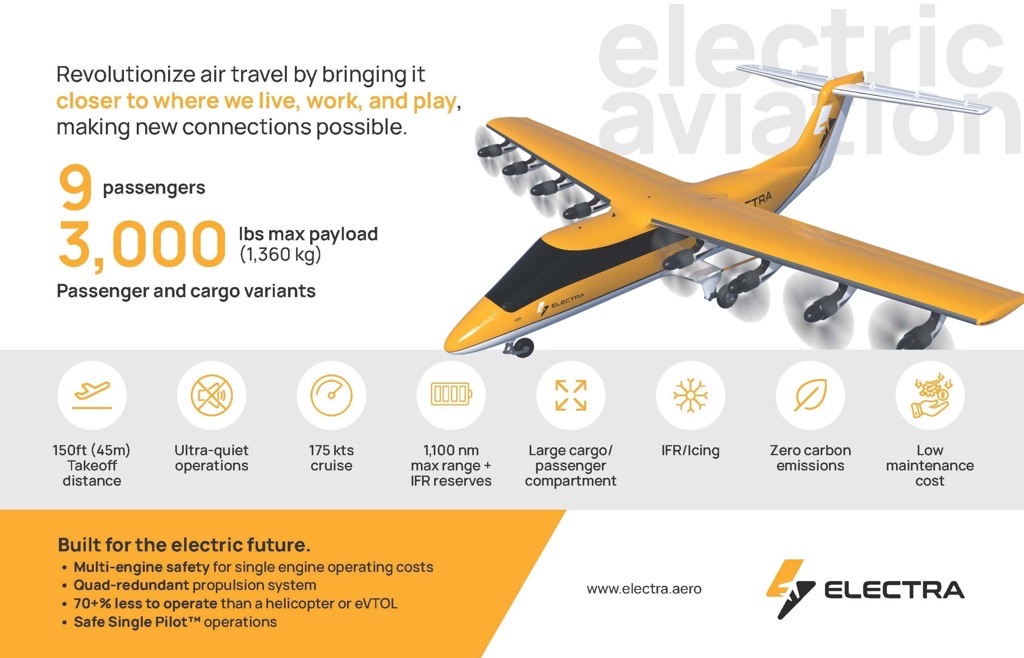
Electra’s upcoming aircraft, commonly referred to as the EL9, looks conventional at first glance. High wing, fixed landing gear, standard tail. But aerodynamically, it’s anything but ordinary.
The aircraft uses blown-wing technology, combining:
-
Eight electrically driven propellers along the wing’s leading edge
-
Large trailing-edge flaps
-
A hybrid-electric powertrain (battery + fuel generator)
This setup forces air over the wings at low speeds, generating enormous lift even when barely moving forward.
Key Performance Highlights
| Metric | Electra EL9 |
|---|---|
| Takeoff speed | 35 mph (56 km/h) |
| Takeoff distance | ~300 ft (92 m) |
| Landing distance | ~300 ft (92 m) |
| Cruise speed | ~200 mph (322 km/h) |
| Range | 1,100 nautical miles (2,037 km) |
| Capacity | 9 passengers or 3,000 lb (1,361 kg) cargo |
| Noise level | 55 dB at 500 ft |
To put that into perspective: the aircraft can operate from spaces smaller than a soccer field, at noise levels comparable to a normal indoor conversation.
Flying Slower Than You Thought Possible
Electra’s two-seat EL2 technology demonstrator has been flying since May 2024, and the results have surprised even seasoned aerospace engineers.
According to company test data:
-
Shortest takeoff: ~150 ft (46 m)
-
Shortest landing: 114 ft (34.7 m)
-
Minimum observed airspeed: 22 knots (25 mph / 40 km/h)
“We still haven’t found the stall speed yet,”
— J.P. Stewart, VP & GM, ElectraAircraft
The Electric VTOL Aircraft: BETA’s Bizarrely Cool Electric Flying Machine
Is it a bird? A plane? No, it’s the ALIA – BETA Technologies’ impressively weird electric vertical take-off and landing...
Aircraft
The LEO Coupe: Indiana’s $460K Flying Car Revolution
Redefining Personal Transportation Forget everything you know about traditional vehicles. The LEO Coupe is here to transform how we think...
Aircraft
Joby Aviation’s Hydrogen Breakthrough: The 523-Mile Flying Taxi Revolution
A Quantum Leap in Clean Aviation Joby Aviation has just redefined the possibilities of electric vertical takeoff and landing (eVTOL)...
That’s an almost unheard-of statement in fixed-wing aviation.
Quiet Enough for Cities — Without Rooftops
Noise is where Electra quietly demolishes the competition.
At 500 ft overhead, the EL2 prototype measures just 55 dB. By comparison:
-
Conventional turboprop aircraft: ~75 dB
-
Vacuum cleaner: ~70–75 dB
This makes the aircraft suitable for:
-
Urban-adjacent airfields
-
Regional routes near residential areas
-
Noise-restricted zones where helicopters are banned
Electra claims 100× less noise, 70% lower operating cost, and dramatically lower emissions compared to helicopters.


Why Airlines and Operators Are Ordering in Bulk
Unlike eVTOLs, Electra’s aircraft:
-
Uses existing aviation infrastructure
-
Requires no vertiports
-
Fits within current fixed-wing certification frameworks
That matters enormously.
While many eVTOL startups are still navigating regulatory uncertainty, Electra’s approach offers a much smoother path to FAA certification, with far fewer unknowns.
Certification Timeline
-
2026: Full-scale 9-seat technology demonstrator flight
-
2028: Targeted FAA certification & entry into service
$9 Billion in Orders — Beating the eVTOL Giants
Electra reports more than 2,200 aircraft pre-ordered, totaling nearly $9 billion in value.
For comparison:
-
Archer Aviation: ~$6 billion in provisional orders
-
Many other eVTOL startups: significantly less
That’s remarkable, considering eSTOL is a less flashy concept than vertical flight.
But customers — including regional airlines, cargo operators, humanitarian organizations, and defense contractors — clearly value practicality over spectacle.
The CEO’s Vision
“We’ve created a fixed-wing airplane that delivers the access of a helicopter with 100 times less noise, 70% lower cost, improved safety, and dramatically reduced emissions.”
— Marc Allen, CEO, Electra
The real disruption here isn’t rooftop-to-rooftop travel. It’s opening thousands of new regional routes that were previously impossible due to runway length or noise restrictions.



Why Electra Might Matter More Than Flying Cars
While eVTOLs grab headlines and venture capital, Electra is quietly building something airlines can actually deploy at scale.
No vertiports.
No radical retraining.
No regulatory moonshots.
Just:
-
Ultra-short runways
-
Extremely low noise
-
Familiar flight operations
-
Real-world economics
Sometimes the future of aviation isn’t vertical — it’s just astonishingly efficient.
Electra has amassed nearly $9 billion in pre-orders for its hybrid-electric eSTOL aircraft, outperforming eVTOL competitors by offering ultra-short takeoff, extremely low noise, and a faster path to certification—positioning it as one of the most practical breakthroughs in next-generation aviation.