

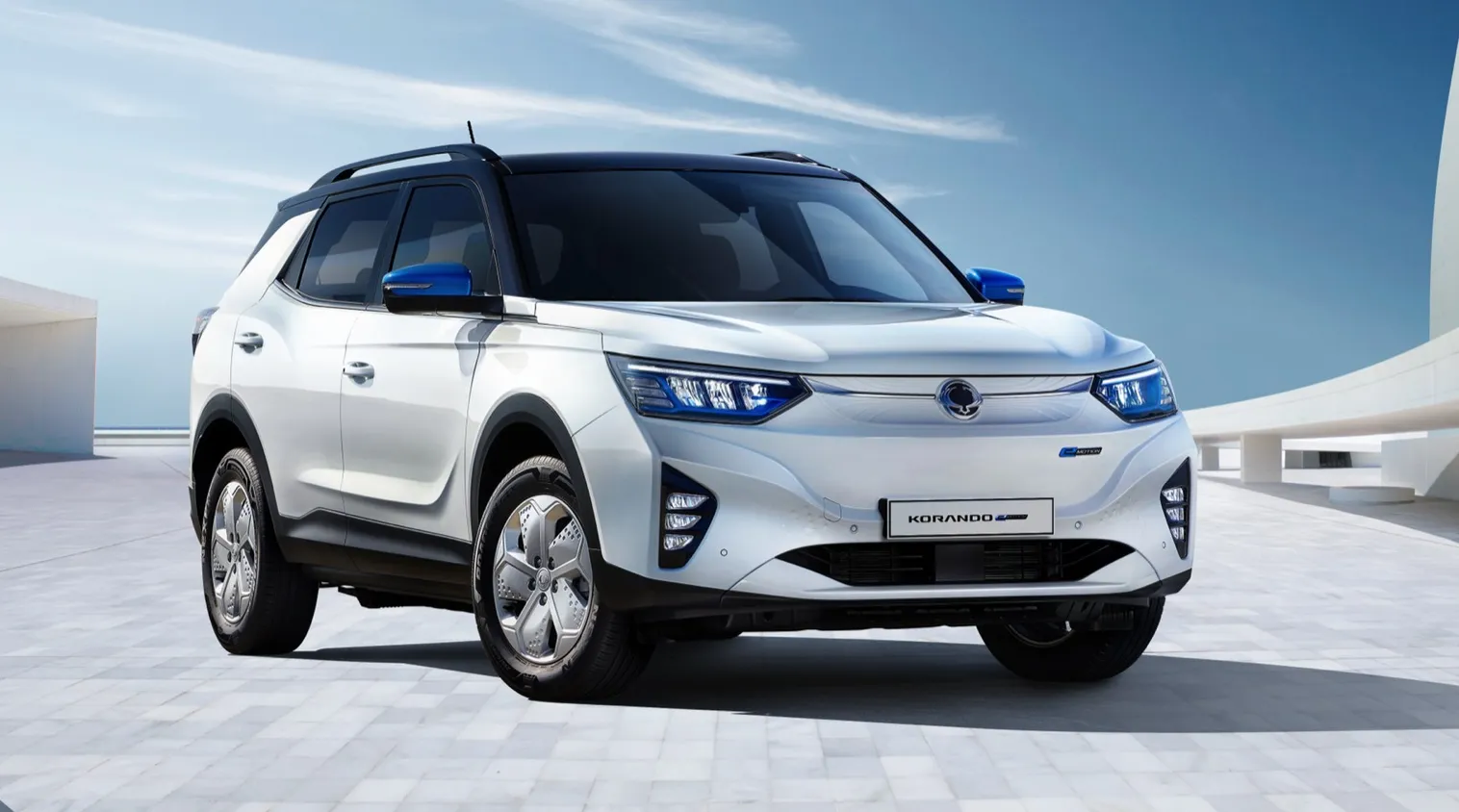
SsangYong Korando e-Motion
Key Specifications
Real Range Estimation
| City - Cold Weather * | 295 km |
| Highway - Cold Weather * | 205 km |
| Combined - Cold Weather * | 250 km |
between 205 - 435 km
| City - Mild Weather * | 435 km |
| Highway - Mild Weather * | 265 km |
| Combined - Mild Weather * | 335 km |
Battery
| Nominal Capacity | 61.5 kWh |
| Battery Type | Lithium-ion |
| Number of Cells | No Data |
| Architecture | 400 V |
| Warranty Period | 7 years |
| Warranty Mileage | 150,000 km |
| Useable Capacity* | 56.0 kWh |
| Cathode Material | No Data |
| Pack Configuration | No Data |
| Nominal Voltage | No Data |
| Form Factor | No Data |
| Name / Reference | No Data |
Performance
| Acceleration 0 - 100 km/h * | 8.5 sec |
| Top Speed | 156 km/h |
| Electric Range * | 290 km |
| Total Power | 140 kW (190 PS) |
| Total Torque | 360 Nm |
| Drive | Front |
Home and Destination Charging (0 -> 100%)
Charging is possible by using a regular wall plug or a charging station. Public charging is always done through a charging station. How fast the EV can charge depends on the charging station (EVSE) used and the maximum charging capacity of the EV. The table below shows all possible options for charging the SsangYong Korando e-Motion. Each option shows how fast the battery can be charged from empty to full.
Europe
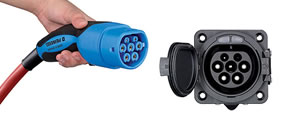
Charging an EV in Europe differs by country. Some European countries primarily use 1-phase connections to the grid, while other countries are almost exclusively using a 3-phase connection. The table below shows all possible ways the SsangYong Korando e-Motion can be charged, but some modes of charging might not be widely available in certain countries.
| Type 2 (Mennekes - IEC 62196) |
|---|
 |
| Charging Point | Max. Power | Power | Time | Rate |
|---|---|---|---|---|
| Wall Plug (2.3 kW) | 230V / 1x10A | 2.3 kW | 28h45m | 10 km/h |
| 1-phase 16A (3.7 kW) | 230V / 1x16A | 3.7 kW | 18 hours | 16 km/h |
| 1-phase 32A (7.4 kW) | 230V / 1x29A | 6.6 kW † | 10 hours | 29 km/h |
| 3-phase 16A (11 kW) | 230V / 1x16A | 3.7 kW † | 18 hours | 16 km/h |
| 3-phase 32A (22 kW) | 230V / 1x29A | 6.6 kW † | 10 hours | 29 km/h |
† = Limited by on-board charger, vehicle cannot charge faster.
Fast Charging (10 -> 80%)
Rapid charging enables longer journeys by adding as much range as possible in the shortest amount of time. Charging power will decrease significantly after 80% state-of-charge has been reached. A typical rapid charge therefore rarely exceeds 80% SoC. The rapid charge rate of an EV depends on the charger used and the maximum charging power the EV can handle. The table below shows all details for rapid charging the SsangYong Korando e-Motion.
- Max. Power: maximum power provided by charge point
- Avg. Power: average power provided by charge point over a session from 10% to 80%
- Time: time needed to charge from 10% to 80%
- Rate: average charging speed over a session from 10% to 80%
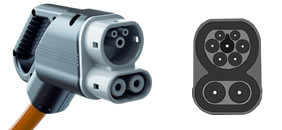
| Combined Charging System (CCS Combo 2) |
|---|
 |
| Charging Point | Max. Power | Avg. Power | Time | Rate |
|---|---|---|---|---|
| CCS (50 kW DC) | 50 kW | 47 kW † | 53 min | 230 km/h |
| CCS (150 kW DC) | 74 kW † | 69 kW † | 36 min | 330 km/h |
| Charge Curve |
|---|
 |
Data made available by Fastned |
| This vehicle supports Autocharge |
|---|
| This vehicle does not support Plug & Charge |
† = Limited by charging capabilities of vehicle
Autocharge: allows for automatic initiation of a charging session at supported CCS charging stations.
Plug & Charge: allows for automatic initiation of a charging session at supported CCS charging stations in accordance with ISO 15118.
Actual charging rates may differ from data shown due to factors like outside temperature, state of the battery and driving style.
Dimensions and Weight
| Length | 4465 mm |
| Width | 1870 mm |
| Width with mirrors | No Data |
| Height | 1635 mm |
| Wheelbase | 2675 mm |
| Weight Unladen (EU) | 1840 kg |
| Gross Vehicle Weight (GVWR) | 2250 kg |
| Max. Payload | 485 kg |
| Cargo Volume | 551 L |
| Cargo Volume Max | No Data |
| Cargo Volume Frunk | 0 L |
| Roof Load | No Data |
| Tow Hitch Possible | Yes |
| Towing Weight Unbraked | 500 kg |
| Towing Weight Braked | 1500 kg |
| Vertical Load Max | No Data |
About this Vehicle
SsangYong Korando e-Motion Overview
The SsangYong Korando e-Motion (also sold as the KGM Korando e-Motion) is a value-focused compact electric SUV aimed at buyers who want family practicality and SUV space without premium-brand pricing. As the brand’s first full SsangYong electric SUV, it targets mainstream EV shoppers cross-shopping cars like the Kia e-Niro, Hyundai Kona Electric and entry-level Tesla Model Y, but with a sharper sticker price and generous equipment.
Underpinning the Korando e-Motion is a Mahindra-derived MESMA electric architecture with a 61.5 kWh lithium-ion polymer battery and a single front-mounted motor, delivering 140 kW (188 hp) and 360 Nm of torque. This gives it respectable EV specs and towing capability up to 1,500 kg, which many rivals lack. The design sticks closely to the combustion Korando but adds an EV-specific closed grille and aero tweaks.
In the current EV landscape, the SsangYong Korando e-Motion matters because it broadens access to electric SUVs for budget-conscious families. While rivals often beat it on ultimate electric vehicle range or cabin polish, the Korando e-Motion offers a compelling mix of space, equipment and usable performance at a lower cost, making it a smart choice for drivers prioritizing value over badges.
—
SsangYong Korando e-Motion Performance and Driving Experience
On paper, the SsangYong Korando e-Motion delivers solid real-world performance. Its 140 kW (188 hp) front motor and 360 Nm of instant torque provide brisk off-the-line acceleration, with 0–60 mph in around 8.3 seconds and 0–100 km/h in about 8.5–8.6 seconds. Power delivery is smooth and typical of modern EVs, with strong low-speed response for city driving and enough punch for confident motorway merging.
The Korando e-Motion is front-wheel drive (FWD) only, with no AWD option. The chassis is tuned for comfort rather than sportiness; reviews describe the handling as safe and predictable but not especially engaging. Around town it rides comfortably, but at higher speeds the tall body can feel less composed over rougher surfaces. Steering is light with some play around the straight-ahead, encouraging a relaxed driving style. Paddle-controlled regenerative braking offers three levels, helping boost efficiency, though it doesn’t quite deliver full one-pedal driving.
| Specification | Value |
|---|---|
| 0-60 mph (0-100 km/h) | 8.3 sec / 8.5–8.6 sec |
| Top Speed | 97 mph / 156 km/h |
| Power Output | 188 hp / 140 kW |
| Torque | 266 lb-ft / 360 Nm |
—
SsangYong Korando e-Motion Range and Battery Specifications
The SsangYong Korando e-Motion WLTP range is quoted at up to 339 km (210–211 miles) on the combined cycle, with an even higher 474 km claimed for city driving. In independent testing, reviewers have seen energy consumption of about 3.3 mi/kWh, giving a real-world range of roughly 180 miles (around 290 km) from its usable battery capacity, depending on conditions and driving style.
Battery specs are competitive for the class: a 61.5 kWh gross / 55.3 kWh usable lithium-ion polymer pack. Official WLTP consumption is around 16.8 kWh/100 km, translating to solid efficiency for a relatively heavy SUV. As with any EV, the Korando e-Motion real-world range is influenced by cold weather, frequent high-speed driving, hilly terrain and aggressive acceleration. Sticking to Eco mode and mainly urban or suburban routes can push the real-world range closer to the official figures.
| Range Metric | Value |
|---|---|
| WLTP Range | 210–211 miles / 339 km |
| EPA Range | Not officially rated |
| Real-World Range | ~180 miles / ~290 km |
| Battery Capacity | 55.3 kWh (usable) |
—
SsangYong Korando e-Motion Charging Times and Options
For home use, the SsangYong Korando e-Motion supports AC charging up to around 7.2–7.4 kW, typical for a family electric SUV. On a dedicated home wallbox, a 0–100% charge takes about 10 hours, making overnight charging straightforward. A standard 120 V domestic socket (where available) is much slower and best reserved for occasional top-ups.
On the road, the Korando e-Motion charging specs include DC fast charging with a peak of around 80–100 kW, depending on source. Official figures quote 10–80% in just over 40 minutes on a suitably powerful rapid charger, which is competitive in this segment. It uses the common CCS connector for DC charging, giving access to most public high-speed networks across Europe and the UK. In practical terms, a 20–40 minute coffee stop will usually add enough range for another 100–150 miles of driving.
| Charging Method | Time | Speed |
|---|---|---|
| Level 1 (120V) | ~30–40 hours (0–100%) | ~2 kW |
| Level 2 (240V/7kW) | ~10 hours (0–100%) | ~7.2–7.4 kW |
| Level 2 (240V/11kW) | ~7 hours (0–100%, if available) | ~11 kW |
| DC Fast Charge (10-80%) | ~40–45 min | up to 80–100 kW |
—
SsangYong Korando e-Motion vs Competitors
In a SsangYong Korando e-Motion vs Tesla Model Y comparison, the Korando loses on range, performance and charging speed but undercuts the Tesla significantly on price and insurance costs. Against mainstream rivals like the Hyundai Ioniq 5, Kia EV6 or Hyundai Kona Electric, the Korando e-Motion offers a similar battery size but shorter range and a less polished interior. However, it fights back with strong standard equipment, good towing capacity, and a lower entry price, making the SsangYong Korando e-Motion comparison appealing for buyers primarily focused on affordability and practicality rather than cutting-edge tech.
—