

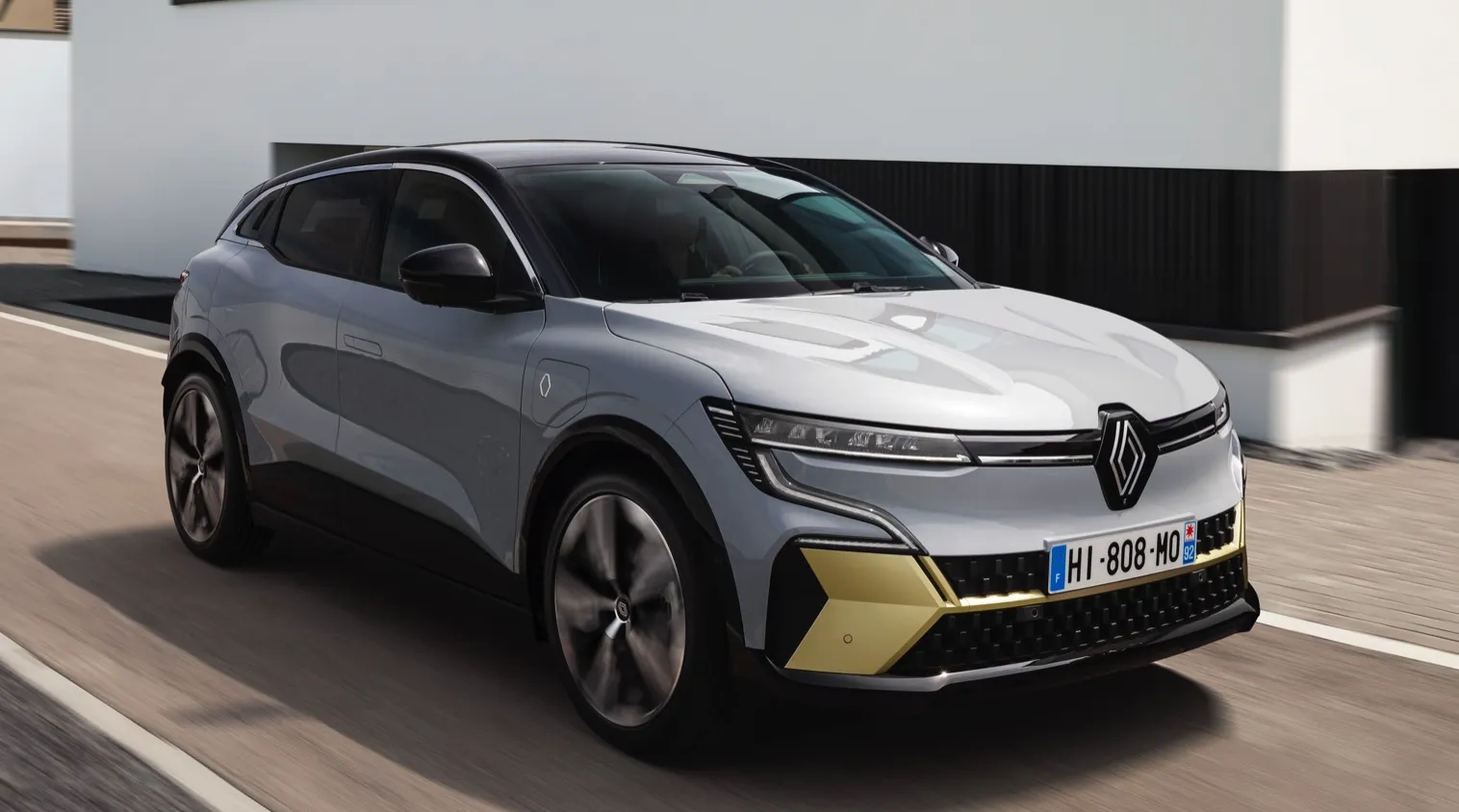
Renault Megane E-Tech EV60 220hp
Key Specifications
Real Range
| City - Cold Weather | 370 km |
| Highway - Cold Weather | 270 km |
| Combined - Cold Weather | 320 km |
between 270 - 570 km
| City - Mild Weather | 570 km |
| Highway - Mild Weather | 350 km |
| Combined - Mild Weather | 440 km |
Battery
| Nominal Capacity | 65.0 kWh |
| Battery Type | Lithium-ion |
| Number of Cells | 288 |
| Architecture | 400 V |
| Warranty Period | No Data |
| Warranty Mileage | No Data |
| Useable Capacity | 60.0 kWh |
| Cathode Material | NCM |
| Pack Configuration | 96s3p |
| Nominal Voltage | 352 V |
| Form Factor | No Data |
| Name / Reference | No Data |
Performance
| Acceleration 0 - 100 km/h | 7.4 sec |
| Top Speed | 160 km/h |
| Electric Range | 380 km |
| Total Power | 160 kW (218 PS) |
| Total Torque | 300 Nm |
| Drive | Front |
Home and Destination Charging (0 -> 100%)
Charging is possible by using a regular wall plug or a charging station. Public charging is always done through a charging station. How fast the EV can charge depends on the charging station (EVSE) used and the maximum charging capacity of the EV. The table below shows all possible options for charging the Renault Megane E-Tech EV60 220hp. Each option shows how fast the battery can be charged from empty to full.
Europe
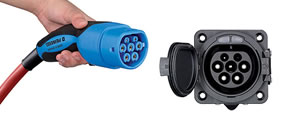
Charging an EV in Europe differs by country. Some European countries primarily use 1-phase connections to the grid, while other countries are almost exclusively using a 3-phase connection. The table below shows all possible ways the Renault Megane E-Tech EV60 220hp can be charged, but some modes of charging might not be widely available in certain countries.
| Type 2 (Mennekes - IEC 62196) |
|---|
 |
| Charging Point | Max. Power | Power | Time | Rate |
|---|---|---|---|---|
| Wall Plug (2.3 kW) | 230V / 1x10A | 2.3 kW | 30h45m | 12 km/h |
| 1-phase 16A (3.7 kW) | 230V / 1x16A | 3.7 kW | 19h15m | 20 km/h |
| 1-phase 32A (7.4 kW) | 230V / 1x32A | 7.4 kW | 9h45m | 39 km/h |
| 3-phase 16A (11 kW) | 400V / 3x16A | 11 kW | 6h30m | 58 km/h |
| 3-phase 32A (22 kW) | 400V / 3x32A | 22 kW † | 3h15m | 110 km/h |
† = Limited by on-board charger, vehicle cannot charge faster.
Fast Charging (10 -> 80%)
Rapid charging enables longer journeys by adding as much range as possible in the shortest amount of time. Charging power will decrease significantly after 80% state-of-charge has been reached. A typical rapid charge therefore rarely exceeds 80% SoC. The rapid charge rate of an EV depends on the charger used and the maximum charging power the EV can handle. The table below shows all details for rapid charging the Renault Megane E-Tech EV60 220hp.
- Max. Power: maximum power provided by charge point
- Avg. Power: average power provided by charge point over a session from 10% to 80%
- Time: time needed to charge from 10% to 80%
- Rate: average charging speed over a session from 10% to 80%
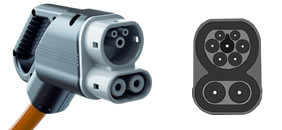
| Combined Charging System (CCS Combo 2) |
|---|
 |
| Charging Point | Max. Power | Avg. Power | Time | Rate |
|---|---|---|---|---|
| CCS (50 kW DC) | 50 kW | 47 kW † | 56 min | 280 km/h |
| CCS (150 kW DC) | 129 kW † | 88 kW † | 30 min | 530 km/h |
| Charge Curve |
|---|
 |
Data made available by Fastned |
| This vehicle supports Autocharge |
|---|
| This vehicle does not support Plug & Charge |
† = Limited by charging capabilities of vehicle
Autocharge: allows for automatic initiation of a charging session at supported CCS charging stations.
Plug & Charge: allows for automatic initiation of a charging session at supported CCS charging stations in accordance with ISO 15118.
Actual charging rates may differ from data shown due to factors like outside temperature, state of the battery and driving style.
Renault Claimed Specifications
The table below shows the claimed specifications from the manufacturer for charging the Renault Megane E-Tech EV60 220hp. The specifications can differ from the table above for a variety of reasons. If real-world charge tests are available, these differences can be signifcant. If no real-world tests are available, the table above will be based on the manufacturer specifications as per the table below.
- Max. Power: maximum charge power during charging session
- Charge From: battery percentage (% SoC) where charging session is started
- Charge To: battery percentage (% SoC) where charging session is ended
- Time: time needed for charging session
| Renault Claimed Specifications |
|---|
| Max. Power | Charge From | Charge To | Time |
|---|---|---|---|
| 130 kW | 0 % | 90 % | 42 min |
Dimensions and Weight
| Length | 4200 mm |
| Width | 1860 mm |
| Width with mirrors | 2055 mm |
| Height | 1505 mm |
| Wheelbase | 2685 mm |
| Weight Unladen (EU) | 1711 kg |
| Gross Vehicle Weight (GVWR) | 2158 kg |
| Max. Payload | 522 kg |
| Cargo Volume | 440 L |
| Cargo Volume Max | 1332 L |
| Cargo Volume Frunk | No Data |
| Roof Load | 80 kg |
| Tow Hitch Possible | Yes |
| Towing Weight Unbraked | 750 kg |
| Towing Weight Braked | 900 kg |
| Vertical Load Max | 75 kg |
About this Vehicle
Renault Megane E-Tech EV60 220hp Overview
The Renault Megane E-Tech EV60 220hp is a compact, premium-leaning Renault electric hatchback/SUV crossover aimed at buyers who want sharp design, strong EV specs and everyday usability without premium-brand pricing. Sitting in the heart of the C‑segment, it targets families and company-car drivers cross-shopping compact electric SUVs and hatchbacks such as the Tesla Model 3, Hyundai Ioniq 5 and VW ID.3.
Built on Renault’s dedicated CMF-EV platform with a slim underfloor battery and compact motor, the Megane E-Tech EV60 220hp focuses on efficiency, low weight and agile dynamics. It combines a 65 kWh battery (60 kWh usable) with a 160 kW motor, front‑wheel drive and advanced driver assistance. Inside, the Google‑based OpenR infotainment system, over‑the‑air updates and high‑quality materials help it stand out in this crowded electric vehicle segment.
In the broader EV landscape, the Renault Megane E-Tech EV60 220hp matters because it shows how a mainstream European brand can deliver an efficient, stylish, tech-forward EV at a more attainable price point than many premium rivals, while still offering competitive electric vehicle range and charging performance. For many buyers, it hits a sweet spot between city-friendly dimensions and genuine long-distance capability.
—
Renault Megane E-Tech EV60 220hp Performance and Driving Experience
With 220 hp (160 kW) and 300 Nm of torque driving the front wheels, the Renault Megane E-Tech EV60 220hp delivers brisk, linear acceleration that feels more than adequate in everyday use. Officially it sprints from 0–100 km/h in 7.4 seconds and tops out at 160 km/h, giving it enough performance for confident overtakes and easy motorway cruising.
On the road, the Megane E-Tech EV60 220hp feels composed and agile thanks to its relatively low weight for an EV and low-mounted battery. The front‑wheel‑drive setup provides predictable handling and strong traction in the dry, while multiple regenerative braking levels let you tailor the driving experience from coasting to near one‑pedal driving. Reviews highlight the car’s quiet cabin, solid ride comfort and stable behavior at speed, making it a capable all‑rounder for both city and highway driving.
| Specification | Value |
|---|---|
| 0-60 mph (0-100 km/h) | 7.4 sec |
| Top Speed | 99 mph / 160 km/h |
| Power Output | 220 hp / 160 kW |
| Torque | 221 lb-ft / 300 Nm |
—
Renault Megane E-Tech EV60 220hp Range and Battery Specifications
The Renault Megane E-Tech EV60 220hp WLTP range is quoted between 429 and 450 km, depending on specification and wheels, placing it among the more efficient compact EVs. In independent testing, real‑world range estimates are around 384 km, with broader conditions suggesting roughly 270–380 km on mixed driving, making it a strong choice for commuters and long‑distance drivers alike.
Under the floor sits a 65 kWh gross battery, with 60 kWh usable capacity, using modern lithium‑ion chemistry on a 400 V architecture. Energy efficiency figures are around 15.6 kWh/100 km, which is competitive in this class and helps keep running costs low. As with any EV, the Renault Megane E-Tech EV60 220hp real‑world range will vary with temperature, motorway speeds, driving style and terrain; cold weather and sustained high‑speed driving will reduce range, while urban use can often exceed official figures.
| Range Metric | Value |
|---|---|
| WLTP Range | 267–280 miles / 429–450 km |
| EPA Range | N/A (not officially rated) |
| Real-World Range | ~240 miles / ~384 km |
| Battery Capacity | 60.0 kWh (usable) |
—
Renault Megane E-Tech EV60 220hp Charging Times and Options
The Renault Megane E-Tech EV60 220hp offers flexible charging options for both home and public use. On AC, it comes with 11 kW onboard charging as standard in many markets, with 22 kW available, allowing a 0–100% charge in around 3–6 hours depending on supply. This suits overnight home charging on a wallbox or daytime top‑ups at destination chargers.
For longer trips, the Megane E-Tech EV60 220hp supports up to 130 kW DC fast charging. On an appropriately powerful CCS charger, Renault quotes roughly 10–80% in about 30–34 minutes, adding around 300 km of range in half an hour under optimal conditions. It uses the common CCS Type 2 standard in Europe, giving access to most major charging networks and making it easy to integrate into existing EV life.
| Charging Method | Time | Speed |
|---|---|---|
| Level 1 (120V) | ~30–35 hours (0–100%) | ~2 kW |
| Level 2 (240V/7kW) | ~9 hours (0–100%) | ~7 kW |
| Level 2 (240V/11kW) | ~6 hours (0–100%) | ~11 kW |
| DC Fast Charge (10-80%) | ~30–34 min | up to 130 kW |
—
Renault Megane E-Tech EV60 220hp vs Competitors
In a Renault Megane E-Tech EV60 220hp vs Tesla Model 3 comparison, the Tesla typically offers longer range and faster charging, but the Renault counters with a more compact footprint, easier parking and a more traditional hatchback practicality. Against the Hyundai Ioniq 5 and Kia EV6, the Megane E-Tech EV60 220hp is smaller and lighter, with comparable real‑world efficiency but less outright space. Versus German rivals like the VW ID.3 or Audi Q4 e‑tron, the Megane stands out with its distinctive design, Google‑built infotainment and strong AC charging capability, making it an attractive alternative for buyers seeking something different in this segment. These Renault Megane E-Tech EV60 220hp comparison points position it as one of the more efficient and stylish compact EVs on sale.
—
Frequently Asked Questions
Related Vehicles
View All Renault
Renault Kangoo E-Tech Electric
 Renault
Renault 5 E-Tech 40kWh 120hp
 Renault
Renault 5 E-Tech 40kWh 95hp
 Renault