Charging is possible by using a regular wall plug or a charging station. Public charging is always done through a charging station. How fast the EV can charge depends on the charging station (EVSE) used and the maximum charging capacity of the EV. The table below shows all possible options for charging the Peugeot e-308. Each option shows how fast the battery can be charged from empty to full.
Europe
Charging an EV in Europe differs by country. Some European countries primarily use 1-phase connections to the grid, while other countries are almost exclusively using a 3-phase connection. The table below shows all possible ways the Peugeot e-308 can be charged, but some modes of charging might not be widely available in certain countries.
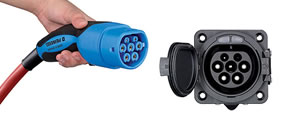
Type 2 (Mennekes - IEC 62196)
Charging Point
Max. Power
Power
Time
Rate
Wall Plug (2.3 kW)
230V / 1x10A
2.3 kW
26 hours
12 km/h
1-phase 16A (3.7 kW)
230V / 1x16A
3.7 kW
16h15m
18 km/h
1-phase 32A (7.4 kW)
230V / 1x32A
7.4 kW
8h15m
36 km/h
3-phase 16A (11 kW)
400V / 3x16A
11 kW
5h30m
55 km/h
3-phase 32A (22 kW)
400V / 3x16A
11 kW †
5h30m
55 km/h
† = Limited by on-board charger, vehicle cannot charge faster.
Fast Charging (10 -> 80%)
Rapid charging enables longer journeys by adding as much range as possible in the shortest amount of time. Charging power will decrease significantly after 80% state-of-charge has been reached. A typical rapid charge therefore rarely exceeds 80% SoC. The rapid charge rate of an EV depends on the charger used and the maximum charging power the EV can handle. The table below shows all details for rapid charging the Peugeot e-308.
Max. Power: maximum power provided by charge point
Avg. Power: average power provided by charge point over a session from 10% to 80%
Time: time needed to charge from 10% to 80%
Rate: average charging speed over a session from 10% to 80%
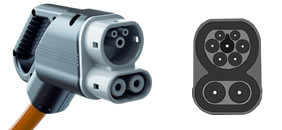
Combined Charging System (CCS Combo 2)
Charging Point
Max. Power
Avg. Power
Time
Rate
CCS (50 kW DC)
50 kW
45 kW †
50 min
250 km/h
CCS (100 kW DC)
100 kW
80 kW †
28 min
450 km/h
CCS (150 kW DC)
100 kW †
80 kW †
28 min
450 km/h
This vehicle supports Autocharge
This vehicle does not support Plug & Charge
† = Limited by charging capabilities of vehicle
Autocharge: allows for automatic initiation of a charging session at supported CCS charging stations.
Plug & Charge: allows for automatic initiation of a charging session at supported CCS charging stations in accordance with ISO 15118.
Actual charging rates may differ from data shown due to factors like outside temperature, state of the battery and driving style.
Peugeot Claimed Specifications
The table below shows the claimed specifications from the manufacturer for charging the Peugeot e-308. The specifications can differ from the table above for a variety of reasons. If real-world charge tests are available, these differences can be signifcant. If no real-world tests are available, the table above will be based on the manufacturer specifications as per the table below.
Max. Power: maximum charge power during charging session
Charge From: battery percentage (% SoC) where charging session is started
Charge To: battery percentage (% SoC) where charging session is ended
Time: time needed for charging session
Peugeot Claimed Specifications
Max. Power
Charge From
Charge To
Time
100 kW
20 %
80 %
30 min
Dimensions and Weight
Length
4367 mm
Width
1852 mm
Width with mirrors
2062 mm
Height
1441 mm
Wheelbase
2675 mm
Weight Unladen (EU)
1759 kg
Gross Vehicle Weight (GVWR)
2110 kg
Max. Payload
426 kg
Cargo Volume
412 L
Cargo Volume Max
1323 L
Cargo Volume Frunk
0 L
Roof Load
No Data
Tow Hitch Possible
No
Towing Weight Unbraked
0 kg
Towing Weight Braked
0 kg
Vertical Load Max
0 kg
About this Vehicle
Peugeot e-308 Overview
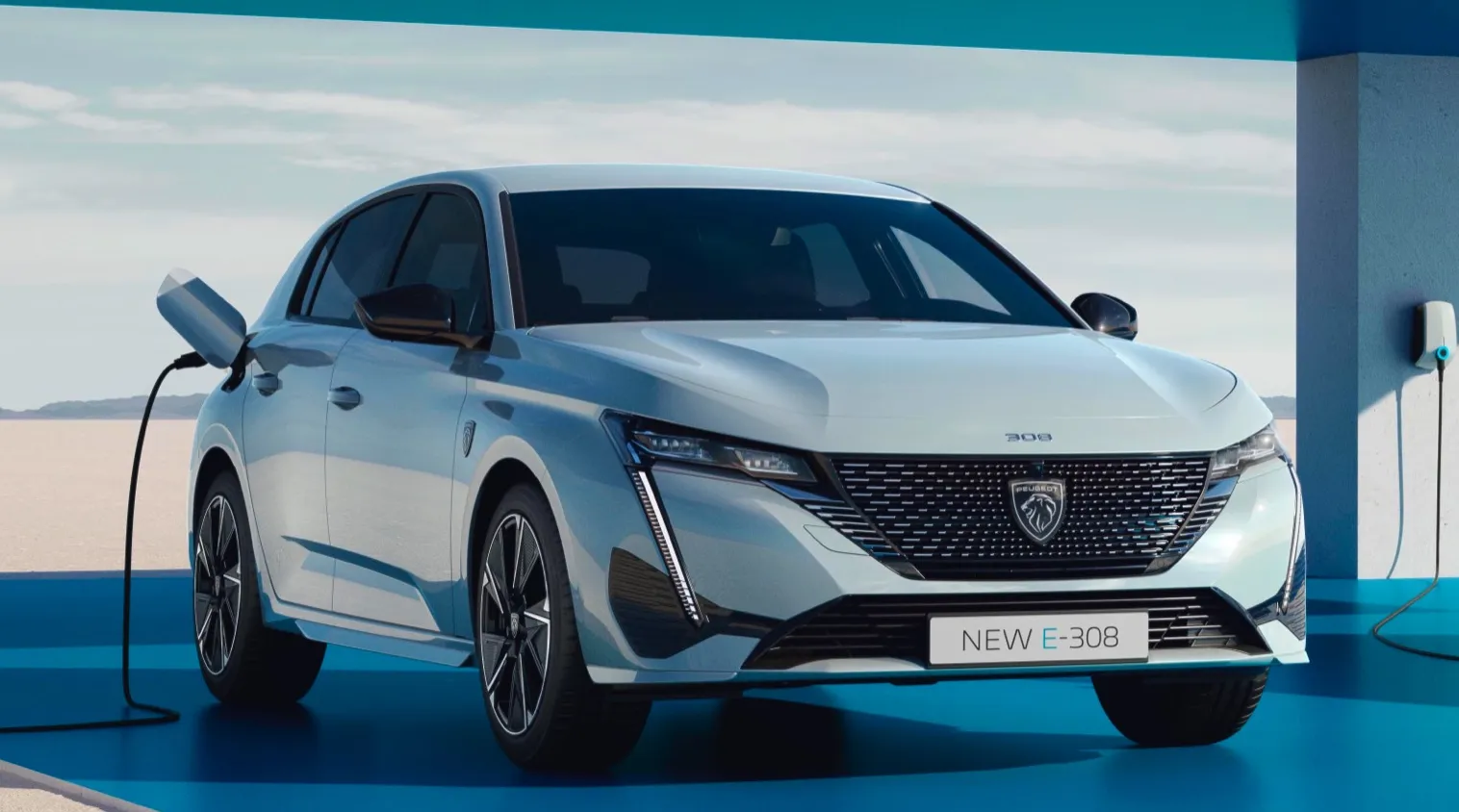
The Peugeot e-308 positions itself as a premium compact electric hatchback in the mainstream EV market, blending French design flair with efficient electric performance. Targeted at urban drivers and families seeking a stylish alternative to traditional hatchbacks, the e-308 appeals to those prioritizing refinement, technology, and zero-emission driving in the competitive C-segment. Built on Stellantis’ dedicated EV platform, it features a sleek silhouette with the iconic three-claw LED lights, illuminated Peugeot emblem, and a spacious 361L boot, making it a practical Peugeot electric hatchback for daily commutes and weekend getaways.
Key distinguishing features include the PEUGEOT i-Cockpit with a compact steering wheel, 10-inch HD touchscreen, and digital cluster, plus advanced driver aids like lane keep assist and adaptive speed control. Available in Allure, GT, and GT Premium trims, it offers heated seats, a heat pump for efficiency, and Vehicle-to-Load (V2L) capability. In the EV landscape, the Peugeot e-308 matters for elevating compact EVs with up to 281 miles WLTP range, competitive pricing, and seamless integration of Plug & Charge tech, challenging the dominance of Tesla and Korean rivals in EV specs and real-world usability. This e-308 review highlights its evolution into a segment leader for style-conscious buyers.
Peugeot e-308 Performance and Driving Experience
The Peugeot e-308 delivers smooth, responsive acceleration thanks to its 156 hp (115 kW) front-mounted electric motor producing 270 Nm of torque, achieving 0-60 mph in 9.8 seconds. Power delivery is instant and linear, with multi-mode selector (Eco, Normal, Sport) allowing tailored dynamics—Sport mode sharpens throttle response for spirited overtakes. As a front-wheel-drive (FWD) vehicle, it offers agile handling with a low center of gravity from the underfloor battery, providing composed cornering and minimal body roll on twisty roads. Real-world impressions praise its serene cabin, precise electric power steering, and refined ride, ideal for city maneuvering and motorway cruising, though top speed caps at 106 mph.
Specification
Value
0-60 mph (0-100 km/h)
9.8 sec
Top Speed
106 mph / 170 km/h
Power Output
156 hp / 115 kW
Torque
270 lb-ft / 365 Nm
Peugeot e-308 Range and Battery Specifications
Official Peugeot e-308 WLTP range reaches up to 281 miles, with most sources confirming 258-279 miles depending on trim and conditions, while EPA-equivalent real-world range hovers around 230-250 miles. The 58.4 kWh battery (55.4 kWh usable) employs NMC chemistry at 400V, delivering strong efficiency of about 160-180 Wh/mi. Factors like cold weather reduce range by 20-30% (mitigated by standard heat pump on GT Premium), aggressive driving, or highway loads; gentle urban styles maximize e-308 real-world range closer to WLTP figures. Peugeot e-308 battery specs emphasize longevity with an 8-year warranty, supporting its role as a reliable daily driver.
Range Metric
Value
WLTP Range
281 miles / 452 km
EPA Range
N/A (est. 250 miles)
Real-World Range
230-250 miles / 370-402 km
Battery Capacity
58.4 kWh (55.4 kWh usable)
Peugeot e-308 Charging Times and Options
The Peugeot e-308 supports versatile charging, with an 11 kW tri-phase onboard charger ideal for Level 2 home setups, fully replenishing from empty in about 5-6 hours at 11 kW. Level 1 (120V) suits overnight top-ups for short drives. DC fast charging peaks at up to 100 kW, achieving 20-80% in 30 minutes for road trips. Compatible with public networks via Plug & Charge and Mode 3 Type 2 cable, practical scenarios include daily home charging for 80-100 miles added overnight or rapid DC stops adding 150+ miles in half an hour. This makes the e-308 suited for mixed urban-highway use.
Charging Method
Time
Speed
Level 1 (120V)
24 hours
~1.4 kW
Level 2 (240V/7kW)
9 hours
~7 kW
Level 2 (240V/11kW)
5.5 hours
~11 kW
DC Fast Charge (10-80%)
30 min
up to 100 kW
Peugeot e-308 vs Competitors
In the Peugeot e-308 vs Tesla Model 3 matchup, the e-308 edges out with superior interior luxury and a lower price point, though the Model 3 offers longer range and AWD options. Compared to the Hyundai Ioniq 5, the e-308 provides a more premium cabin and hatchback practicality versus the Ioniq’s SUV stance and faster 350 kW charging, while matching similar e-308 comparison efficiency. Against the Kia EV6, it trades some acceleration for better ride comfort and French styling, positioning as a refined alternative in the compact EV segment.
Frequently Asked Questions
The Peugeot e-308 real-world range is typically 230-250 miles, depending on weather, speed, and load—colder climates or highways may drop it to 200 miles, while mild urban driving achieves near 258 WLTP figures.
Home Level 2 at 11 kW takes 5.5 hours for a full charge; DC fast charging (up to 100 kW) delivers 20-80% in 30 minutes, adding over 150 miles quickly.
The Peugeot e-308 is front-wheel-drive (FWD) only, prioritizing efficiency and agile handling over AWD traction for its compact hatchback design.
The PEUGEOT i-Cockpit features a compact steering wheel, 10-inch HD touchscreen, digital instrument panel, and customizable i-Toggles for intuitive control of navigation, modes, and connected services.
The e-308 offers a more upscale interior and 281-mile WLTP range at a lower cost than the Ioniq 5, but lags in charging speed (100 kW vs 350 kW) and SUV versatility.
Yes, the Peugeot e-308 excels with stylish design, 281-mile range, premium tech, and efficiency, though firmer ride and FWD-only may not suit all; pros include value and refinement, cons are moderate acceleration.> The Peugeot e-308 is a stylish compact electric hatchback from Peugeot with a 58.4 kWh battery, up to 281 miles WLTP range, and 156 hp power. It stands out with premium i-Cockpit tech, fast 100 kW charging, and French elegance, making it an ideal choice for efficient urban driving over Tesla Model 3 or Hyundai Ioniq 5 rivals.


 Peugeot
 Peugeot
 Peugeot
 Peugeot