

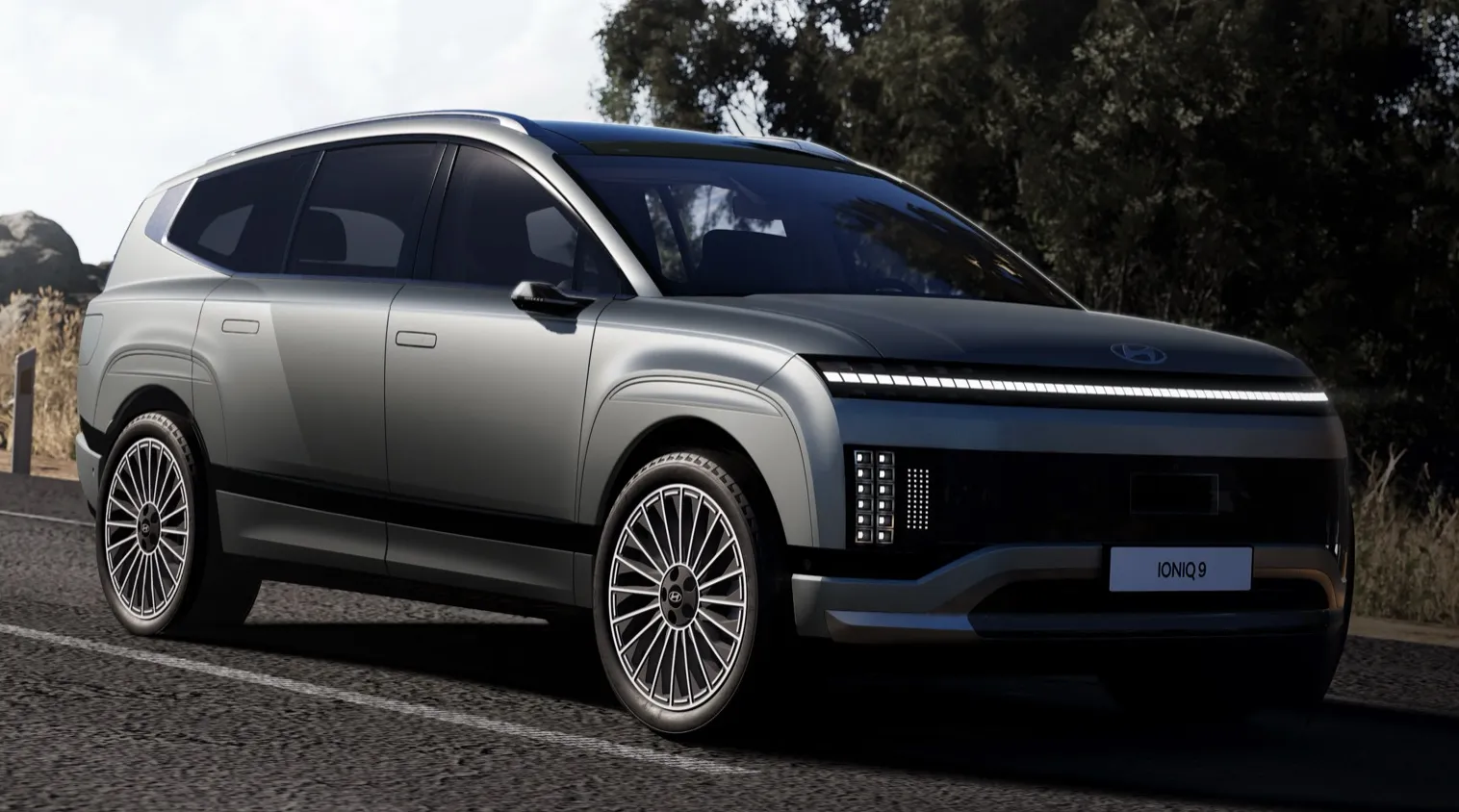
Hyundai IONIQ 9 Long Range AWD
Key Specifications
Real Range Estimation
| City - Cold Weather * | 480 km |
| Highway - Cold Weather * | 345 km |
| Combined - Cold Weather * | 410 km |
between 345 - 685 km
| City - Mild Weather * | 685 km |
| Highway - Mild Weather * | 435 km |
| Combined - Mild Weather * | 540 km |
Battery
| Nominal Capacity | 110.3 kWh |
| Battery Type | Lithium-ion |
| Number of Cells | No Data |
| Architecture | 800 V |
| Warranty Period | No Data |
| Warranty Mileage | No Data |
| Useable Capacity* | 106.0 kWh |
| Cathode Material | No Data |
| Pack Configuration | No Data |
| Nominal Voltage | No Data |
| Form Factor | No Data |
| Name / Reference | No Data |
Performance
| Acceleration 0 - 100 km/h | 6.7 sec |
| Top Speed * | 200 km/h |
| Electric Range * | 480 km |
| Total Power * | 230 kW (313 PS) |
| Total Torque * | 600 Nm |
| Drive | AWD |
Home and Destination Charging (0 -> 100%)
Charging is possible by using a regular wall plug or a charging station. Public charging is always done through a charging station. How fast the EV can charge depends on the charging station (EVSE) used and the maximum charging capacity of the EV. The table below shows all possible options for charging the Hyundai IONIQ 9 Long Range AWD. Each option shows how fast the battery can be charged from empty to full.
Europe
Charging an EV in Europe differs by country. Some European countries primarily use 1-phase connections to the grid, while other countries are almost exclusively using a 3-phase connection. The table below shows all possible ways the Hyundai IONIQ 9 Long Range AWD can be charged, but some modes of charging might not be widely available in certain countries.
| Type 2 (Mennekes - IEC 62196) |
|---|
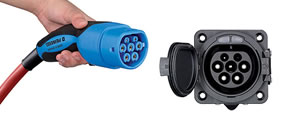 |
| Charging Point | Max. Power | Power | Time | Rate |
|---|---|---|---|---|
| Wall Plug (2.3 kW) | 230V / 1x10A | 2.3 kW | 54h15m | 9 km/h |
| 1-phase 16A (3.7 kW) | 230V / 1x16A | 3.7 kW | 33h45m | 14 km/h |
| 1-phase 32A (7.4 kW) | 230V / 1x32A | 7.4 kW | 17 hours | 28 km/h |
| 3-phase 16A (11 kW) | 400V / 3x16A | 11 kW | 11h30m | 42 km/h |
| 3-phase 32A (22 kW) | 400V / 3x16A | 11 kW † | 11h30m | 42 km/h |
† = Limited by on-board charger, vehicle cannot charge faster.
Fast Charging (10 -> 80%)
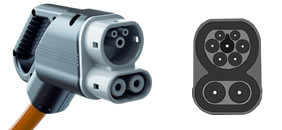
Rapid charging enables longer journeys by adding as much range as possible in the shortest amount of time. Charging power will decrease significantly after 80% state-of-charge has been reached. A typical rapid charge therefore rarely exceeds 80% SoC. The rapid charge rate of an EV depends on the charger used and the maximum charging power the EV can handle. The table below shows all details for rapid charging the Hyundai IONIQ 9 Long Range AWD.
Hyundai has not released details about rapid charging the IONIQ 9. The information below is based on estimated values of the most likely rapid charging capabilities.
- Max. Power: maximum power provided by charge point
- Avg. Power: average power provided by charge point over a session from 10% to 80%
- Time: time needed to charge from 10% to 80%
- Rate: average charging speed over a session from 10% to 80%
| Combined Charging System (CCS Combo 2) |
|---|
 |
| Charging Point | Max. Power | Avg. Power | Time | Rate |
|---|---|---|---|---|
| CCS (50 kW DC) | 50 kW | 50 kW | 94 min | 210 km/h |
| CCS (100 kW DC) | 100 kW | 95 kW † | 49 min | 410 km/h |
| CCS (150 kW DC) | 150 kW | 130 kW † | 36 min | 560 km/h |
| CCS (175 kW DC) | 175 kW | 145 kW † | 32 min | 630 km/h |
| CCS (350 kW DC) | 250 kW † | 195 kW † | 24 min | 840 km/h |
| This vehicle supports Autocharge |
|---|
† = Limited by charging capabilities of vehicle
Autocharge: allows for automatic initiation of a charging session at supported CCS charging stations.
Actual charging rates may differ from data shown due to factors like outside temperature, state of the battery and driving style.
Dimensions and Weight
| Length | 5060 mm |
| Width | 1980 mm |
| Width with mirrors | No Data |
| Height | 1790 mm |
| Wheelbase | 3130 mm |
| Weight Unladen (EU) * | 2700 kg |
| Gross Vehicle Weight (GVWR) | No Data |
| Max. Payload | No Data |
| Cargo Volume | 620 L |
| Cargo Volume Max | No Data |
| Cargo Volume Frunk | 52 L |
| Roof Load | No Data |
| Tow Hitch Possible | Yes |
| Towing Weight Unbraked | 750 kg |
| Towing Weight Braked | 2500 kg |
| Vertical Load Max | No Data |
About this Vehicle
Hyundai IONIQ 9 Overview
The Hyundai IONIQ 9 is a premium three-row electric SUV that redefines family transportation with its combination of advanced technology, exceptional range, and spacious interior. Built on Hyundai’s groundbreaking E-GMP architecture, the IONIQ 9 targets families and professionals seeking a practical yet performance-oriented electric vehicle that doesn’t compromise on comfort or capability. This electric SUV distinguishes itself through its innovative flat-floor design that maximizes interior space, a drag coefficient of just 0.259 Cd for superior efficiency, and multiple powertrain configurations to suit different driving preferences.
The IONIQ 9 represents a significant milestone in Hyundai’s electrification strategy, offering up to seven seats and the versatility of a traditional SUV with zero-emission driving. The vehicle’s E-GMP platform features an enhanced power electronics system with optimized gear ratios for hill climbing and a two-stage inverter for improved efficiency. With its robust body structure engineered for optimal collision protection and advanced safety systems, the IONIQ 9 delivers confidence-inspiring performance across all terrain types.
The Long-Range AWD variant specifically appeals to buyers who prioritize balanced performance and range without sacrificing practicality. This configuration makes the Hyundai IONIQ 9 Long Range AWD an ideal choice for families navigating diverse driving conditions, from daily commutes to extended road trips.
Hyundai IONIQ 9 Performance and Driving Experience
The IONIQ 9 Long Range AWD delivers responsive acceleration and refined driving dynamics through its dual-motor setup. The Long-Range AWD configuration pairs a 70 kW front motor with a 160 kW rear motor, generating 303 horsepower and 446 pound-feet of torque. This powertrain accelerates from 0-100 km/h in 6.7 seconds, providing confident passing performance with an 80-120 km/h acceleration time of 4.8 seconds.
The IONIQ 9’s intelligent all-wheel-drive system optimizes torque distribution for enhanced traction and stability. In trailer mode, the vehicle automatically detects trailer weight and adjusts range predictions accordingly, while maintaining a fixed 50:50 front-to-rear motor torque distribution for optimal performance. The vehicle features multiple drive modes—Eco, Normal, Sport, Snow, and My Mode—allowing drivers to customize their driving experience based on conditions and preferences.
| Specification | Value |
|---|---|
| 0-60 mph | 6.7 seconds (0-100 km/h) |
| Top Speed | 124 mph / 200 km/h |
| Power Output | 303 hp / 226.1 kW |
| Torque | 446 lb-ft / 605 Nm |
Hyundai IONIQ 9 Range and Battery Specifications
The IONIQ 9 Long Range AWD delivers impressive real-world range thanks to its 110.3 kWh NCM lithium-ion battery and aerodynamic design. The Long-Range AWD model achieves approximately 320 miles of EPA-estimated range, with WLTP estimates reaching up to 620 km for the RWD variant. Energy consumption efficiency reaches 194 Wh/km on the RWD model, demonstrating the platform’s exceptional optimization.
The floor-mounted battery in the IONIQ 9 provides consistent performance across various weather conditions. Hyundai’s advanced climate control system intelligently maintains an optimal interior temperature of 22°C while minimizing energy consumption, ensuring consistent driving range even in low temperatures. The pre-conditioning ventilation system allows drivers to warm up the cabin remotely before departure, further optimizing energy use and extending practical range.
| Range Metric | Value |
|---|---|
| EPA Range (Long-Range AWD) | 320 miles |
| WLTP Range (RWD) | 620 km |
| Real-World Range | 360-710 km |
| Battery Capacity | 110.3 kWh (usable) |
| Energy Efficiency | 194 Wh/km |
Hyundai IONIQ 9 Charging Times and Options
The IONIQ 9 supports rapid charging through its 800V ultra-fast charging system, enabling 10-80% recharge in just 24 minutes using a 350 kW charger. The vehicle includes Vehicle-to-Load (V2L) capability, allowing owners to power external devices directly from the battery. Home charging options accommodate various electrical setups, with Level 2 charging providing convenient overnight replenishment for daily driving needs.
The IONIQ 9’s on-board charger supports multiple charging scenarios, from standard 240V Level 2 home installations to public DC fast-charging networks. This flexibility makes the Hyundai IONIQ 9 Long Range AWD practical for both daily commuting and extended travel, with charging infrastructure compatibility across major networks.
| Charging Method | Time | Speed |
|---|---|---|
| Level 2 (240V) | ~10 hours | 10.9 kW |
| DC Fast Charge (10-80%) | 24 minutes | up to 350 kW |
| V2L Capability | Continuous | Variable |
Hyundai IONIQ 9 vs Competitors
The IONIQ 9 competes directly with the Tesla Model Y, BMW iX, and Mercedes EQS SUV in the premium electric SUV segment. Compared to the Tesla Model Y, the IONIQ 9 offers superior interior space with three rows and more competitive pricing, though the Model Y maintains a slight acceleration advantage. Against the BMW iX, the IONIQ 9 delivers better range efficiency and faster charging capabilities. The Mercedes EQS SUV provides comparable luxury features, but the IONIQ 9 offers more practical seating configurations and stronger value proposition for families prioritizing space and range.
Frequently Asked Questions
Related Vehicles
View All Hyundai
Hyundai Kona Electric 48.6 kWh 2026
 Hyundai
Hyundai Kona Electric 64.8 kWh 2026
 Hyundai
Hyundai INSTER Standard Range
 Hyundai