

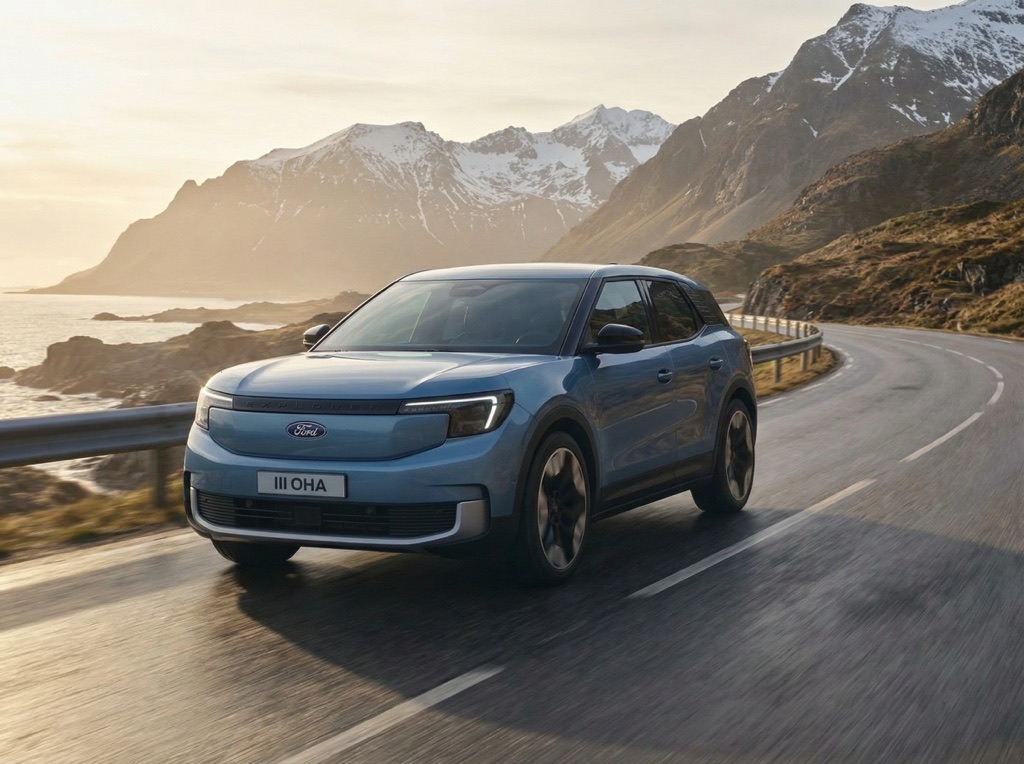
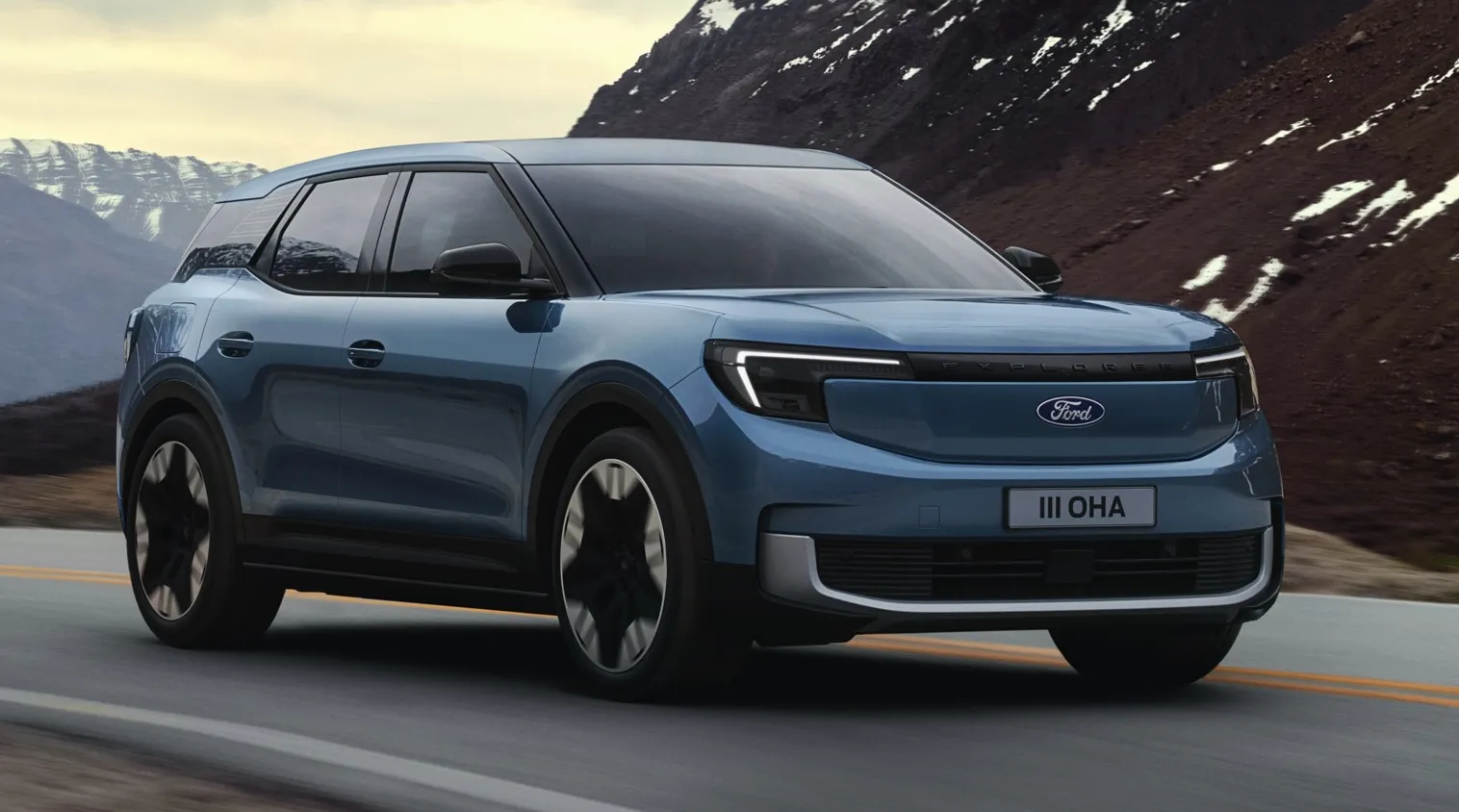
Ford Explorer Extended Range RWD 2026
Key Specifications
Real Range Estimation
| City - Cold Weather * | 440 km |
| Highway - Cold Weather * | 320 km |
| Combined - Cold Weather * | 380 km |
| City - Mild Weather * | 660 km |
| Highway - Mild Weather * | 410 km |
| Combined - Mild Weather * | 515 km |
Indication of real-world range in several situations. Cold weather: 'worst-case' based on -10°C and use of heating. Mild weather: 'best-case' based on 23°C and no use of A/C. For 'Highway' figures a constant speed of 110 km/h is assumed. The actual range will depend on speed, style of driving, weather and route conditions.
Battery
| Nominal Capacity | 84.0 kWh |
| Battery Type | Lithium-ion |
| Number of Cells | 288 |
| Architecture | 400 V |
| Warranty Period | 8 years |
| Warranty Mileage | 160,000 km |
| Useable Capacity | 79.0 kWh |
| Cathode Material | NMC |
| Pack Configuration | 96s3p |
| Nominal Voltage | 353 V |
| Form Factor | No Data |
| Name / Reference | No Data |
Performance
| Acceleration 0 - 100 km/h | 6.4 sec |
| Top Speed | 180 km/h |
| Electric Range * | 450 km |
| Total Power | 210 kW (286 PS) |
| Total Torque | 545 Nm |
| Drive | Rear |
Home and Destination Charging (0 -> 100%)
Charging is possible by using a regular wall plug or a charging station. Public charging is always done through a charging station. How fast the EV can charge depends on the charging station (EVSE) used and the maximum charging capacity of the EV. The table below shows all possible options for charging the Ford Explorer Extended Range RWD. Each option shows how fast the battery can be charged from empty to full.
Europe
Charging an EV in Europe differs by country. Some European countries primarily use 1-phase connections to the grid, while other countries are almost exclusively using a 3-phase connection. The table below shows all possible ways the Ford Explorer Extended Range RWD can be charged, but some modes of charging might not be widely available in certain countries.
Type 2 (Mennekes - IEC 62196)

| Charging Point | Max. Power | Power | Time | Rate |
|---|---|---|---|---|
| Wall Plug (2.3 kW) | 230V / 1x10A | 2.3 kW | 40h30m | 11 km/h |
| 1-phase 16A (3.7 kW) | 230V / 1x16A | 3.7 kW | 25h15m | 18 km/h |
| 1-phase 32A (7.4 kW) | 230V / 1x32A | 7.4 kW | 12h45m | 35 km/h |
| 3-phase 16A (11 kW) | 400V / 3x16A | 11 kW | 8h30m | 53 km/h |
| 3-phase 32A (22 kW) | 400V / 3x16A | 11 kW † | 8h30m | 53 km/h |
† = Limited by on-board charger, vehicle cannot charge faster.
Fast Charging (10 -> 80%)
Rapid charging enables longer journeys by adding as much range as possible in the shortest amount of time. Charging power will decrease significantly after 80% state-of-charge has been reached. A typical rapid charge therefore rarely exceeds 80% SoC. The rapid charge rate of an EV depends on the charger used and the maximum charging power the EV can handle. The table below shows all details for rapid charging the Ford Explorer Extended Range RWD.
- Max. Power: maximum power provided by charge point
- Avg. Power: average power provided by charge point over a session from 10% to 80%
- Time: time needed to charge from 10% to 80%
- Rate: average charging speed over a session from 10% to 80%
Combined Charging System (CCS Combo 2)

| Charging Point | Max. Power | Avg. Power | Time | Rate |
|---|---|---|---|---|
| CCS (50 kW DC) | 50 kW | 50 kW | 70 min | 270 km/h |
| CCS (150 kW DC) | 150 kW | 115 kW † | 30 min | 630 km/h |
| CCS (350 kW DC) | 185 kW † | 135 kW † | 26 min | 720 km/h |
| CCS (500 kW DC) | 185 kW † | 135 kW † | 26 min | 720 km/h |
This vehicle does not support Autocharge
This vehicle supports Plug & Charge
† = Limited by charging capabilities of vehicle
Autocharge: allows for automatic initiation of a charging session at supported CCS charging stations.
Plug & Charge: allows for automatic initiation of a charging session at supported CCS charging stations in accordance with ISO 15118.
Actual charging rates may differ from data shown due to factors like outside temperature, state of the battery and driving style.
Ford Claimed Specifications
The table below shows the claimed specifications from the manufacturer for charging the Ford Explorer Extended Range RWD. The specifications can differ from the table above for a variety of reasons. If real-world charge tests are available, these differences can be significant. If no real-world tests are available, the table above will be based on the manufacturer specifications as per the table below.
- Max. Power: maximum charge power during charging session
- Charge From: battery percentage (% SoC) where charging session is started
- Charge To: battery percentage (% SoC) where charging session is ended
- Time: time needed for charging session
Ford Claimed Specifications
| Max. Power | Charge From | Charge To | Time |
|---|---|---|---|
| 185 kW | No Data | No Data | No Data |
Dimensions and Weight
| Length | 4468 mm |
| Width | 1872 mm |
| Width with mirrors | 2063 mm |
| Height | 1632 mm |
| Wheelbase | 2767 mm |
| Weight Unladen (EU) | 2090 kg |
| Gross Vehicle Weight (GVWR) | 2675 kg |
| Max. Payload | 660 kg |
| Cargo Volume | 532 L |
| Cargo Volume Max | 1460 L |
| Cargo Volume Frunk | 0 L |
| Roof Load | 75 kg |
| Tow Hitch Possible | Yes |
| Towing Weight Unbraked | 750 kg |
| Towing Weight Braked | 1200 kg |
| Vertical Load Max | 75 kg |
About this Vehicle
Ford Explorer Extended Range RWD 2026 Overview
TheFord Explorer Extended Range RWDD 2026 positions itself as a premium electric SUV in Ford’s growing EV lineup, blending family-friendly practicality with advanced electric vehicle technology. Built on Ford’s dedicated EV platform, this rear-wheel-drive model targets families and adventure seekers who prioritize long-range capability, spacious interiors, and efficient performance over the gas-powered Explorer variants. With its EV specs including a robust battery and smooth electric powertrain, the Ford Explorer Extended Range RWD stands out in the electric vehicle range wars, offering up to 374 miles WLTP for extended road trips without range anxiety.
Key distinguishing features include a sleek SUV design with a 179.8-inch length, 450-liter trunk space, and seating for five, paired with Ford’s innovative software-defined architecture for over-the-air updates. This Ford Explorer review highlights its role in the EV landscape: as a bridge between mainstream crossovers like the Hyundai Ioniq 5 and luxury options like the BMW iX, it delivers American SUV toughness with zero-emission efficiency. In a market shifting to electrification, the Ford Explorer Extended Range RWD matters for its towing capacity up to 2646 lbs and real-world usability, making premium electric SUVs accessible for daily commutes and weekend getaways.
Ford Explorer Extended Range RWD 2026 Performance and Driving Experience
The Ford Explorer Extended Range RWD 2026 delivers responsive acceleration with instant torque, hitting 0-60 mph in 6.2 seconds thanks to its single rear electric motor. Power delivery is smooth and linear, ideal for highway merging and urban driving, while the rear-wheel-drive setup provides balanced handling with a low center of gravity from the battery placement. Real-world impressions emphasize composed dynamics, a 112 mph top speed, and a tight 31.8-foot turning circle, making it agile for its 4608-lb weight. The Terrain Management System enhances versatility on varied surfaces.
| Specification | Value |
|---|---|
| 0-60 mph (0-100 km/h) | 6.2 sec (6.4 sec) |
| Top Speed | 112 mph / 180 km/h |
| Power Output | 282 hp / 210 kW |
| Torque | 402 lb-ft / 545 Nm |
Ford Explorer Extended Range RWD 2026 Range and Battery Specifications
Official Ford Explorer Extended Range RWD WLTP range reaches 374 miles (602 km), though real-world estimates vary from 199-410 miles depending on conditions, with city cold-weather figures around 273 miles. The Ford Explorer’s real-world range shines in mild weather, achieving up to 410 miles on highways. Its 82 kWh battery (84 kWh nominal) uses advanced lithium-ion chemistry for efficiency at 22.4 kWh/100 miles. Factors like cold weather, aggressive driving, or hilly terrain can reduce range by 20-30%, but its 13.9 kWh/100 km consumption keeps it competitive among Ford Explorer battery specs.
| Range Metric | Value |
|---|---|
| WLTP Range | 374 miles / 602 km |
| EPA Range | Not specified |
| Real-World Range | 199-410 miles / 320-660 km |
| Battery Capacity | 82 kWh (usable) |
Ford Explorer Extended Range RWD 2026 Charging Times and Options
Home charging for the Ford Explorer Extended Range RWD is straightforward with its standard 11 kW AC onboard charger, fully replenishing from Level 2 in under 8 hours. DC fast charging peaks at 135 kW via CCS port (rear right), hitting 10-80% in about 28 minutes for quick road trips. It’s compatible with major networks like Electrify America, supporting practical scenarios like overnight garage top-ups or 200-mile adds in 20 minutes. Level 1 suits emergencies but takes longer.
| Charging Method | Time | Speed |
|---|---|---|
| Level 1 (120V) | 40+ hours | ~1.4 kW |
| Level 2 (240V/7kW) | ~12 hours | ~7 kW |
| Level 2 (240V/11kW) | ~7.5 hours | ~11 kW |
| DC Fast Charge (10-80%) | ~28 min | up to 135 kW |
Ford Explorer Extended Range RWD 2026 vs Competitors
In the Ford Explorer Extended Range RWD vs Tesla Model Y matchup, Ford edges out with superior towing (2646 lbs vs Model Y’s 3500 lbs max but less interior space) and a lower price point, though Tesla leads in supercharger access. Compared to the Hyundai Ioniq 5 and Kia EV6, the Ford offers longer WLTP range (374 miles vs Ioniq 5’s 303 miles) and more cargo room, but Korean rivals charge faster (350 kW peaks). The Ford Explorer comparison favors families needing three-row potential over sportier Audi Q4 e-tron dynamics.
Frequently Asked Questions
Pros: 374-mile range, 282 hp torque, family SUV space; cons: No frunk, moderate 135 kW charging. Excellent for long-haul EV adopters.> The 2026 Ford Explorer Extended Range RWD is Ford’s premium electric SUV with 282 hp, 402 lb-ft torque, and up to 374-mile WLTP range from its 82 kWh battery. It excels in family hauling with 450L cargo and 2646-lb towing, outpacing rivals like Ioniq 5 in endurance while delivering smooth RWD dynamics for everyday drives.
Related Vehicles
View All Ford
Ford
Ford Capri Extended Range AWD 2026
 Ford
Ford
Ford Capri Extended Range RWD 2026
 Ford
Ford
Ford Explorer Extended Range AWD
 Ford
Ford