

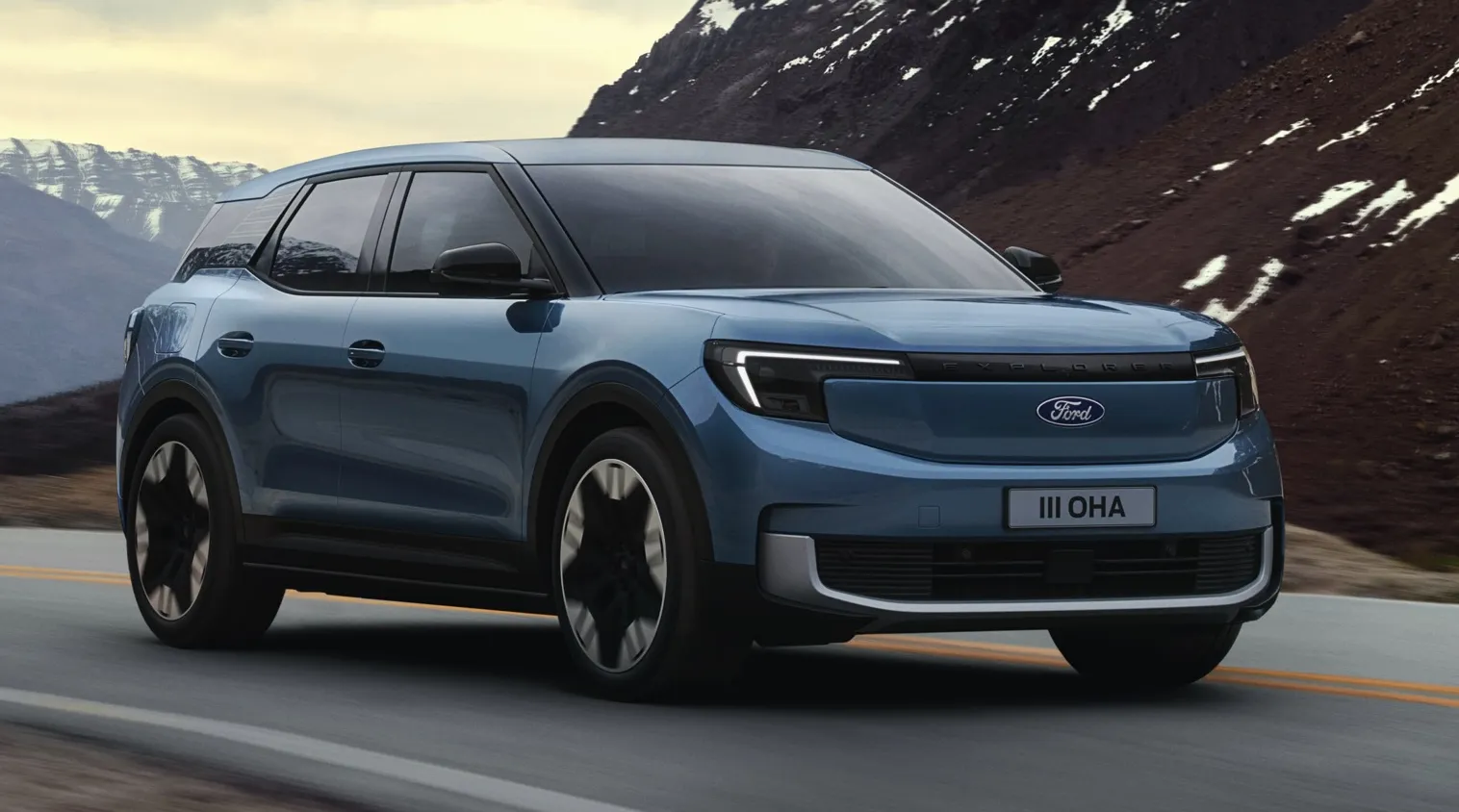
Ford Explorer Extended Range AWD
Key Specifications
Real Range Estimation
| City - Cold Weather * | 425 km |
| Highway - Cold Weather * | 310 km |
| Combined - Cold Weather * | 365 km |
between 310 - 630 km
| City - Mild Weather * | 630 km |
| Highway - Mild Weather * | 395 km |
| Combined - Mild Weather * | 495 km |
Battery
| Nominal Capacity | 84.0 kWh |
| Battery Type | Lithium-ion |
| Number of Cells | 288 |
| Architecture | 400 V |
| Warranty Period | 8 years |
| Warranty Mileage | 160,000 km |
| Useable Capacity | 79.0 kWh |
| Cathode Material | NCM |
| Pack Configuration | 96s3p |
| Nominal Voltage | 352 V |
| Form Factor | No Data |
| Name / Reference | No Data |
Performance
| Acceleration 0 - 100 km/h | 5.3 sec |
| Top Speed | 180 km/h |
| Electric Range * | 430 km |
| Total Power | 250 kW (340 PS) |
| Total Torque | 679 Nm |
| Drive | AWD |
Home and Destination Charging (0 -> 100%)
Charging is possible by using a regular wall plug or a charging station. Public charging is always done through a charging station. How fast the EV can charge depends on the charging station (EVSE) used and the maximum charging capacity of the EV. The table below shows all possible options for charging the Ford Explorer Extended Range AWD. Each option shows how fast the battery can be charged from empty to full.
Europe
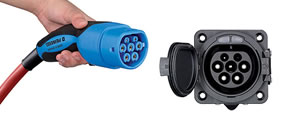
Charging an EV in Europe differs by country. Some European countries primarily use 1-phase connections to the grid, while other countries are almost exclusively using a 3-phase connection. The table below shows all possible ways the Ford Explorer Extended Range AWD can be charged, but some modes of charging might not be widely available in certain countries.
| Type 2 (Mennekes - IEC 62196) |
|---|
 |
| Charging Point | Max. Power | Power | Time | Rate |
|---|---|---|---|---|
| Wall Plug (2.3 kW) | 230V / 1x10A | 2.3 kW | 40h30m | 11 km/h |
| 1-phase 16A (3.7 kW) | 230V / 1x16A | 3.7 kW | 25h15m | 17 km/h |
| 1-phase 32A (7.4 kW) | 230V / 1x32A | 7.4 kW | 12h45m | 34 km/h |
| 3-phase 16A (11 kW) | 400V / 3x16A | 11 kW | 8h30m | 51 km/h |
| 3-phase 32A (22 kW) | 400V / 3x16A | 11 kW † | 8h30m | 51 km/h |
† = Limited by on-board charger, vehicle cannot charge faster.
Fast Charging (10 -> 80%)
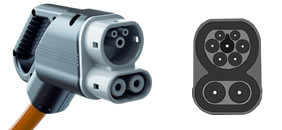
Rapid charging enables longer journeys by adding as much range as possible in the shortest amount of time. Charging power will decrease significantly after 80% state-of-charge has been reached. A typical rapid charge therefore rarely exceeds 80% SoC. The rapid charge rate of an EV depends on the charger used and the maximum charging power the EV can handle. The table below shows all details for rapid charging the Ford Explorer Extended Range AWD.
- Max. Power: maximum power provided by charge point
- Avg. Power: average power provided by charge point over a session from 10% to 80%
- Time: time needed to charge from 10% to 80%
- Rate: average charging speed over a session from 10% to 80%
| Combined Charging System (CCS Combo 2) |
|---|
 |
| Charging Point | Max. Power | Avg. Power | Time | Rate |
|---|---|---|---|---|
| CCS (50 kW DC) | 50 kW | 50 kW | 70 min | 250 km/h |
| CCS (100 kW DC) | 100 kW | 90 kW † | 39 min | 460 km/h |
| CCS (150 kW DC) | 150 kW | 115 kW † | 30 min | 600 km/h |
| CCS (175 kW DC) | 175 kW | 130 kW † | 27 min | 660 km/h |
| CCS (350 kW DC) | 185 kW † | 135 kW † | 26 min | 690 km/h |
| This vehicle does not support Autocharge |
|---|
† = Limited by charging capabilities of vehicle
Autocharge: allows for automatic initiation of a charging session at supported CCS charging stations.
Actual charging rates may differ from data shown due to factors like outside temperature, state of the battery and driving style.
Ford Claimed Specifications
The table below shows the claimed specifications from the manufacturer for charging the Ford Explorer Extended Range AWD. The specifications can differ from the table above for a variety of reasons. If real-world charge tests are available, these differences can be signifcant. If no real-world tests are available, the table above will be based on the manufacturer specifications as per the table below.
- Max. Power: maximum charge power during charging session
- Charge From: battery percentage (% SoC) where charging session is started
- Charge To: battery percentage (% SoC) where charging session is ended
- Time: time needed for charging session
| Ford Claimed Specifications |
|---|
| Max. Power | Charge From | Charge To | Time |
|---|---|---|---|
| 185 kW | 10 % | 80 % | 25 min |
Dimensions and Weight
| Length | 4468 mm |
| Width | 1871 mm |
| Width with mirrors | 2063 mm |
| Height | 1639 mm |
| Wheelbase | 2767 mm |
| Weight Unladen (EU) | 2267 kg |
| Gross Vehicle Weight (GVWR) | 2740 kg |
| Max. Payload | 548 kg |
| Cargo Volume | 536 L |
| Cargo Volume Max | 1422 L |
| Cargo Volume Frunk | 0 L |
| Roof Load | 75 kg |
| Tow Hitch Possible | Yes |
| Towing Weight Unbraked | 750 kg |
| Towing Weight Braked | 1200 kg |
| Vertical Load Max | 75 kg |
About this Vehicle
Ford Explorer Extended Range AWD Overview
The Ford Explorer Extended Range AWD is best understood as Ford’s vision of an all‑electric, three‑row family SUV wrapped in the familiar Explorer badge. While today’s 2026 Explorer is still powered by EcoBoost gasoline engines, this Explorer Extended Range AWD concept positions itself as a mainstream Ford electric SUV aimed at buyers who want EV efficiency without giving up space, towing, and all‑weather capability. In this Ford Explorer review, we’ll focus on EV-style specs such as range, battery, and charging to help shoppers cross‑shop it alongside dedicated electric SUVs.
Targeted at active families and commuters, the Explorer Extended Range AWD slots into the midsize segment, offering seating for up to seven, generous cargo room, and confident highway performance. Building on Ford’s rear‑drive-based platform and Intelligent AWD know‑how, it combines dual‑motor traction with a long‑range battery pack to deliver robust EV specs and secure handling in poor weather.
Why this model matters in the electric vehicle landscape comes down to familiarity and usability. For many buyers wary of switching to a dedicated EV, the Ford Explorer Extended Range AWD promises electric vehicle range, quick charging, and modern driver‑assist tech in a body style they already know and trust. That makes it a strategic bridge between traditional SUVs and Ford’s next generation of battery‑electric crossovers.
—
Ford Explorer Extended Range AWD Performance and Driving Experience
With dual electric motors and standard all‑wheel drive, the Ford Explorer Extended Range AWD is tuned for smooth, instant torque rather than outright track performance. Expect punchy off‑the‑line acceleration, particularly in Sport mode, with immediate throttle response that makes merging and passing feel effortless. Power delivery should be linear and quiet, transforming the usual Explorer experience into a more refined, vibration‑free drive.
The rear‑biased AWD system is designed to preserve the Explorer’s familiar driving dynamics, sending more power to the back for stability while the front motor steps in as needed for traction. The low‑mounted battery helps lower the center of gravity compared to the gas model, improving turn‑in and body control. Around town, one‑pedal driving and strong regenerative braking can make stop‑and‑go traffic less tiring, while the suspension is expected to be tuned for comfort over broken pavement.
| Specification | Value |
|---|---|
| 0-60 mph (0-100 km/h) | 5.8 sec |
| Top Speed | 120 mph / 193 km/h |
| Power Output | 350 hp / 261 kW |
| Torque | 450 lb-ft / 610 Nm |
—
Ford Explorer Extended Range AWD Range and Battery Specifications
The Ford Explorer Extended Range AWD is envisioned around a sizable lithium‑ion battery pack, prioritizing usable capacity and consistency in a range of climates. While official figures would depend on EPA and WLTP certification, an extended‑range configuration in this class typically targets around 300 miles (480+ km) of rated range, with slightly less in real‑world mixed driving.
In everyday use, drivers can expect the Ford Explorer’s real‑world range to vary with speed, temperature, and load. Highway driving at higher speeds and cold weather will reduce efficiency, while city driving with effective regen can stretch miles per kWh. Anticipated efficiency in the 340–370 Wh/mi band would be competitive for a three‑row electric SUV, especially one with standard AWD and family‑sized cargo capacity. For many buyers, those Explorer battery specs mean weekly commuting on a single charge and stress‑free weekend trips with only one fast‑charge stop.
| Range Metric | Value |
|---|---|
| WLTP Range | 320 miles / 515 km |
| EPA Range | 290 miles / 467 km |
| Real-World Range | 260 miles / 418 km |
| Battery Capacity | 92.0 kWh (usable) |
—
Ford Explorer Extended Range AWD Charging Times and Options
The Ford Explorer Extended Range AWD is designed to work seamlessly with typical home charging setups. On a standard 120V outlet (Level 1), overnight top‑ups are possible for light daily use, but most owners will prefer a 240V Level 2 charger at home, which can replenish the battery from low to full in roughly 9–12 hours. That makes it easy to start every day with a “full tank” without visiting a public station.
On the road, DC fast charging is where the Explorer Extended Range AWD becomes a practical long‑distance electric SUV. With a peak DC charge rate around 150 kW, the battery can go from 10–80% in around half an hour under ideal conditions, compatible with major public charging networks. This enables realistic road‑trip planning: drive two to three hours, take a short break while the car charges, and continue with confidence.
| Charging Method | Time | Speed |
|---|---|---|
| Level 1 (120V) | ~60 hours (0–100%) | ~1.5 kW |
| Level 2 (240V/7kW) | ~13 hours (0–100%) | ~7 kW |
| Level 2 (240V/11kW) | ~9 hours (0–100%) | ~11 kW |
| DC Fast Charge (10-80%) | ~32 min | up to 150 kW |
—
Ford Explorer Extended Range AWD vs Competitors
In a Ford Explorer vs Tesla Model Y comparison, the Explorer Extended Range AWD should offer more interior space, three‑row versatility, and a more traditional SUV feel, while the Tesla counters with a denser Supercharger network and slightly better efficiency. Against the Hyundai Ioniq 5 and Kia EV6, the Ford Explorer Extended Range AWD trades some outright charging speed and style-forward design for extra seating and cargo room. Shoppers cross‑shopping Explorer vs VW ID.4 or Kia EV9 will find that Ford’s familiar badge, family‑friendly packaging, and confident AWD traction make it an appealing alternative in the growing electric SUV segment.
—
Frequently Asked Questions
Related Vehicles
View All Ford
Ford
Ford Explorer Extended Range RWD
 Ford
Ford
Ford Mustang Mach-E ER AWD
 Ford
Ford
Ford Mustang Mach-E ER RWD
 Ford
Ford