

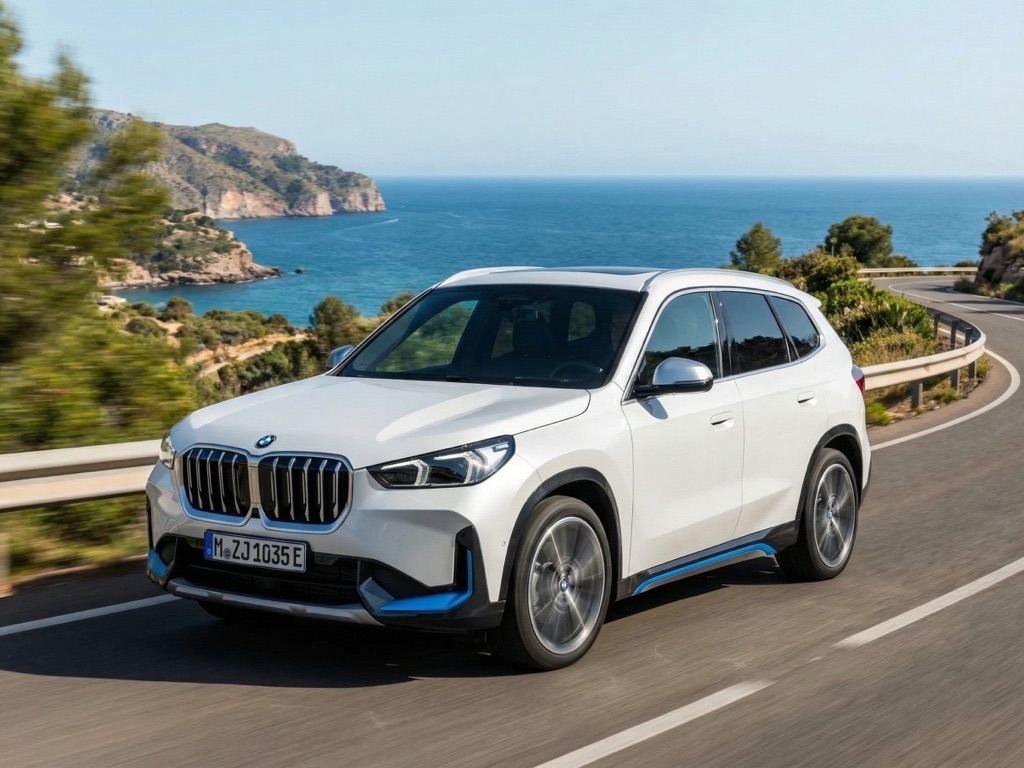
BMW iX1 xDrive30 2026
Key Specifications
Real Range Estimation
| City - Cold Weather * | 375 km |
| Highway - Cold Weather * | 280 km |
| Combined - Cold Weather * | 325 km |
| City - Mild Weather * | 570 km |
| Highway - Mild Weather * | 360 km |
| Combined - Mild Weather * | 450 km |
Battery
| Nominal Capacity | 66.5 kWh |
| Battery Type | Lithium-ion |
| Number of Cells | No Data |
| Architecture | 400 V |
| Warranty Period | 8 years |
| Warranty Mileage | 160,000 km |
| Useable Capacity | 65.2 kWh |
| Cathode Material | NMC811 |
| Pack Configuration | No Data |
| Nominal Voltage | 286 V |
| Form Factor | Prismatic |
| Name / Reference | No Data |
Performance
| Acceleration 0 - 100 km/h | 5.6 sec |
| Top Speed | 180 km/h |
| Electric Range * | 390 km |
| Total Power | 230 kW (313 PS) |
| Total Torque | 494 Nm |
| Drive | AWD |
Home and Destination Charging (0 -> 100%)
Charging is possible by using a regular wall plug or a charging station. Public charging is always done through a charging station. How fast the EV can charge depends on the charging station (EVSE) used and the maximum charging capacity of the EV. The table below shows all possible options for charging the BMW iX1 xDrive30. Each option shows how fast the battery can be charged from empty to full.
Europe
Charging an EV in Europe differs by country. Some European countries primarily use 1-phase connections to the grid, while other countries are almost exclusively using a 3-phase connection. The table below shows all possible ways the BMW iX1 xDrive30 can be charged, but some modes of charging might not be widely available in certain countries.
Type 2 (Mennekes - IEC 62196)

| Charging Point | Max. Power | Power | Time | Rate |
|---|---|---|---|---|
| Standard 11.0 kW On-Board Charger | ||||
| Wall Plug (2.3 kW) | 230V / 1x10A | 2.3 kW | 33h30m | 12 km/h |
| 1-phase 16A (3.7 kW) | 230V / 1x16A | 3.7 kW | 20h45m | 19 km/h |
| 1-phase 32A (7.4 kW) | 230V / 1x32A | 7.4 kW | 10h30m | 37 km/h |
| 3-phase 16A (11 kW) | 400V / 3x16A | 11 kW | 7 hours | 56 km/h |
| 3-phase 32A (22 kW) | 400V / 3x16A | 11 kW † | 7 hours | 56 km/h |
| Optional 22.0 kW On-Board Charger | ||||
| Wall Plug (2.3 kW) | 230V / 1x10A | 2.3 kW | 33h30m | 12 km/h |
| 1-phase 16A (3.7 kW) | 230V / 1x16A | 3.7 kW | 20h45m | 19 km/h |
| 1-phase 32A (7.4 kW) | 230V / 1x32A | 7.4 kW | 10h30m | 37 km/h |
| 3-phase 16A (11 kW) | 400V / 3x16A | 11 kW | 7 hours | 56 km/h |
| 3-phase 32A (22 kW) | 400V / 3x32A | 22 kW † | 3h30m | 110 km/h |
† = Limited by on-board charger, vehicle cannot charge faster.
Fast Charging (10 -> 80%)
Rapid charging enables longer journeys by adding as much range as possible in the shortest amount of time. Charging power will decrease significantly after 80% state-of-charge has been reached. A typical rapid charge therefore rarely exceeds 80% SoC. The rapid charge rate of an EV depends on the charger used and the maximum charging power the EV can handle. The table below shows all details for rapid charging the BMW iX1 xDrive30.
- Max. Power: maximum power provided by charge point
- Avg. Power: average power provided by charge point over a session from 10% to 80%
- Time: time needed to charge from 10% to 80%
- Rate: average charging speed over a session from 10% to 80%
Combined Charging System (CCS Combo 2)

| Charging Point | Max. Power | Avg. Power | Time | Rate |
|---|---|---|---|---|
| CCS (50 kW DC) | 50 kW | 40 kW † | 72 min | 220 km/h |
| CCS (150 kW DC) | 130 kW † | 95 kW † | 30 min | 540 km/h |
| CCS (350 kW DC) | 130 kW † | 95 kW † | 30 min | 540 km/h |
| CCS (500 kW DC) | 130 kW † | 95 kW † | 30 min | 540 km/h |
This vehicle supports Autocharge
This vehicle supports Plug & Charge
† = Limited by charging capabilities of vehicle
Autocharge: allows for automatic initiation of a charging session at supported CCS charging stations.
Plug & Charge: allows for automatic initiation of a charging session at supported CCS charging stations in accordance with ISO 15118.
Actual charging rates may differ from data shown due to factors like outside temperature, state of the battery and driving style.
BMW Claimed Specifications
The table below shows the claimed specifications from the manufacturer for charging the BMW iX1 xDrive30. The specifications can differ from the table above for a variety of reasons. If real-world charge tests are available, these differences can be significant. If no real-world tests are available, the table above will be based on the manufacturer specifications as per the table below.
- Max. Power: maximum charge power during charging session
- Charge From: battery percentage (% SoC) where charging session is started
- Charge To: battery percentage (% SoC) where charging session is ended
- Time: time needed for charging session
BMW Claimed Specifications
| Max. Power | Charge From | Charge To | Time |
|---|---|---|---|
| 130 kW | 10 % | 80 % | 29 min |
Dimensions and Weight
| Length | 4500 mm |
| Width | 1845 mm |
| Width with mirrors | 2104 mm |
| Height | 1616 mm |
| Wheelbase | 2692 mm |
| Weight Unladen (EU) | 2085 kg |
| Gross Vehicle Weight (GVWR) | 2580 kg |
| Max. Payload | 570 kg |
| Cargo Volume | 490 L |
| Cargo Volume Max | 1495 L |
| Cargo Volume Frunk | 0 L |
| Roof Load | 75 kg |
| Tow Hitch Possible | Yes |
| Towing Weight Unbraked | 750 kg |
| Towing Weight Braked | 1200 kg |
| Vertical Load Max | 75 kg |
About this Vehicle
BMW iX1 xDrive30 Overview
The BMW iX1 xDrive30 positions itself as a premium compact electric SUV, blending luxury, performance, and efficiency in the competitive EV market. As BMW’s entry into the subcompact electric SUV segment, it targets urban professionals and families seeking a sophisticated alternative to mainstream options like the Tesla Model Y. Built on BMW’s dedicated EV platform, the iX1 xDrive30 features dual electric motors for all-wheel drive, advanced Curved Display technology with a 10.3-inch driver display and 10.7-inch infotainment screen, and a minimalist interior with high-quality contrast stitching for a calm yet powerful atmosphere.
Key distinguishing features include progressive steering that adjusts based on speed, multiple drive modes (Personal, Sport, Efficient), and one-pedal driving via Regen on Accelerator Pedal with up to 134 kW regenerative power. In the EV landscape, the BMW iX1 xDrive30 matters for its sporty dynamics and premium build, offering a WLTP range of up to 440 km (274 miles) while upholding BMW’s driving heritage. This BMW electric SUV stands out in iX1 reviews for its black shadow line details, 19-inch alloy wheels, and adaptive LED headlights, making it a top choice for those prioritizing EV specs like refined handling and tech-forward design.
BMW iX1 xDrive30 Performance and Driving Experience
The BMW iX1 xDrive30 delivers spirited performance with its dual-motor all-wheel-drive (xDrive) system, providing instant torque for confident acceleration and superior traction in varied conditions. Progressive steering and drive modes like Sport enhance handling, offering dynamic throttle response and balanced dynamics for engaging drives. Real-world impressions highlight its stability on slippery roads via Electronic Stability Control, with optional features like Adaptive Cruise Control and Lane Centering Assist adding semi-autonomous comfort.
| Specification | Value |
|---|---|
| 0-60 mph (0-100 km/h) | 5.6 sec |
| Top Speed | 112 mph / 180 km/h |
| Power Output | 313 hp / 230 kW |
| Torque | 365 lb-ft / 494 Nm |
BMW iX1 xDrive30 Range and Battery Specifications
The BMW iX1 xDrive30 boasts a WLTP range of 417-440 km (259-274 miles), though real-world range typically falls to around 350-400 km depending on factors like cold weather, aggressive driving, or hilly terrain. Its battery employs advanced chemistry with new power electronics for the 2026 model year, improving efficiency to competitive levels. Energy consumption hovers efficiently, making it suitable for daily commutes and longer trips.
| Range Metric | Value |
|---|---|
| WLTP Range | 274 miles / 440 km |
| EPA Range | 259 miles / 417 km |
| Real-World Range | 217-249 miles / 350-400 km |
| Battery Capacity | 64.7 kWh (usable) |
BMW iX1 xDrive30 Charging Times and Options
Charging the BMW iX1 xDrive30 is straightforward with Level 2 home options for overnight top-ups and robust DC fast charging for road trips. It supports major networks, with peak speeds enabling quick 10-80% sessions. Practical scenarios include full charges via 11 kW AC for daily use or rapid DC stops, adding significant range in under 30 minutes.
| Charging Method | Time | Speed |
|---|---|---|
| Level 1 (120V) | 20+ hours | ~1.4 kW |
| Level 2 (240V/7kW) | 9-10 hours | ~7 kW |
| Level 2 (240V/11kW) | 6-7 hours | ~11 kW |
| DC Fast Charge (10-80%) | 29 min | up to 130 kW |
BMW iX1 xDrive30 vs Competitors
In the BMW iX1 xDrive30 vs Tesla Model Y matchup, the iX1 edges out with superior build quality and driving dynamics, though the Model Y offers longer range and lower pricing. Compared to the Hyundai Ioniq 5, the iX1 provides premium interior tech and AWD grip, while the Kia EV6 matches acceleration but lacks BMW’s refined steering. Overall, the iX1 excels in luxury segments against Audi Q4 e-tron.
Frequently Asked Questions
Yes, with pros like 313 hp punch, AWD stability, and advanced safety (AEB, ESC), cons include slightly shorter real-world range than rivals, but it’s excellent for premium EV SUV buyers.> The 2026 BMW iX1 xDrive30 is a premium compact electric SUV with 313 hp, AWD, and up to 274 miles WLTP range from its 64.7 kWh battery. It shines with sporty handling, Curved Display tech, and fast 130 kW charging, outpacing competitors in luxury dynamics for urban EV drivers.
Related Vehicles
View All BMW
BMW
BMW iX2 xDrive30 2026
 BMW
BMW
BMW iX1 eDrive20 2026
 BMW
BMW
BMW i5 M60 xDrive Touring
 BMW
BMW