Charging is possible by using a regular wall plug or a charging station. Public charging is always done through a charging station. How fast the EV can charge depends on the charging station (EVSE) used and the maximum charging capacity of the EV. The table below shows all possible options for charging the Jaguar I-Pace EV400. Each option shows how fast the battery can be charged from empty to full.
Europe
Charging an EV in Europe differs by country. Some European countries primarily use 1-phase connections to the grid, while other countries are almost exclusively using a 3-phase connection. The table below shows all possible ways the Jaguar I-Pace EV400 can be charged, but some modes of charging might not be widely available in certain countries.
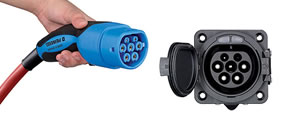
Type 2 (Mennekes - IEC 62196)
Charging Point
Max. Power
Power
Time
Rate
Wall Plug (2.3 kW)
230V / 1x10A
2.3 kW
43h30m
9 km/h
1-phase 16A (3.7 kW)
230V / 1x16A
3.7 kW
27 hours
14 km/h
1-phase 32A (7.4 kW)
230V / 1x32A
7.4 kW
13h30m
28 km/h
3-phase 16A (11 kW)
400V / 3x16A
11 kW
9h15m
41 km/h
3-phase 32A (22 kW)
400V / 3x16A
11 kW †
9h15m
41 km/h
† = Limited by on-board charger, vehicle cannot charge faster.
Fast Charging (10 -> 80%)
Rapid charging enables longer journeys by adding as much range as possible in the shortest amount of time. Charging power will decrease significantly after 80% state-of-charge has been reached. A typical rapid charge therefore rarely exceeds 80% SoC. The rapid charge rate of an EV depends on the charger used and the maximum charging power the EV can handle. The table below shows all details for rapid charging the Jaguar I-Pace EV400.
Max. Power: maximum power provided by charge point
Avg. Power: average power provided by charge point over a session from 10% to 80%
Time: time needed to charge from 10% to 80%
Rate: average charging speed over a session from 10% to 80%
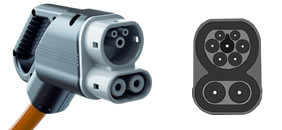
Combined Charging System (CCS Combo 2)
Charging Point
Max. Power
Avg. Power
Time
Rate
CCS (50 kW DC)
50 kW
50 kW
75 min
210 km/h
CCS (175 kW DC)
104 kW †
85 kW †
44 min
360 km/h
CCS (350 kW DC)
104 kW †
85 kW †
44 min
360 km/h
Charge Curve
Data made available by Fastned
This vehicle supports Autocharge
This vehicle does not support Plug & Charge
† = Limited by charging capabilities of vehicle
Autocharge: allows for automatic initiation of a charging session at supported CCS charging stations.
Plug & Charge: allows for automatic initiation of a charging session at supported CCS charging stations in accordance with ISO 15118.
Actual charging rates may differ from data shown due to factors like outside temperature, state of the battery and driving style.
Dimensions and Weight
Length
4682 mm
Width
2011 mm
Width with mirrors
2139 mm
Height
1566 mm
Wheelbase
2990 mm
Weight Unladen (EU)
2226 kg
Gross Vehicle Weight (GVWR)
2670 kg
Max. Payload
519 kg
Cargo Volume
505 L
Cargo Volume Max
1163 L
Cargo Volume Frunk
27 L
Roof Load
75 kg
Tow Hitch Possible
Yes
Towing Weight Unbraked
750 kg
Towing Weight Braked
750 kg
Vertical Load Max
45 kg
About this Vehicle
Jaguar I-Pace EV400 Overview
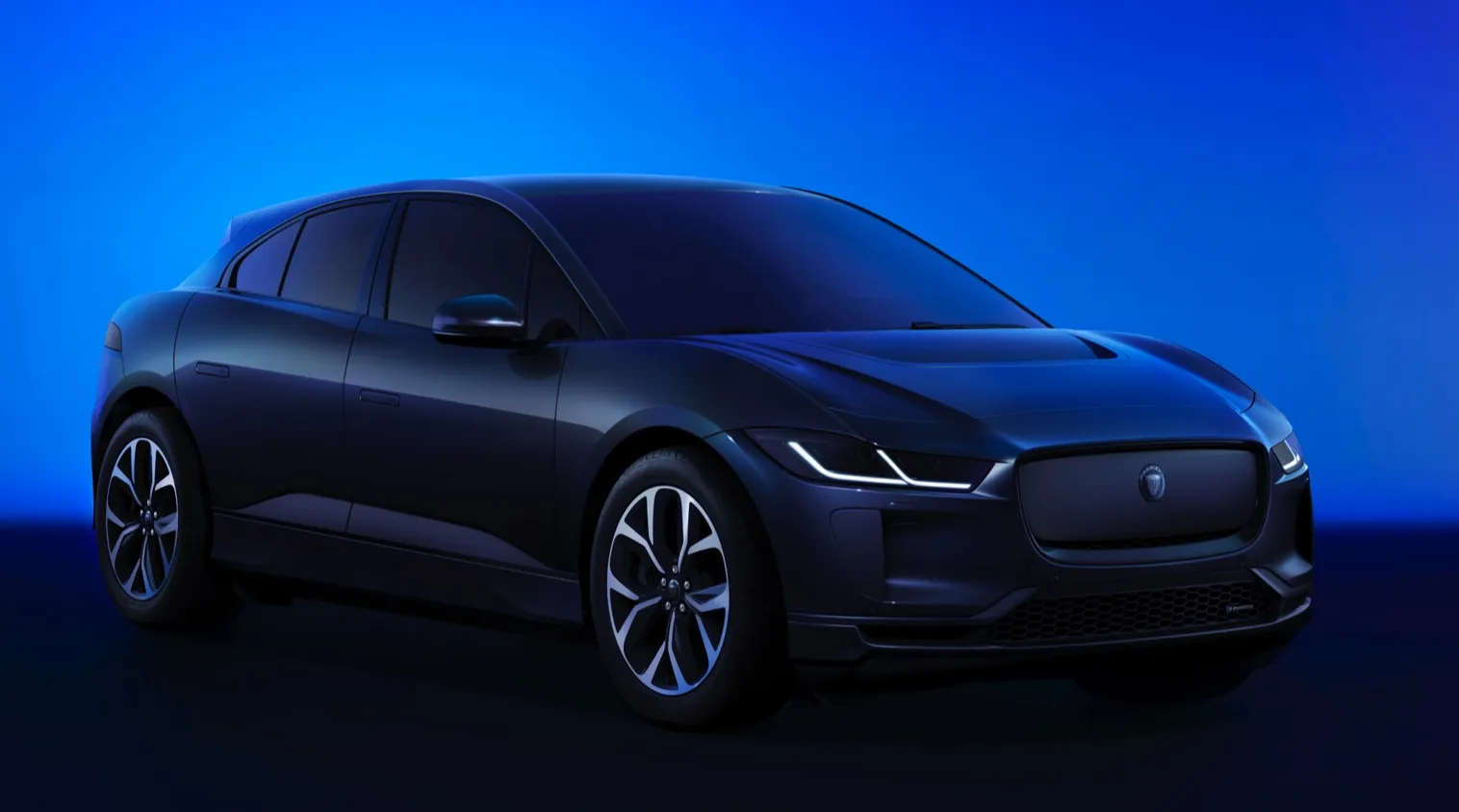
The Jaguar I-Pace EV400 stands as a premium electric SUV blending British luxury with athletic performance, positioning itself as a sophisticated alternative in the high-end EV market. Launched as Jaguar’s first all-electric vehicle, the I-Pace EV400 targets discerning drivers seeking a sporty crossover with distinctive design and zero-emissions capability. Built on the JLR PLA D7e platform—not a dedicated EV architecture but optimized for dynamic handling—this Jaguar electric SUV features a low-slung battery placement for a low center of gravity, bold styling with flush door handles, and a drag coefficient of 0.29 for efficiency.
Key distinguishing features include dual electric motors delivering all-wheel drive, a spacious cabin with 505 liters of trunk space expanding to 1163 liters, and advanced tech like a panoramic glass roof. In the evolving EV landscape, the I-Pace EV400 review highlights its relevance as a driver’s EV, prioritizing engagement over outright range, appealing to luxury buyers who value Jaguar’s heritage amid rivals pushing longer ranges. With EV specs like 394 hp and WLTP up to 292 miles, it remains a compelling choice for urban and highway cruising.
Jaguar I-Pace EV400 Performance and Driving Experience
The Jaguar I-Pace EV400 delivers thrilling acceleration with instant torque from its dual-motor AWD setup, hitting 0-60 mph in 4.5 seconds thanks to 394 hp and 513 lb-ft of torque through a single-speed gearbox. Handling shines with nimble dynamics, a balanced 53/47 weight distribution, and precise steering, making it one of the sportiest electric SUVs despite its 4868 lbs curb weight. Real-world impressions praise its responsive power delivery and stable cornering, ideal for twisty roads, though its 124 mph top speed caps high-speed thrills.
Specification
Value
0-60 mph (0-100 km/h)
4.5 sec (4.8 sec)
Top Speed
124 mph / 200 km/h
Power Output
394 hp / 294 kW
Torque
513 lb-ft / 696 Nm
Jaguar I-Pace EV400 Range and Battery Specifications
Official Jaguar I-Pace EV400 WLTP range reaches 292 miles (470 km TEL), dropping to 258 miles (415 km TEH) with heavier options, while EPA estimates 246 miles. Real-world range typically hits 250-280 miles in mixed conditions, influenced by cold weather (20-30% loss), aggressive driving, or highway speeds. The 90 kWh gross (84.7 kWh usable) lithium nickel manganese cobalt (NMC) battery offers efficiency around 35.4 Wh/mi (22 kWh/100 km) in ideal scenarios, with the underfloor placement enhancing stability.
I-Pace EV400 battery specs include minimal consumption of 22-25.2 kWh/100 km, making it efficient for its class, though terrain and climate play key roles—preconditioning mitigates winter dips.
Range Metric
Value
WLTP Range
292 miles / 470 km
EPA Range
246 miles / 396 km
Real-World Range
250-280 miles / 402-450 km
Battery Capacity
84.7 kWh (usable)
Jaguar I-Pace EV400 Charging Times and Options
Home charging for the Jaguar I-Pace EV400 is straightforward with its 11 kW onboard AC charger: Level 2 at 7 kW takes about 12 hours for a full charge, while 11 kW completes it in 8.6 hours overnight. DC fast charging peaks at 100 kW via CCS port, achieving 10-80% in around 44 minutes under optimal conditions, compatible with major networks. Practical scenarios favor workplace Level 2 for daily top-ups or public DC for road trips, though its 100 kW limit trails newer rivals.
Charging Method
Time
Speed
Level 1 (120V)
24+ hours
~1.4 kW
Level 2 (240V/7kW)
12 hours
~7 kW
Level 2 (240V/11kW)
8.6 hours
~11 kW
DC Fast Charge (10-80%)
44 min
up to 100 kW
Jaguar I-Pace EV400 vs Competitors
In the Jaguar I-Pace EV400 vs Tesla Model Y matchup, the I-Pace offers superior luxury and handling but lags in EPA range (246 vs 320 miles) and charging speed. Against the BMW iX, it undercuts on price ($72,500 MSRP) with similar power yet concedes ground in fast-charging (100 kW vs 195 kW) and interior tech. The Audi Q4 e-tron provides comparable AWD dynamics, but the I-Pace edges ahead in acceleration and style, making the I-Pace EV400 comparisons favor it for driving purists over efficiency-focused buyers.
Frequently Asked Questions
The Jaguar I-Pace EV400 real-world range averages 250-280 miles in mixed driving, dropping to 200-220 miles in winter or highway use, based on its 84.7 kWh usable battery and 35.4 Wh/mi efficiency.
Full AC home charging (11 kW Level 2) takes 8.6 hours; DC fast charging (100 kW) reaches 10-80% in 44 minutes, ideal for quick road-trip refills.
The I-Pace EV400 is exclusively AWD with dual motors (one per axle) producing 394 hp, ensuring excellent traction and dynamic handling across all conditions.
It features a 90 kWh gross (84.7 kWh usable) lithium nickel manganese cobalt (NMC) battery pack, floor-mounted for low center of gravity and WLTP efficiency of 22 kWh/100 km.
The I-Pace excels in luxury build and sporty dynamics with 4.5-second 0-60 mph, but trails Model Y in range (246 vs 320 EPA miles) and 250 kW charging.
Yes, for driving enthusiasts—pros include thrilling AWD performance, premium interior, and 292-mile WLTP range; cons are dated 100 kW charging and aging platform versus newer EVs.> The Jaguar I-Pace EV400 is a premium all-electric SUV from Jaguar delivering 394 hp AWD power, 246-mile EPA range, and 4.5-second 0-60 mph acceleration. Its sporty handling and luxury cabin make it ideal for dynamic drivers, with 100 kW DC charging for practical use. Despite rivals’ advances, the I-Pace remains a stylish EV benchmark.
1 / 10
We use cookies to improve your experience on our website. By browsing this website, you agree to our use of cookies. Learn more