

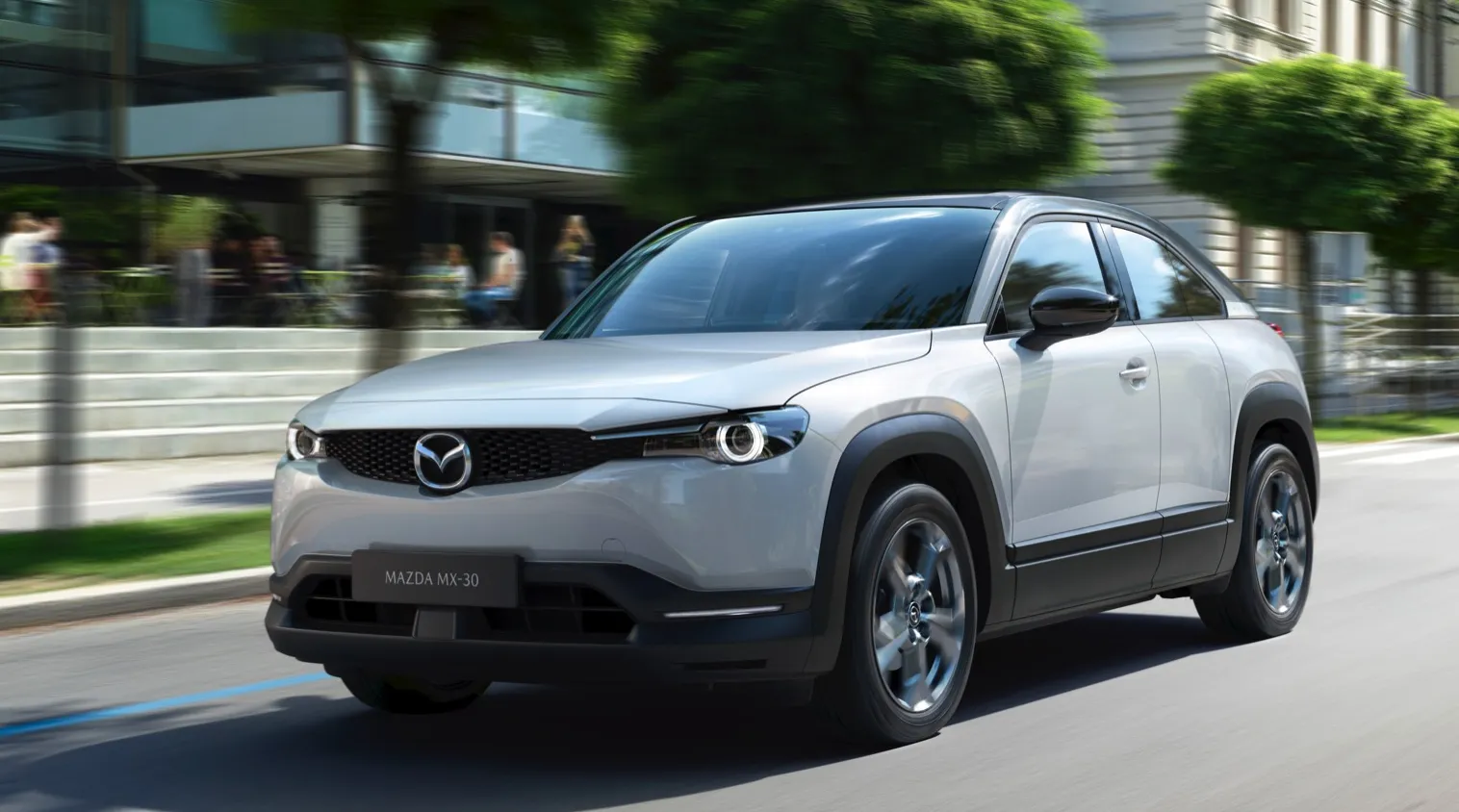
Mazda MX-30
Key Specifications
Real Range
| City - Cold Weather | 170 km |
| Highway - Cold Weather | 120 km |
| Combined - Cold Weather | 140 km |
between 120 - 250 km
| City - Mild Weather | 250 km |
| Highway - Mild Weather | 150 km |
| Combined - Mild Weather | 195 km |
Battery
| Nominal Capacity | 35.5 kWh |
| Battery Type | Lithium-ion |
| Number of Cells | No Data |
| Architecture | 400 V |
| Warranty Period | 8 years |
| Warranty Mileage | 160,000 km |
| Useable Capacity* | 30.0 kWh |
| Cathode Material | No Data |
| Pack Configuration | No Data |
| Nominal Voltage | No Data |
| Form Factor | No Data |
| Name / Reference | No Data |
Performance
| Acceleration 0 - 100 km/h | 9.7 sec |
| Top Speed | 140 km/h |
| Electric Range | 170 km |
| Total Power | 107 kW (145 PS) |
| Total Torque | 271 Nm |
| Drive | Front |
Home and Destination Charging (0 -> 100%)
Charging is possible by using a regular wall plug or a charging station. Public charging is always done through a charging station. How fast the EV can charge depends on the charging station (EVSE) used and the maximum charging capacity of the EV. The table below shows all possible options for charging the Mazda MX-30. Each option shows how fast the battery can be charged from empty to full.
Europe
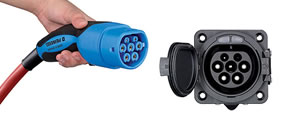
Charging an EV in Europe differs by country. Some European countries primarily use 1-phase connections to the grid, while other countries are almost exclusively using a 3-phase connection. The table below shows all possible ways the Mazda MX-30 can be charged, but some modes of charging might not be widely available in certain countries.
| Type 2 (Mennekes - IEC 62196) |
|---|
 |
| Charging Point | Max. Power | Power | Time | Rate |
|---|---|---|---|---|
| Wall Plug (2.3 kW) | 230V / 1x10A | 2.3 kW | 15h30m | 11 km/h |
| 1-phase 16A (3.7 kW) | 230V / 1x16A | 3.7 kW | 9h45m | 17 km/h |
| 1-phase 32A (7.4 kW) | 230V / 1x32A | 7.4 kW | 5 hours | 34 km/h |
| 3-phase 16A (11 kW) | 400V / 3x16A | 11 kW | 3h15m | 52 km/h |
| 3-phase 32A (22 kW) | 400V / 3x16A | 11 kW † | 3h15m | 52 km/h |
† = Limited by on-board charger, vehicle cannot charge faster.
Fast Charging (10 -> 80%)
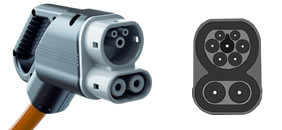
Rapid charging enables longer journeys by adding as much range as possible in the shortest amount of time. Charging power will decrease significantly after 80% state-of-charge has been reached. A typical rapid charge therefore rarely exceeds 80% SoC. The rapid charge rate of an EV depends on the charger used and the maximum charging power the EV can handle. The table below shows all details for rapid charging the Mazda MX-30.
- Max. Power: maximum power provided by charge point
- Avg. Power: average power provided by charge point over a session from 10% to 80%
- Time: time needed to charge from 10% to 80%
- Rate: average charging speed over a session from 10% to 80%
| Combined Charging System (CCS Combo 2) |
|---|
 |
| Charging Point | Max. Power | Avg. Power | Time | Rate |
|---|---|---|---|---|
| CCS (50 kW DC) | 45 kW † | 31 kW † | 43 min | 160 km/h |
| CCS (150 kW DC) | 54 kW † | 32 kW † | 41 min | 170 km/h |
| Charge Curve |
|---|
 |
Data made available by Fastned |
| This vehicle does not support Autocharge |
|---|
| This vehicle does not support Plug & Charge |
† = Limited by charging capabilities of vehicle
Autocharge: allows for automatic initiation of a charging session at supported CCS charging stations.
Plug & Charge: allows for automatic initiation of a charging session at supported CCS charging stations in accordance with ISO 15118.
Actual charging rates may differ from data shown due to factors like outside temperature, state of the battery and driving style.
Dimensions and Weight
| Length | 4395 mm |
| Width | 1848 mm |
| Width with mirrors | 2035 mm |
| Height | 1555 mm |
| Wheelbase | 2655 mm |
| Weight Unladen (EU) | 1720 kg |
| Gross Vehicle Weight (GVWR) | 2119 kg |
| Max. Payload | 474 kg |
| Cargo Volume | 366 L |
| Cargo Volume Max | 1171 L |
| Cargo Volume Frunk | 0 L |
| Roof Load | 75 kg |
| Tow Hitch Possible | No |
| Towing Weight Unbraked | 0 kg |
| Towing Weight Braked | 0 kg |
| Vertical Load Max | 0 kg |
About this Vehicle
# Mazda MX-30
Mazda MX-30 Overview
The Mazda MX-30 is a compact urban electric vehicle designed for city dwellers and daily commuters seeking an affordable entry into EV ownership. Positioned as a mainstream, budget-friendly option, the MX-30 targets environmentally conscious drivers who prioritize practicality over long-distance capability. This subcompact hatchback combines Mazda’s distinctive design philosophy with modern electric technology, featuring unique freestyle doors and a floating center console that emphasize openness and accessibility.
The Mazda MX-30 distinguishes itself through thoughtful interior design elements, including cork accents that pay homage to Mazda’s heritage as a cork manufacturer. Equipped with Mazda’s e-Skyactiv technology and a lithium-ion battery, the MX-30 represents a practical solution for urban mobility. The vehicle’s modern styling is distinctly Mazda, offering a refreshing alternative to more conventional electric vehicles in the compact segment.
Why the Mazda MX-30 matters in the EV landscape is its focus on urban practicality rather than highway performance. With standard features like heated front seats, a power moonroof, and comprehensive i-Activsense safety technology, the MX-30 delivers value-oriented electric driving for neighborhood commuting and city exploration.
Mazda MX-30 Performance and Driving Experience
The Mazda MX-30 delivers modest but adequate performance for urban driving scenarios. Its single electric motor produces 143 horsepower and 200 lb-ft of torque, enabling smooth acceleration through city streets. The front-wheel-drive configuration provides predictable handling characteristics, though all-wheel drive isn’t available. Real-world acceleration feels responsive for everyday driving, with the MX-30 reaching 60 mph in approximately 8.7 seconds according to independent testing.
Handling dynamics emphasize comfort over sportiness, making the Mazda MX-30 well-suited for urban environments where smooth, predictable performance matters more than aggressive acceleration. The vehicle’s compact dimensions and light steering make it easy to navigate congested streets and tight parking spaces.
| Specification | Value |
|---|---|
| 0-60 mph | 8.7 seconds |
| Top Speed | 91 mph |
| Power Output | 143 hp |
| Torque | 200 lb-ft |
Mazda MX-30 Range and Battery Specifications
The Mazda MX-30 features a 35.5 kWh lithium-ion battery pack that delivers an EPA-estimated range of 100 miles per full charge. Real-world testing shows highway driving at 75 mph returns approximately 76 MPGe, with actual range around 70 miles under those conditions. The MX-30’s efficiency rating of 92 MPGe combined is lower than competitors like the Hyundai Kona Electric and Chevrolet Bolt EV, which achieve 120+ MPGe combined.
The Mazda MX-30 battery capacity is intentionally modest, reflecting its urban-focused design philosophy. This approach keeps the vehicle lightweight and affordable while limiting long-distance capability. Weather conditions, driving style, and terrain significantly impact real-world range, with cold temperatures reducing efficiency more substantially than in larger battery packs.
| Range Metric | Value |
|---|---|
| EPA Range | 100 miles |
| Real-World Highway Range | 70 miles |
| Battery Capacity | 35.5 kWh |
| EPA Efficiency | 92 MPGe combined |
Mazda MX-30 Charging Times and Options
The Mazda MX-30 supports both standard AC charging and DC fast charging. Home charging via a Level 2 charger (240V, 6.6 kW onboard charger) requires approximately 5-6 hours for a full charge from empty. DC fast charging delivers 50 kW capability, achieving an 80% charge in roughly 25 minutes, making the MX-30 practical for quick top-ups during shopping trips or errands.
Standard Level 1 charging (120V household outlet) is available but impractical for regular use, requiring 24+ hours for a full charge. The Mazda MX-30 works with modern DC fast charging networks, though its modest battery capacity means charging sessions are relatively brief compared to larger EVs.
| Charging Method | Time | Speed |
|---|---|---|
| Level 1 (120V) | 24+ hours | ~1.4 kW |
| Level 2 (240V/6.6kW) | 5-6 hours | 6.6 kW |
| DC Fast Charge (10-80%) | 25 minutes | 50 kW |
Mazda MX-30 vs Competitors
The Mazda MX-30 competes directly with the Hyundai Kona Electric and Chevrolet Bolt EV in the affordable compact EV segment. However, the MX-30’s 100-mile EPA range significantly trails the Kona Electric (258 miles) and Bolt EV (259 miles), making it less suitable for drivers requiring longer range capability. The Mazda MX-30 compensates with superior interior design, standard premium features, and Mazda’s reputation for driving enjoyment. Pricing positions the MX-30 competitively, though its limited range restricts its appeal to urban commuters with predictable, short-distance driving patterns.