

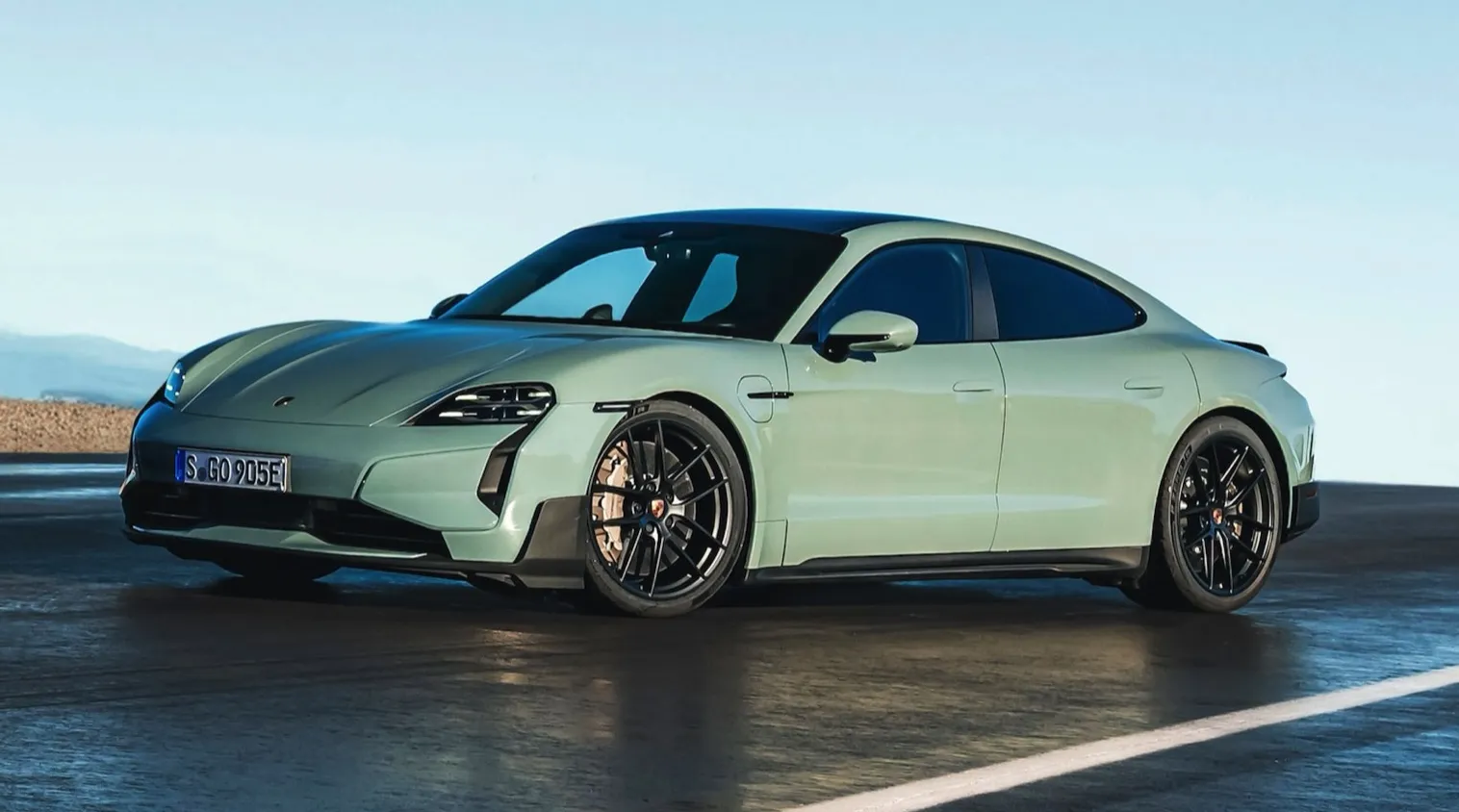
Porsche Taycan Turbo GT
Key Specifications
Real Range Estimation
| City - Cold Weather * | 465 km |
| Highway - Cold Weather * | 345 km |
| Combined - Cold Weather * | 405 km |
between 345 - 675 km
| City - Mild Weather * | 675 km |
| Highway - Mild Weather * | 440 km |
| Combined - Mild Weather * | 540 km |
Battery
| Nominal Capacity | 105.0 kWh |
| Battery Type | Lithium-ion |
| Number of Cells | 396 |
| Architecture | 800 V |
| Warranty Period | 8 years |
| Warranty Mileage | 160,000 km |
| Useable Capacity | 97.0 kWh |
| Cathode Material | NCM811 |
| Pack Configuration | 198s2p |
| Nominal Voltage | No Data |
| Form Factor | No Data |
| Name / Reference | No Data |
Performance
| Acceleration 0 - 100 km/h | 2.3 sec |
| Top Speed | 290 km/h |
| Electric Range * | 475 km |
| Total Power | 760 kW (1033 PS) |
| Total Torque | 1340 Nm |
| Drive | AWD |
Home and Destination Charging (0 -> 100%)
Charging is possible by using a regular wall plug or a charging station. Public charging is always done through a charging station. How fast the EV can charge depends on the charging station (EVSE) used and the maximum charging capacity of the EV. The table below shows all possible options for charging the Porsche Taycan Turbo GT. Each option shows how fast the battery can be charged from empty to full.
Europe
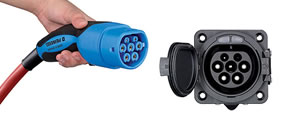
Charging an EV in Europe differs by country. Some European countries primarily use 1-phase connections to the grid, while other countries are almost exclusively using a 3-phase connection. The table below shows all possible ways the Porsche Taycan Turbo GT can be charged, but some modes of charging might not be widely available in certain countries.
| Type 2 (Mennekes - IEC 62196) |
|---|
 |
| Charging Point | Max. Power | Power | Time | Rate |
|---|---|---|---|---|
| Standard 11.0 kW On-Board Charger | ||||
| Wall Plug (2.3 kW) | 230V / 1x10A | 2.3 kW | 49h45m | 10 km/h |
| 1-phase 16A (3.7 kW) | 230V / 1x16A | 3.7 kW | 31 hours | 15 km/h |
| 1-phase 32A (7.4 kW) | 230V / 1x32A | 7.4 kW | 15h30m | 31 km/h |
| 3-phase 16A (11 kW) | 400V / 3x16A | 11 kW | 10h30m | 45 km/h |
| 3-phase 32A (22 kW) | 400V / 3x16A | 11 kW † | 10h30m | 45 km/h |
| Optional 22.0kW On-Board Charger | ||||
| Wall Plug (2.3 kW) | 230V / 1x10A | 2.3 kW | 49h45m | 10 km/h |
| 1-phase 16A (3.7 kW) | 230V / 1x16A | 3.7 kW | 31 hours | 15 km/h |
| 1-phase 32A (7.4 kW) | 230V / 1x32A | 7.4 kW | 15h30m | 31 km/h |
| 3-phase 16A (11 kW) | 400V / 3x16A | 11 kW | 10h30m | 45 km/h |
| 3-phase 32A (22 kW) | 400V / 3x32A | 22 kW † | 5h15m | 90 km/h |
† = Limited by on-board charger, vehicle cannot charge faster.
Fast Charging (10 -> 80%)
Rapid charging enables longer journeys by adding as much range as possible in the shortest amount of time. Charging power will decrease significantly after 80% state-of-charge has been reached. A typical rapid charge therefore rarely exceeds 80% SoC. The rapid charge rate of an EV depends on the charger used and the maximum charging power the EV can handle. The table below shows all details for rapid charging the Porsche Taycan Turbo GT.
- Max. Power: maximum power provided by charge point
- Avg. Power: average power provided by charge point over a session from 10% to 80%
- Time: time needed to charge from 10% to 80%
- Rate: average charging speed over a session from 10% to 80%
| Combined Charging System (CCS Combo 2) |
|---|
 |
| Charging Point | Max. Power | Avg. Power | Time | Rate |
|---|---|---|---|---|
| CCS (50 kW DC) | 50 kW | 50 kW | 86 min | 230 km/h |
| CCS (100 kW DC) | 100 kW | 95 kW † | 45 min | 440 km/h |
| CCS (150 kW DC) | 150 kW | 130 kW † | 33 min | 600 km/h |
| CCS (175 kW DC) | 175 kW | 150 kW † | 29 min | 680 km/h |
| CCS (350 kW DC) | 320 kW † | 240 kW † | 18 min | 1100 km/h |
| This vehicle supports Autocharge |
|---|
| This vehicle supports Plug & Charge |
† = Limited by charging capabilities of vehicle
Autocharge: allows for automatic initiation of a charging session at supported CCS charging stations.
Plug & Charge: allows for automatic initiation of a charging session at supported CCS charging stations in accordance with ISO 15118.
Actual charging rates may differ from data shown due to factors like outside temperature, state of the battery and driving style.
Porsche Claimed Specifications
The table below shows the claimed specifications from the manufacturer for charging the Porsche Taycan Turbo GT. The specifications can differ from the table above for a variety of reasons. If real-world charge tests are available, these differences can be signifcant. If no real-world tests are available, the table above will be based on the manufacturer specifications as per the table below.
- Max. Power: maximum charge power during charging session
- Charge From: battery percentage (% SoC) where charging session is started
- Charge To: battery percentage (% SoC) where charging session is ended
- Time: time needed for charging session
| Porsche Claimed Specifications |
|---|
| Max. Power | Charge From | Charge To | Time |
|---|---|---|---|
| 320 kW | 10 % | 80 % | 18 min |
Dimensions and Weight
| Length | 4968 mm |
| Width | 1966 mm |
| Width with mirrors | 2144 mm |
| Height | 1378 mm |
| Wheelbase | 2900 mm |
| Weight Unladen (EU) | 2365 kg |
| Gross Vehicle Weight (GVWR) | 2710 kg |
| Max. Payload | 420 kg |
| Cargo Volume | 326 L |
| Cargo Volume Max | No Data |
| Cargo Volume Frunk | 84 L |
| Roof Load | 75 kg |
| Tow Hitch Possible | No |
| Towing Weight Unbraked | 0 kg |
| Towing Weight Braked | 0 kg |
| Vertical Load Max | 0 kg |
About this Vehicle
Porsche Taycan Turbo GT Overview
The Porsche Taycan Turbo GT stands as the pinnacle of premium electric sedans, delivering uncompromised performance in the high-end EV market. Positioned as Porsche’s ultimate electric vehicle, this four-door powerhouse targets affluent enthusiasts seeking track-ready dynamics blended with everyday luxury. With its aggressive aerodynamics, including a unique front splitter and active rear spoiler, the Taycan Turbo GT embodies Porsche’s design philosophy of precision engineering and motorsport heritage on the Porsche electric sedan platform.
What sets the Taycan Turbo GT apart are its advanced dual-motor AWD system, upgraded rear motor, enhanced cooling, and software tweaks for 2025, pushing boundaries in the EV specs arena. In the evolving EV landscape, it matters as Porsche’s statement against hypercars like the Tesla Model S Plaid, proving electric vehicles can lap the Nürburgring faster while offering refined road manners. For Taycan Turbo GT review seekers, it’s the benchmark for blending electric vehicle range, brutal acceleration, and Porsche poise.
Porsche Taycan Turbo GT Performance and Driving Experience
The Porsche Taycan Turbo GT unleashes 1,019 horsepower and 914 lb-ft of torque via its dual permanent-magnet synchronous AC motors, with a 900-amp rear inverter enabling 10-second power bursts in Launch Control. Acceleration is otherworldly, shattering 0-60 mph in as little as 1.9 seconds, with quarter-mile times around 9.2 seconds at 152 mph. Handling shines through active aerodynamics, precise steering, and exceptional body control, pulling 1.11 g on the skidpad even in Sport Plus mode. The AWD system, with direct-drive front and two-speed rear transmission, provides confident grip on sweeping roads or tracks, feeling composed yet exhilarating.
Real-world impressions highlight linear throttle response, comfortable ride quality despite track prowess, and Attack Mode for on-demand surges. It’s a driver’s car that rewards skill without punishing daily use.
| Specification | Value |
|---|---|
| 0-60 mph (0-100 km/h) | 1.9-2.2 sec |
| Top Speed | 180-190 mph / 290 km/h |
| Power Output | 1,019 hp / 760 kW |
| Torque | 914 lb-ft / 1,234 Nm |
Porsche Taycan Turbo GT Range and Battery Specifications
The Porsche Taycan Turbo GT boasts an EPA range of up to 276 miles, with real-world figures around 250-270 miles depending on conditions, thanks to its 97 kWh usable liquid-cooled lithium-ion battery (105 kWh gross in some configs). Efficiency hits 81 MPGe combined, or about 41 kWh/100 miles, bolstered by 30% improved regen braking up to 400 kW. Taycan Turbo GT WLTP range equivalents reach 475 km in ideal tests, but real-world range dips in cold weather, aggressive driving, or on highways.
Battery tech includes enhanced cooling for sustained track performance, where temps rise from 57°F to 144°F without thermal limits. Factors like terrain and style significantly impact Taycan Turbo GT battery specs, making it efficient for a 5,000-lb beast.
| Range Metric | Value |
|---|---|
| WLTP Range | 295 miles / 475 km |
| EPA Range | 276 miles / 444 km |
| Real-World Range | 250-270 miles / 400-435 km |
| Battery Capacity | 97 kWh (usable) |
Porsche Taycan Turbo GT Charging Times and Options
Charging the Porsche Taycan Turbo GT is blisteringly quick, peaking at 320 kW DC for 10-80% in just 18 minutes, compatible with major networks like Electrify America. Home options include an 11 kW onboard charger for Level 2, fully replenishing from empty in under 10 hours. Level 1 suits overnight top-ups for short drives.
Practical scenarios shine: add 200+ miles in 20 minutes on road trips, with improved software ensuring consistent speeds. It’s a game-changer for high-performance EV ownership.
| Charging Method | Time | Speed |
|---|---|---|
| Level 1 (120V) | 30+ hours | ~1.4 kW |
| Level 2 (240V/7kW) | 14 hours | ~7 kW |
| Level 2 (240V/11kW) | 9 hours | 11 kW |
| DC Fast Charge (10-80%) | 18 min | up to 320 kW |
Porsche Taycan Turbo GT vs Competitors
The Porsche Taycan Turbo GT outpaces the Tesla Model S Plaid (1,020 hp) with a 1.9-second 0-60 and superior handling, while edging the Lucid Air Sapphire (1,234 hp) in track times thanks to better aero and tires. Against the BMW i5 M60, it dominates in power and charging speed, though the Hyundai Ioniq 5 offers better value. In Taycan Turbo GT vs Tesla Model Y or Porsche Taycan comparison debates, its precision and build quality reign supreme for enthusiasts.
Frequently Asked Questions
Related Vehicles
View All Porsche
Porsche Taycan
 Porsche
Porsche Taycan 4 Plus
 Porsche
Porsche Macan 4 Electric
 Porsche