

Introduction: A Defining Moment for the Global Auto Industry
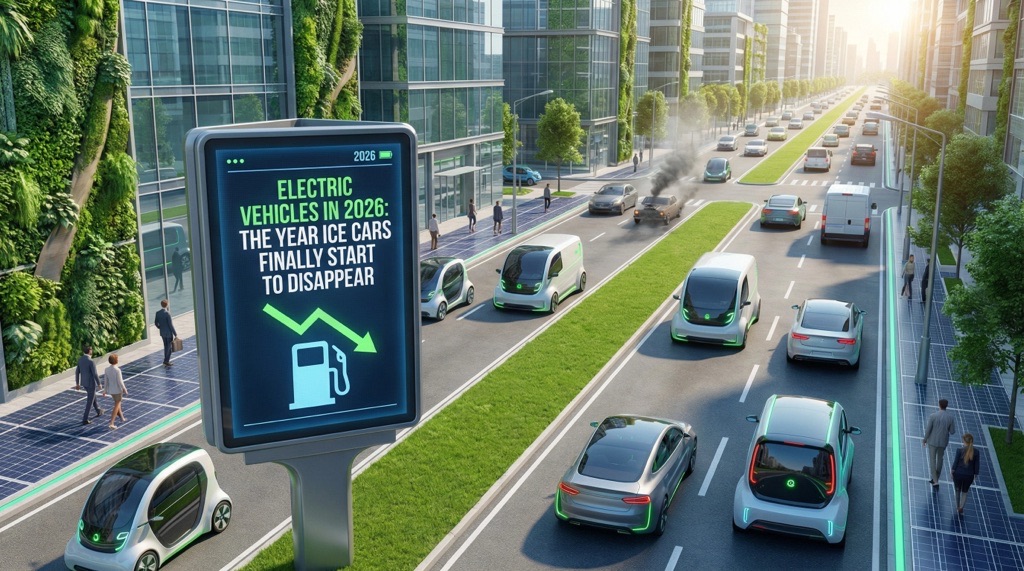
The year 2026 will be remembered as the moment when electric vehicles stopped being an alternative and became the default direction of the global car market. Internal combustion engine (ICE) cars will not vanish overnight, but their decline will become clearly visible — in sales data, model lineups, infrastructure investment, and consumer behavior.
This shift is not being driven primarily by regulation or ideology. Instead, it is the result of technological superiority, improving affordability, and real-world user experience. Electric vehicles in 2026 will charge faster, cost less to own, and offer better daily usability than comparable petrol or diesel cars. For the first time, EVs will win on logic, not just on vision.
Why 2026 Changes Everything for Electric Vehicles
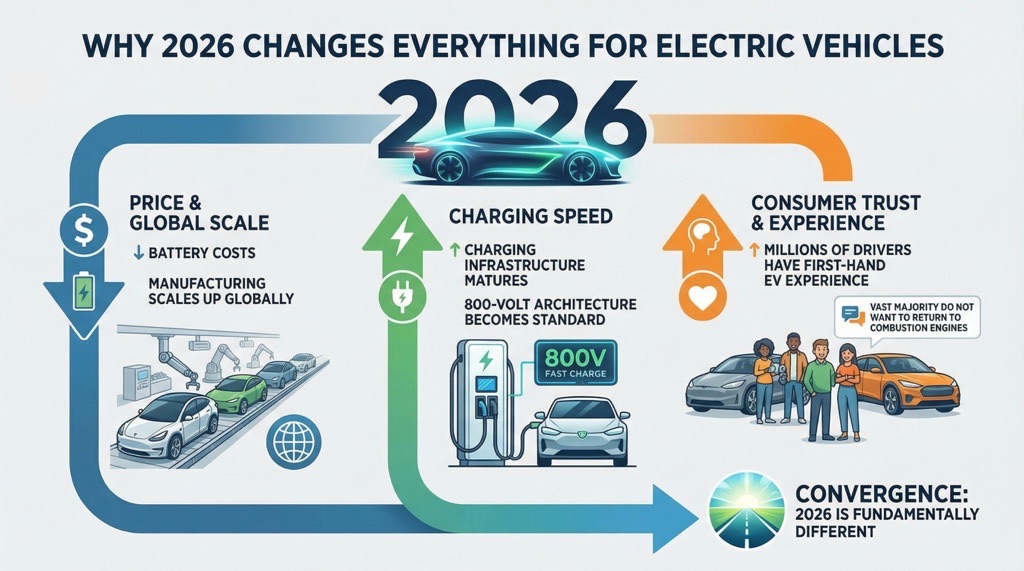
Electric vehicles have existed for more than a decade in modern form, yet mass adoption has been slowed by three persistent barriers: price, charging speed, and consumer trust. By 2026, all three are being dismantled simultaneously.
Battery costs continue to fall, while manufacturing scales up globally. Charging infrastructure is maturing, with 800-volt architectures becoming standard rather than exotic. At the same time, millions of drivers now have first-hand EV experience — and the vast majority do not want to return to combustion engines.
This convergence makes 2026 fundamentally different from any previous year.
Charging Speed Reaches a Psychological Breakthrough
One of the strongest arguments against EVs has always been charging time. In 2026, that argument loses much of its power.
Thanks to widespread adoption of 800V platforms, many new electric vehicles can now charge from 10 to 80 percent in 12–20 minutes under optimal conditions. This brings real-world charging times close enough to traditional refueling that the difference becomes irrelevant for most users.
Manufacturers such as Hyundai, Kia, Porsche, and BYD are heavily investing in high-rate charging batteries and thermal management systems that maintain fast charging even beyond 50 percent state of charge.
For long-distance travel, EVs in 2026 are no longer an inconvenience — they are simply different, and increasingly competitive.

Affordable EVs Finally Go Mainstream
Perhaps the most important shift in 2026 is price accessibility. The long-promised affordable electric car finally arrives in meaningful volume.
Multiple manufacturers are launching EVs priced between €20,000 and €30,000, without positioning them as compromises. These vehicles are designed from the ground up as electric cars, not adapted ICE platforms.
Brands such as Volkswagen, Renault, Dacia, and Skoda are targeting high-volume European segments where small and compact cars dominate. At these price points, the total cost of ownership often undercuts ICE vehicles within just a few years.
Once EVs become cheaper not only to run, but also to buy, the rationale for choosing combustion engines begins to collapse.
German Automakers Commit Fully to Electric
Germany, long associated with combustion engineering, is now one of the strongest indicators of ICE decline. Electric vehicles already account for a rapidly growing share of new registrations, and 2026 accelerates this trend.
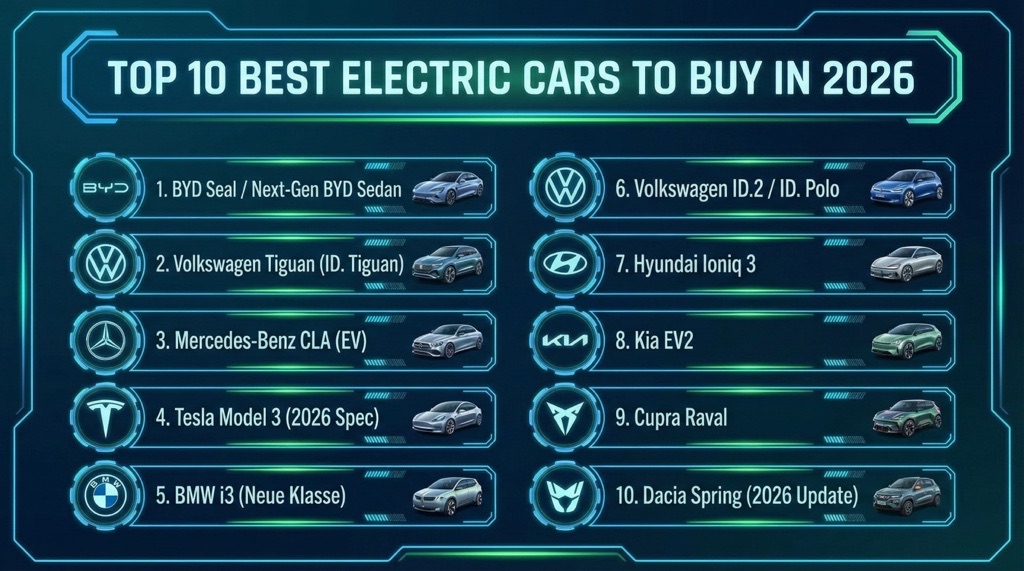
BMW pushes forward with its Neue Klasse models, redefining efficiency, software integration, and manufacturing simplicity. Mercedes-Benz is launching an unprecedented number of electric models, moving away from experimental design toward familiar, conservative styling combined with advanced EV platforms.
Volkswagen, once criticized for its slow start, now benefits from scale. Its electric portfolio covers nearly every segment, from small city cars to large family vehicles, making ICE alternatives increasingly redundant.
China’s EV Momentum Reshapes the Global Market
No discussion of electric vehicles in 2026 is complete without acknowledging China’s influence. Chinese manufacturers are no longer just cost leaders — they are technology leaders.
Companies like BYD are vertically integrated, controlling battery production, power electronics, and software development. This allows rapid innovation cycles and aggressive pricing that Western competitors struggle to match.
The result is a global market where ICE cars face pressure not only from regulation, but from better electric products arriving faster than ever before.
Software, Not Engines, Defines the New Car
In 2026, cars are no longer defined by engines and gearboxes, but by software and computing power.
Electric vehicles increasingly rely on centralized vehicle computers, over-the-air updates, AI-based driver assistance, and predictive energy management. Improvements arrive via software updates rather than mechanical revisions.
Manufacturers that fail to master software development are falling behind — regardless of how strong their legacy engineering once was. This shift disproportionately disadvantages ICE platforms, which cannot evolve digitally at the same pace.
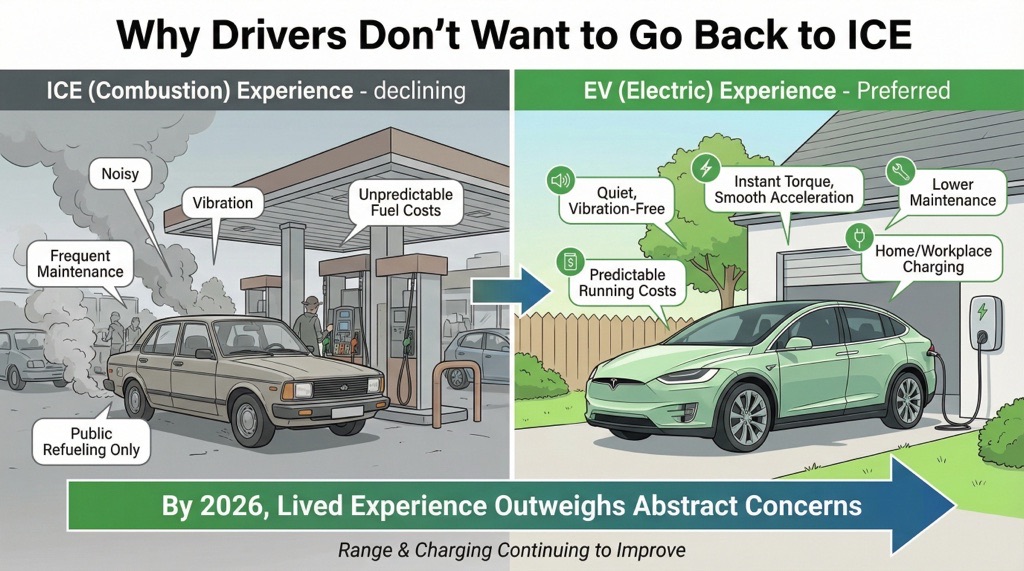
Why Drivers Don’t Want to Go Back to ICE
One of the most telling indicators of the ICE decline is customer behavior. Surveys and ownership data consistently show that EV owners rarely return to combustion cars.
Reasons include:
-
Quiet, vibration-free driving
-
Instant torque and smooth acceleration
-
Lower maintenance requirements
-
Predictable running costs
-
Home and workplace charging convenience
By 2026, this lived experience outweighs abstract concerns about range or charging — especially as both continue to improve.
ICE Cars Won’t Vanish — But They Will Fade
Internal combustion engines will not disappear in 2026. They will still exist in niche segments, remote regions, and enthusiast markets. However, they will increasingly feel like legacy technology — more expensive to operate, harder to justify, and less aligned with consumer expectations.
Electric vehicles in 2026 mark the beginning of a long, irreversible decline for ICE cars. The market does not turn because it is forced to — it turns because it wants to.
Final Outlook: 2026 as the Point of No Return
By the end of 2026, the global automotive landscape will look fundamentally different. Electric vehicles will dominate innovation, investment, and mindshare. ICE cars will still be present, but no longer central.
This is not the end of combustion engines — but it is the moment they stop defining the future.
Electric vehicles in 2026 mark the true turning point for the global auto industry. With ultra-fast charging, mass-market pricing, and a wave of new models from Volkswagen, BMW, Mercedes-Benz, Tesla, BYD, and others, ICE cars begin their visible decline. While combustion engines won’t disappear overnight, 2026 is the year electric mobility clearly becomes the dominant path forward — driven by technology, economics, and consumer preference rather than regulation alone.